
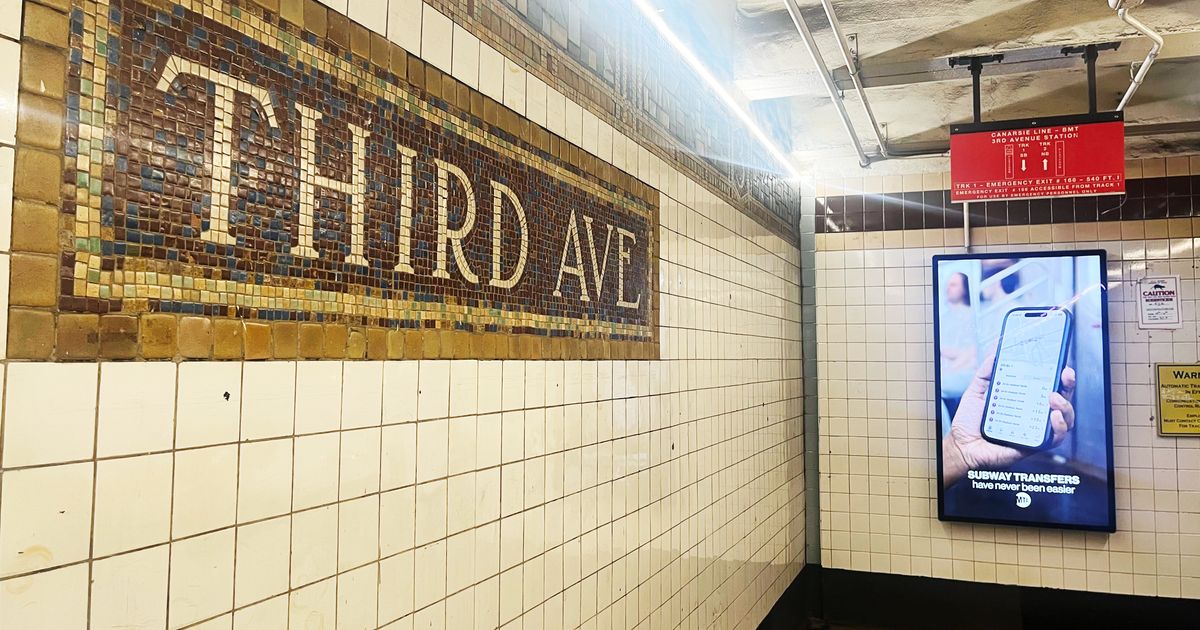
Photo: Christopher Bonanos Joshua Wolk is a subway-riding software engineer who’s turned MTA data into music. His latest mission is to make one bit of the Brooklyn-Manhattan commute more efficient. As a data cruncher who rides the L train regularly, he recently established that the stop at Third Avenue and 14th Street is, by his figuring, the least efficient in the subway system. “I ran a simulation built on 700 million real MTA trips. It said to close the 3rd Avenue L stop,” he wrote yesterday on X. “At 3rd Avenue, only 5% of riders get on or off the train.” He’s put up a website, stopthestop.com, that makes the case for shutting it down. We called to ask how he did the math and whether he thinks the idea’s going anywhere. I should establish for our readers up front that you are not the Josh Wolk who used to work here, running Vulture. Joshua Wolk: I have seen his stuff — whenever a friend looks up my name, they’re like, “Who is this guy?” I’ll tell you that he’s a good guy to be associated with, even if it’s confusing. J.W.: That’s good to hear. Anyway, I gather that you’re a software engineer. J.W.: Yeah — a software product designer, both apps and websites. I love playing with data. And what drew you to this particular project? J.W.: The Third Avenue L stop has always been a frustration. I was riding late at night a week ago with a friend, and she started complaining about it. And then I realized, Wait a second — it’s not just me. It’s so many L riders. And then you decided to go see how few people are getting on or off the train there. J.W.: Yeah. I sort of expected the numbers to prove me wrong. I figured there must be a reason this station exists — but no, it actually showed that the Third Ave L stop is by far the least efficient in the city. Talk to me about how you got to that conclusion. J.W.: I took the MTA’s origin-destination estimates between January and August and routed each trip with RAPTOR, a transit-routing algorithm, on the GTFS timetable, once with Third Avenue and once without. Then I measured the time savings against the additional walk for Third Avenue riders to adjacent stations, counting every additional walking minute as double a minute on the train. Meaning that bit of the train ride is twice as fast as walking? So, say, a two-minute ride from there to the next stop at Union Square equates to a four-minute walk? J.W.: No — it’s not about speed. It’s counting every minute of extra walking as two minutes, out of fairness, since walking might feel worse than riding. So, for instance, a two-minute extra walk gets charged as four minutes. So you’re using minutes of walking as a proxy for convenience? J.W.: Pretty much. Counting walking as double because of the inconvenience seemed to be a rule of thumb in transit economics. Did any other station you modeled deserve closure, or was this one an outlier? J.W.: This one was an incredible outlier. The data shows that closing Third Avenue would save us 1,824 rider hours every weekday. The next worst station is 138th Street and Grand Concourse, and that would save 700 hours less. So it is a big jump. But I’m sure if you talk to other people, they will be able to speak very eloquently about other stops that they think deserve to close. Obviously, there are a million measures of efficiency, and you focused on some: passengers entering and exiting, distance to other stations. Did you try to run more than one scenario? J.W.: I actually ran about 40 different permutations. Because there were certain variables that I couldn’t lock down, such as the actual delay of the train stopping at Third Avenue versus going through, because you don’t know exactly how long it takes to slow down and speed up and such. But in 39 of those permutations, the Third Avenue L was still a costly stop. The only permutation where it was not is if you assume that the train delays for only 20 seconds instead of 50, including slowing-down and speeding-up time, and if you count walking as three times as costly as riding instead of twice as much. A pilot program would reveal the most accurate numbers. I was going to ask you about walking times, because among people who know about rail systems, it’s generally held that our older Manhattan lines have stops that are closer together than they need to be. In other cities, especially newer ones, the stations are farther apart. J.W.: It was pretty interesting hearing the public reception to the proposal because so many people pointed toward other stops they felt they were much closer than they had to be. At the same time, there is a case to be made that New York City density calls for them to be close. J.W.: In many cases, that’s true, but the real goal of the study was to actually understand that trade-off. Because even if the city is so dense, if more people are on that train waiting than using the station, and that total time is significantly larger than the time saved by walking, then there’s still a justification. Your models value walking instead of riding as a consistent burden for everyone, but obviously it is harder for some people than others. If, say, 14th Street has more elderly people than most areas, there might be an additional argument for keeping the station. J.W.: That is a really good point. But I would gesture toward the fact that the Third Avenue stop actually is not wheelchair accessible, unlike First Avenue and Union Square. I suppose someone could look at this study as a moneymaking opportunity: A developer could say, “Ah, that’s a spot that needs more apartments so the station gets more use and therefore is more justifiable.” [Both laugh] More new towers on Third Avenue! J.W.: I could be for that. Have you had any contact with the MTA? Or do you know if it’s considered this idea internally? Given that they didn’t add an elevator to Third Avenue when they rehabbed the line a few years ago, I wonder. Every other Manhattan stop on the L has one. J.W.: As far as I understand, the MTA has not considered getting rid of the Third Avenue stop. There is the proposal to create a Second Avenue line that would hit at Third Avenue. But I guess my counterproposal would be to actually take that through First Avenue instead, which would also just be better for service toward the Lower East Side. When there have been closures in the past — I imagine you know this — they’ve extended the platforms of the stations on either end. Like the old 18th Street stop on the East Side: That went away when they extended 14th Street to the north and 23rd to the south. J.W.: That closed back in 1948, right? That sounds right. They don’t really do this anymore. J.W.: I’m really curious as to why, and I wasn’t able to find a good answer. My assumption is, you imagine how difficult it is to open a new station, and I think that makes closing any station very, very daunting and makes it feel risky and permanent. I think you’re right. You probably get neighborhood pushback, too. So this brings me down to the big question. Do you think it will ever happen? J.W.: I … [long pause] I try not to be a cynic. I, at the very least, would love to have a conversation with the MTA and discuss a pilot program. And in any world, just the idea has made its rounds now, and that increases the chance that future decisions are very data-intensive. Oh, I meant to ask you earlier: Where do you live? I’m in Stuy Town. No kidding. It’s your own stop? I mean, I take First Avenue. One of my colleagues here is your neighbor, and she has strong opinions about your proposal. For or against? I think she’s with you. I’ll take it. Meet the Guy Who Wants to Close the Third Avenue L Station Your product is saved! You’ll receive emails when your saved products go on sale. Manage preferences.
Meet the Guy Who Really Wants to Shut Down the Third Avenue L Station
Full Article
Original Source
Read the full article at Curbed →KhanList aggregates and links to publicly available news content. We do not host full articles from third-party sources. Always verify important information with original sources.