
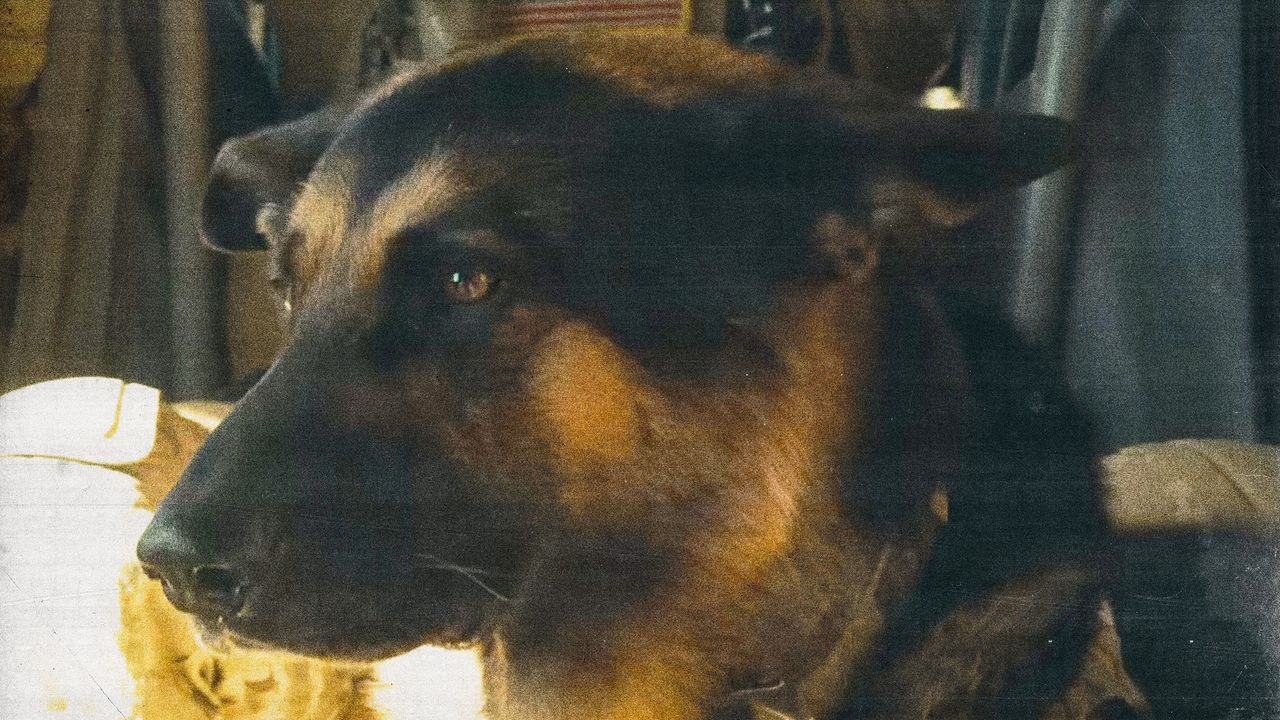
Andrew Simpson had a simple but crucial question before production began on Heart of the Beast: Would Brad Pitt let a German Shepherd lick his face?The longtime Hollywood animal coordinator (Game of Thrones, The Revenant, John Wick: Chapter 3) had spent weeks scouring New Zealand for the movie’s canine star, making dozens of cold calls and house visits to breeders and rescues. Eventually, he discovered Heisenberg Kennels, where a six-year-old retired search-and-rescue stud named Uber was waiting for him. After locking eyes with his furry friend, Simpson knew he’d found his lead actor. “He just had that maturity about him,” Simpson says. “He had a softness about him, too.”Still, not every A-list co-star is keen on getting quite that close to their four-legged scene partner. For Simpson, the relationship between an actor and an animal can make or break a movie, particularly if they’re fabricating a lifelong bond. “There’s nothing worse than dealing with an actor who doesn’t want to get down in the mud with you,” Simpson says. “That’s what makes the connection.” Luckily, Pitt, a dog owner himself, was game for some slobber—and Uber gave him plenty in their three weeks training together. As Simpson put it: “He was a trooper.”That intimate connection bursts through the screen in director David Ayer’s no-frills survival tale, which follows James Belmont (Pitt), a weathered special forces veteran, and his loyal, charismatic combat dog, Odin (Uber). The pair have been through hell together (with PTSD to prove it), but face another challenge when their plane crashes in the Alaskan wilderness, leaving them stranded and forced to rely on each other to survive the elements.Throughout their journey back to civilization, they encounter perilous terrain and voracious predators, obstacles that Simpson knew Uber wouldn’t be able handle on his own. Thankfully, his regal German Shepherd had fathered more than 10 litters, allowing Simpson to track down three of Uber’s offspring—littermates Ryker and Zika, plus their younger half-brother Hondo—to effectively play their dad’s stunt double. “We often have to do extensive coloring or change a dog’s coat and patterns,” Simpson says. “But these dogs had such similar faces, they were the closest matches we’ve ever had in any movie.”Checking in from his ranch in Alberta, where he owns 36 wolves with his wife and co-trainer, the Scottish-born Simpson began his career as an extra on A Cry in the Dark, where he often worked alongside the movie’s dingo trainer. The experience led him to start his own animal-training agency, launching a career that has spanned nearly four decades and taken him around the world. But Heart of the Beast marked a first: a dog receiving top billing on the call sheet, something Pitt specifically pushed for. “It definitely comes with some perks,” Simpson says of the designation. “You get the best parking spot.”GQ: What’s your reaction when you get a script about a canine protagonist surviving the wilderness? Is it just pure catnip for you?Andrew Simpson: It's pure catnip. The first thing you always want to ask is, “What's the budget?” We get so many scripts every day and they all read like they’re epic stories like Heart of the Beast or action movies like John Wick. And then you talk to the producers and they go, “Yeah, we're under a million for this budget.” And you're like, “OK, I want to help you, but let's just be realistic about what we can do.” A lot of it is the time and preparation going into it. But when you get a story like this—we didn't know it was a Brad Pitt movie. It's the story, who the director is, who the studio is, and if they'll let us put our mark on it and how we tell the story.What’s the biggest challenge when trying to cast a dog in a role that requires so much physicality, especially in the wilderness?First of all, we have to find the face, which is going to provide all the close-ups, most of the emotion, looking back and forth. So we’ve got to find the eyes that work for him.We know there's a lot of stunt sequences in this—the water work, the log work, the wolf attack. So we knew the next dogs to cast were going to be younger dogs just hitting their stride, like two or three-year-olds. We wanted those balls-to-the-wall dogs. And that’s when you break down your script into all the emotional beats: “This is very relaxing, so this is Uber stuff,” or “This is a log crossing scene, so this is for Ryker, our stunt dog.” And the wide open spaces—that was Zika. He was like, “I will follow Brad anywhere. I like this guy.” He was used to just trekking for miles and miles in the wilderness. And it just fit perfectly. And Brad was super cool. We only had three weeks with the dogs. It's a very short time. Usually we have a lot more time than that with an actor. And he just jumped right in and bonded with the dog.How would you describe the bond between Brad and Uber?The hardest thing to do is take a dog and suddenly make him look like he belongs to somebody else. The other hurdle is we're just getting to know these dogs ourselves. We haven't raised them, so we're picking up a six-year-old dog and some three-year-old dogs and going, “You're leaving your home and now you're gonna bond with us.” And now tomorrow we're bringing in someone new and you're gonna act with this guy in front of the camera. We have to break the ice with Brad. He doesn't know us. We don't know him. So we chit-chat with him and get a sense of who he is and what he wants to do with the dog. But then he would just go and sit in Uber's kennel with him and email and do his calls and the dog just gets a sense of them. We'll make Brad put the dog through his paces—sit, lay down, come here, roll—so he understands his timing. And then we do the choreography.How much is Uber’s owner around? Or is there a real separation so that Uber can bond with Brad better?Yes, it's a complete separation. We had four owners. One was Lorraine, and then Moira, Nikki, and Sharon. I went and saw all their dogs, and they didn't know who I was but they had complete trust in me. I couldn't tell them what the movie was about. I couldn't tell them who was in the movie. And I couldn't tell them what we were going to train their dogs to do. All these dogs live in the house with them. They're pets. I had to convince them, “Can we have your dog for five months?” That's no small ask. But the owners were welcome to come and visit them. Two of the owners did come visit their dog and the other two decided not to. Sometimes it can upset the dog because he gets a quick flashback and it's upsetting for the owner to reconnect and then have to leave him again.How transparent can you be with them about what their dogs will be doing?We tell them it's an outdoor survival movie and they're in the wilderness of New Zealand, so they had a kind of idea. And of course they Googled me and the work we've done and they've seen the type of movies we've done. So they had an indication of what it was going to do. It comes down to their trust in me to give me their dogs to do that. We've spoken on the phone and they're like, “How did you get them to do that? I was terrified when I saw that.” And so you walk them through the process now that they've seen it. We're all still good friends.There are a few very physically demanding scenes in this movie. What was the stunt that kept you up at night the most?Probably the log sequence. It took a lot of time. Because everything was so tight schedule-wise, we started with all the character stuff and put all the heavy lifting at the end. So the wolf sequence, the swamp sequence, and the log sequence were pushed to the end of shooting. But the log bridge was still pretty high and our stunt coordinator Allan Poppleton designed this beautiful rig with cables because the dog wore a military harness the whole time. We had special pick points put in the harness so we could safely control him like Brad. It’s all removed in visual effects afterwards, but it wasn't a natural thing for a dog to go over that log. Even Brad had a fear of heights. That was not the most pleasant thing for him either.It's impossible to know if a dog is afraid of heights until he reaches the set. How difficult is it to feel out whether a dog is up for something?We couldn't prep that scene on the actual spot until a few days before shooting. But we had the art department actually build us a very similar log setup that we had down in the South Island, so we had access to it every day. Before we got to shooting, we knew which dog was most comfortable on that log scenario. But there was another sequence with the dog jumping in the water. We thought, “This will be our dog for the water gag.” And we got there and he's like, “Yeah, I don't want to jump in the water.” So we used Ryker and he's like, “Geronimo!” When a dog or an animal goes, “Yeah, this is not for me,” there's no point in pushing it.” Nothing's going to look right on camera if you try to force the animal.Right after the log scene, there's this moment where Odin effectively creates a tourniquet by pulling on Brad's broken arm. Are German Shepherds that intuitive or do they rely on the creativity of their owners to come up with something like that?In that situation, the dog would understand when he handed him the belt what he wanted them to do. But they're definitely intuitive. There’s a shot in the helicopter when James is gonna have his heart attack and the dog starts reacting and trying to nudge him and bark and everything.That's based on people with therapy dogs that we've talked to. They say, “When I'm going to have a seizure, when I'm diabetic, the dog will start reacting.” Because the dog knows. And that's obviously the purpose of those dogs. We've spent a lot of time with the military and dog handlers learning about how they communicate with their dog. They told us they'd be out on patrol one day and the dog would be out on point. And then the dog would just go—boom. And they credit their lives being saved multiple times by the dog acting on its instinct rather than waiting. Once they know what their job is in that situation, they're very intuitive when to use it.You have extensive background working with wolves. How much did you consider using real wolves in a fight scene? Is it possible for a dog and a wolf to playfight in a realistic way or is it too dangerous to create that scenario?If the dog and the wolf are raised together, as long as the wolf is young, he'll always be submissive to that dog. It's just the way they are. We have some that are raised together and we can do those wolf-dog fights. For this one, we couldn't import our wolves. We've taken them to a lot of countries like Russia, China, and Europe. But we couldn't get them into New Zealand with their biosecurity. New Zealand is full of flightless birds. There's no natural predators there. So if we brought in a wolf from outside and heaven forbid something happened and he escaped, it would just be like sheer mayhem.The Kiwi bird is an icon. We did not want to be the guys who messed that up.You mentioned the puppetry on set. What does it look like when Uber is around “wolves?” Are there actual actors or trainers mimicking how a wolf acts?Yeah, we did a couple of scenarios. We had actual puppets that looked like wolves. We teach the dogs how to interact with them so they can put their mouth on them and do certain things and the puppet can put its mouth on the dog. These are sometimes used in camera practically or sometimes used to enhance visual effects. And then when we're doing strictly visual effects, the stunt team had great digital suits on, and then they would attack the dog, they would attack Brad in certain choreography, and then the VFX team would just replace them with a digital wolf.What’s harder: coordinating a fight sequence like that or seting up a majestic close-up of Uber?The action sequences are easier once you work out how you're doing it, how you're shooting it, where the camera goes. It's just like any stunt sequence—everything is timing and everything is coordinated between everyone. The hardest thing is to make the dog look like he loves somebody else that he doesn't know that well. Those shots to get that intimate moment between the actor and the dog looking together can be hard. But overall these dogs were amazing for never having stepped on a film set before. We can't say, “Uber, when I count to three, you're gonna look left.” It all comes down to trainers cueing them and manipulating their eye line back and forth.Could you sense that Uber knew when the camera was rolling?Yes, they are 100 percent aware—and usually by the end of the first week of shooting, the director or the AD can no longer shout “action!” Even when they go, “Rolling,” the dog goes, “OK, something's going to start happening here.” Especially on the more emotional scenes, you’ll give a hand signal for rolling and they'll say something completely different. Or they'll just point to you for “action,” because the dogs know that stimuli.So you'd rather have the dog not “acting” in this situation.Yeah, we'd rather not have them anticipate that. “Hey, Brad, walk there and talk with the dog and just be super casual.” They do know the difference.What is the experience like for both you and the dogs when you have to part ways at the end of a shoot?It is very difficult because, for one, you're taking somebody else's dog. And they're entrusting you with that dog. So you put everything you have in keeping that dog safe. You're with them 24/7. When Esther was making Ryker walk across the log, he's trusting that she knows what she's asking him to do, and she's trusting that the dog is actually connected to her and listening to what she's asking to do. Your heart swells with emotion when you see the dog do those types of stunts and actions. But when the movie finally ends, they're not coming with you. You have to say goodbye. It was emotional. When the owners came and we had to hand the dogs back, all the trainers cried. The owners cried. And the dogs are like, “Why are you all crying?” It’s a very emotional thing. It's like you've given part of yourself to that dog and it's given part of itself to you. And now you have to understand you're probably never going to see each other again. But the dog gets to go back to his family and very quickly falls back into his routine.Do you still keep in touch with any of the dogs you’ve worked with?For sure. On this one, we'll be checking in with these people for a long time. Uber's still a breeding dog, so I still hope that I will end up with a pup of his just for memory's sake. It's very sad because, on average, your dog has 12 summers. That’s not a lot when you think about it. You just want them to go back to their owners, fall back into their routine, and live out their life as best they can.
Meet the German Shepherd That Got Top Billing Over Brad Pitt
Full Article
Original Source
Read the full article at Gq →KhanList aggregates and links to publicly available news content. We do not host full articles from third-party sources. Always verify important information with original sources.