
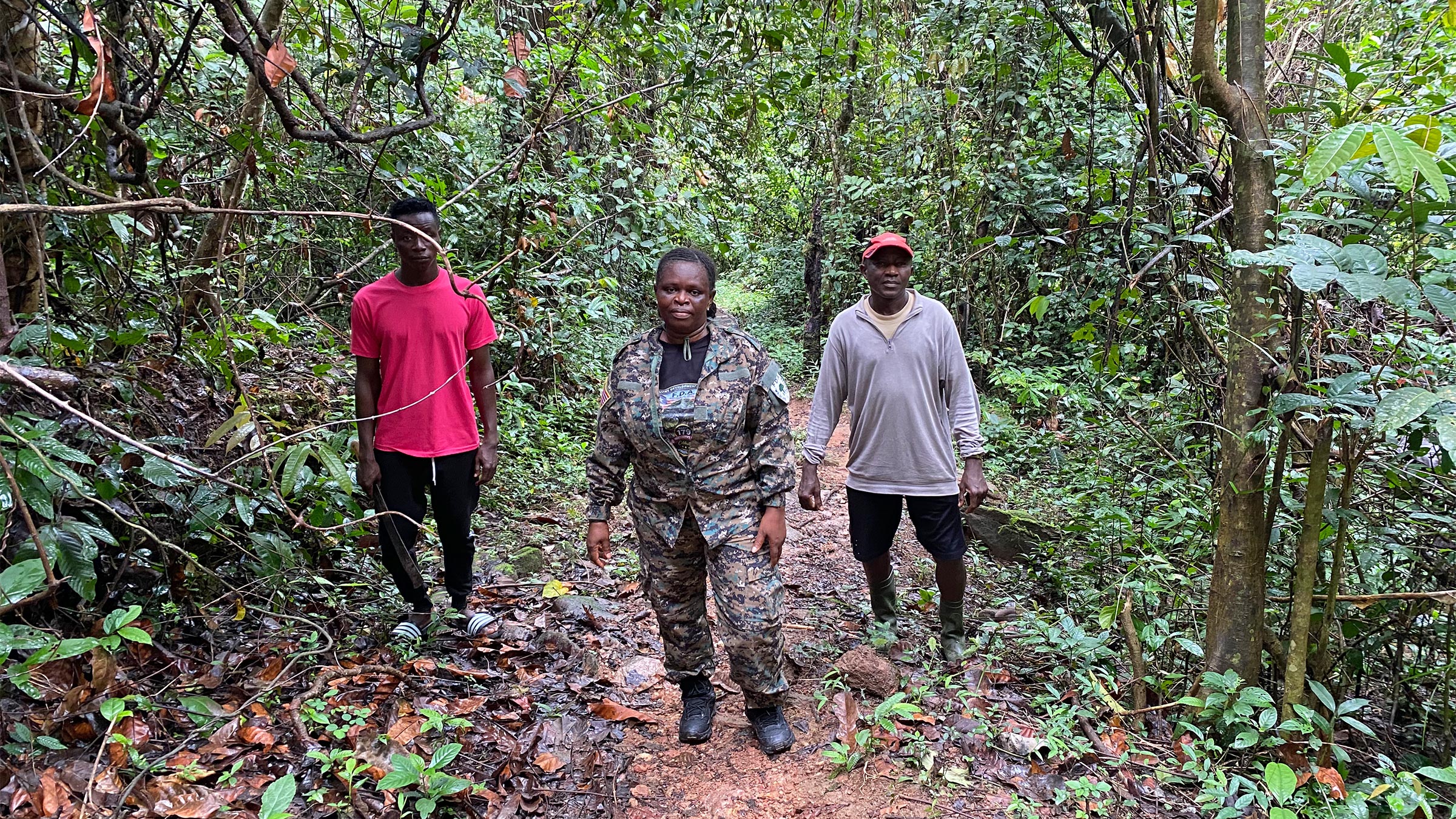
In Liberia, Grace Kotee-Zansi is breaking cultural and gender barriers as a ranger who patrols the East Nimba Nature Reserve to stop wildlife killing and tree cutting.Only 17 of Liberia’s 143 rangers are women; globally, women make up less than 11% of the ranger workforce.The ENNR is one of the country’s largest protected landscapes, home to rare and endangered species, including the Nimba viviparous toad (Nimbaphrynoides occidentalis) and western chimpanzees (Pan troglodytes verus).Women working to protect Liberia’s fragile landscapes liken the work to the nurturing they do for their families and communities. ZORTAPA, Liberia — Grace Kotee-Zansi is living a dream she had as a child: patrolling the East Nimba Nature Reserve (ENNR) as a biologist ranger to stop hunters from killing protected animals. Her job today brings relief from her childhood memories of her grandfather hunting and farming in the forest. The ENNR, a proposed extension to a UNESCO World Heritage Site, covers 13,500 hectares (33,400 acres). Zansi says she’s working to stop wildlife killing and tree cutting. She patrols the forest, checking cameras installed to capture animals and human activities. The Mount Nimba landscape lost roughly 9.9% of its total forest cover between 2013 and 2020, according to a report using satellite imagery. Zansi is one of the few women serving as a ranger here, making her stand out in a field dominated by men. For decades, men have carried out forest protection in Liberia, with only a few women like Zansi now joining the race. They patrol for months, leaving their spouses and children at home, tracking poachers, documenting animal footprints and recording illegal human activity in the park. Official data from the Liberian Forestry Development Authority (FDA) state that a total of 143 rangers are deployed across Liberia’s protected areas; only 17 are women. This gap is due to the struggle of “recruiting qualified women who are willing and prepared to serve as rangers,” the FDA tells Mongabay. “Liberia’s ranger workforce continues to expand through various biodiversity conservation initiatives. However, comprehensive gender-disaggregated data remain limited, and available estimates indicate that women constitute a relatively small proportion of the ranger force,” the FDA says in an email. Grace Kotee-Zansi, a ranger biologist and a mother of two assigned to the East Nimba Nature Reserve forest in Nimba county. Image by Tina S. Mehnpaine. Lassana M. Dorley II, communication and knowledge management officer at the Society for the Conservation of Nature of Liberia (SCNL), agrees with the FDA. His organization is Liberia’s oldest conservation NGO, founded in 1986. It works with the FDA to co-manage forests in Lofa, Nimba and Sinoe counties. While the FDA hires “rangers,” SCNL partners with local communities, training and hiring “eco-brigades” (who work more in wetlands, mangroves and urban areas with flooding) as well as “eco-guards” (who work in forested rural areas). These stewards serve as frontline first responders who support the rangers in patrolling and protecting the forests. In its 2025 annual report, SCNL said it had trained 120 eco-guards and boosted forest protection law enforcement to protect wildlife. Dorley notes that cultural factors and a lack of education among rural women have slowed their progress toward achieving the goal of a 40% female workforce. “We are still finding it difficult to have women who can read,” Dorley said, attributing the literacy rate among rural women to cultural norms. “People feel that women should be at the back,” he adds. Cultural barriers Globally, the ranger workforce is predominantly led by men, with only a small fraction being women. Experts say cultural traditions have pushed many women away from venturing into ranger jobs, especially in many parts of the continent where men are hunters and key players in forest protection governance. Women make up less than 11% of the global ranger workforce. A 2021 report by the Universal Ranger Support Alliance attributed this gap to cultural and gender social norms. This report followed the 2016 Rangers Perception Africa report, which estimated that women constituted only 19% of the ranger workforce in Africa. Zansi’s dedication to her job has made her one of the outstanding women in forest protection, working alongside NGOs like the Liberia Chimpanzee Rescue and Protection, earning her the USAID 2023 Environmentalist of the Year and the World Female Ranger awards. Trees in the ENNR forest. Image by Tina S. Mehnpaine. Breaking from a cultural bottleneck Zansi grew up in Beo Bongarlay, a town bordering Côte d’Ivoire 90 kilometers (56 miles) from the ENNR, where women working as rangers were nonexistent. In fact, women were housewives, farmers, breastfeeding mothers — or they stayed at home. Zansi says seeing her in uniform inspires women and girls, which she considers her biggest accomplishment. Her work is entirely hands-on fieldwork; she rides a motorbike to reach areas for outreach and community awareness. When other women see her driving herself instead of a male driving her, “they are surprised,” she says. “Some will even call their mother to come, and some will even make friends with me.” The ENNR, which spans Liberia, Guinea and Côte d’Ivoire, is one of the country’s largest protected landscapes, as the country races to conserve 30% of its forest. This ecosystem is home to rare and endangered species, including the Nimba viviparous toad (Nimbaphrynoides occidentalis) and western chimpanzees (Pan troglodytes verus). The rangers protecting these species are backed by 104 eco-guards. Louise Gbayee, one of the eco-guards in Zortapa within the ENNR, was inspired by Zansi. As a farmer, Gbayee joined the recruitment to help protect the forest. She’s the only female among the eco-guards, earning $110 in compensation, food and other items for patrol. On a bright Tuesday, Gbayee and her colleague are on their way to a 10-day patrol in the forest, leaving her children at home with her partner. Food, water, cameras and bags are packed for the journey. “I feel good to help protect this forest,” the mother of five says. For all 10 days, Gbayee would be disconnected from her children and boyfriend. No internet, no phone calls. Louise Gbayee, one of the female eco-guards in Zortapa, sat for an interview before departing with her colleagues for a 10-day patrol in Zortapa. Image by Tina S. Mehnpaine. The ENNR is headed by Catherine Kuku Dolo, the park warden. As the only woman park leader in Liberia currently, and mother of a 6-month-old son, Dolo says women have been a great support and inspiration to her work. “Women are nurturers of communities.” Both Zansi and Dolo are breastfeeding mothers. Their babies are left with babysitters whenever they leave for patrol or fieldwork. “My children know the work I do, so they have gotten used to me leaving them for days or hours,” says Zansi, who has two teenage daughters. Beyond field patrols, Zansi supervises bio-monitoring and analyzes data collected by eco-guards and rangers on the plant and animal species that live in the landscape and the threats they face. She ensures the equipment rangers and eco-guards carry on patrol is up-to-date. Liberia’s vast forest — 43% of the Upper Guinea rainforest — is under threat from deforestation fueled by wildfires, forest degradation and agriculture. The situation is worsened by the invasion of cacao farmers from Côte d’Ivoire, who are invading protected forests and leaving communities vulnerable to the effects of climate change. Frontline protectors like Zansi, Gbayee and Dolo are vital to forest habitats and ecosystems, especially as the country wants to sell carbon credits. The partnership between the FDA and local communities is established through an agreement allowing the communities to recruit members like Gbayee. Experts say without the presence of rangers and eco-guards, communities would violate the agreement, cutting down trees for charcoal and firewood, exacerbating deforestation tied to climate change. Liberia’s Nationally Determined Contribution under the Paris Agreement sets an ambitious target to reduce greenhouse gas emissions by 64% by 2035. Reducing deforestation by 10% and establishing at least four protected areas covering 200,000 hectares (494,000 acres) is one way the country plans to achieve this target. Dorley says rangers — particularly women — play a critical role in conservation here “because in most of the communities we go to, women do a lot of the work.” “We have a challenge when it comes to the number of rangers that [are] supposed to be in the park,” he says. Currently, the only female park warden in Liberia, Catherine Kuku Dolo, says her job is more than just being a woman. Image by Tina S. Mehnpaine. Spouse support Abandoning your family for weeks or months as a wife is not widely accepted by men in many African homes. Women are typically the ones who take care of their spouse and children. But Gbayee’s and Zansi’s cases are different. They say their partners support their work. “Sometimes, she spends weeks or even months away from home, leaving me to care for our children. I wake up as early as 4:30 a.m. to prepare them for school, take them there and then proceed to work. Over time, I have grown accustomed to this responsibility,” says Levi Zansi, Grace’s husband. Initially, he had mixed feelings, but he has learned to trust and understand his wife’s mission. “Today, we are happily living together with our children, supporting each other as a family. I love my wife, believe in her abilities and wish her every success as she continues to pursue her dreams and build her career in wildlife conservation.” A career as a ranger can be risky. It is a laborious job. During patrol, rangers climb hills and mountains in dense forest. They walk for long hours for days and spend nights in the forest looking for poachers and animal killers. They confront hunters with cutlasses, knives and single-barrel guns. Hawa Johnson, the chief law enforcement officer in the Wonegizi proposed protected forest, a transboundary landscape in Lofa county, says that’s why they go in pairs, male and female. “As a female, we don’t go alone,” she says, noting that they feel unsafe when confronting hunters in the forest without their male colleague. Unlike Zansi, who owns and rides her motorbike, Johnson does not have a motorbike assigned to her; she relies on her male colleagues. During patrols, women are not excluded from covering long distances or staying back at the camp — a tent housing built in the forest. Their movement is always cordial. “All of us are doing the same scientific research, monitoring and law enforcement on both fauna and flora,” says T. Momo Ricks, Johnson’s colleague and the zone one warden at Wonegizi. Men set up the camping tent; females are not required to participate except if they choose. But women do the cooking. “All rangers are treated equally. No discrimination, but in relation to maternity issues, female rangers benefit from maternity leave that lasts for 60-90 days,” the FDA says. Zansi confirms this, saying that she was given a 60-day maternity leave when she gave birth this year. Hawa Johnson, a law enforcement officer, head of her zone in the Wonegizi proposed protected forest. Image by Tina S. Mehnpaine. The battles at hand Rangers patrol the forest unarmed, working with limited tools, including cameras and equipment. Johnson says they mostly use their phones to take pictures because they have no designated cameras. “Sometime you are working in the field and your phone go off because battery is low.” The FDA says it is implementing measures to enhance ranger operational effectiveness through improved logistical support, capacity development, accommodation facilities and safety systems, though rangers say they are yet to see these upgrades. While the FDA improvement plans are underway, Zansi, Gbayee, Johnson and Dolo say they love their jobs. Beyond the challenges, the women are determined to continue serving and making an impact on their communities by helping to conserve their forest. Dolo’s dream is to become the first female managing director of the FDA in the post-war era; she is bent on giving more women the opportunity to serve their communities and inspire other women by establishing an association of female rangers. “I see protecting forest as nurturing and caring. The same way I take care of my children, and my family,” Zansi says. Banner image: Hawa Johnson, a law enforcement officer and head of her zone in the Wonegizi proposed protected forest. Image by Tina S. Mehnpaine. The women leading a quiet conservation revolution in a Nigerian gorilla sanctuary Burkina Faso’s women farmers reviving the land with fertilizer trees Citation: Garrett, R., Lyons-White, J., Maguire-Rajpaul, V., Freeman, B., Dzudzor, M., Burgess, N., … Worthington, T. (2026). Conservation, development, and transformative change in the upper guinean forests of West Africa. Annual Review of Environment and Resources, 51(1), 357-386. doi:10.1146/annurev-environ-121224-090229 Credits Topics
Meet the few Liberian women rangers in a race to protect wildlife and forests
Full Article
Original Source
Read the full article at News →KhanList aggregates and links to publicly available news content. We do not host full articles from third-party sources. Always verify important information with original sources.