
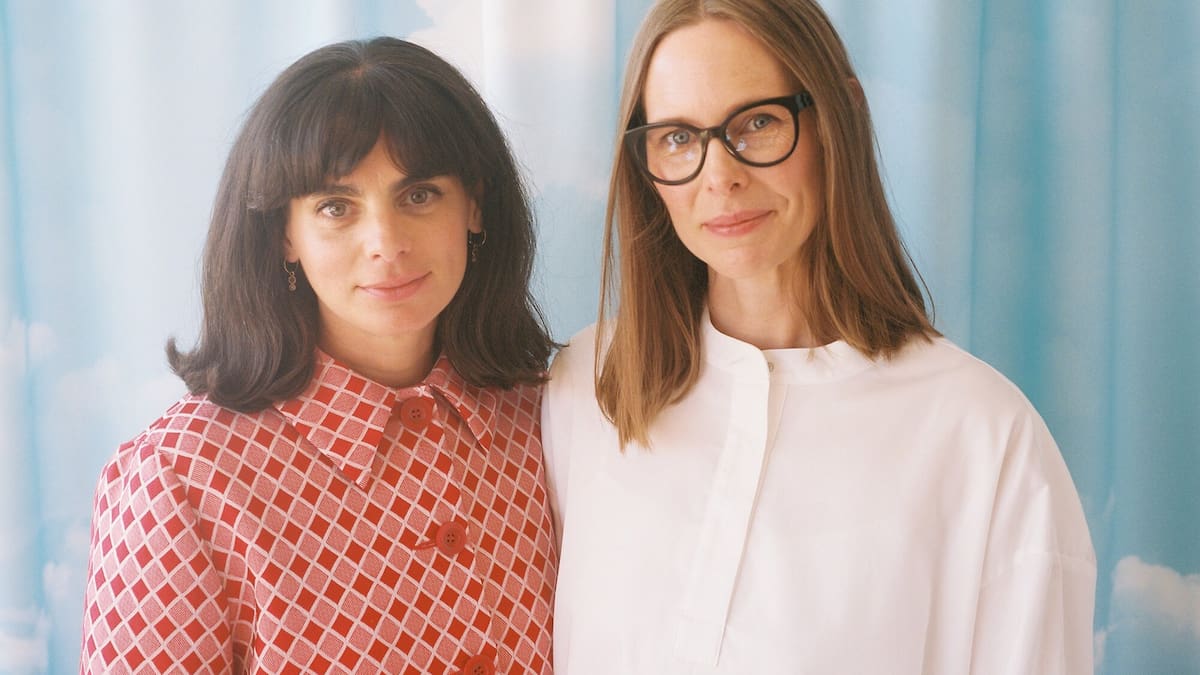
Wellington has had some bad press over recent years with headlines about the economic downturn, public sector cuts, hospitality and fashion business closures, and political turmoil. But the capital deserves better. Many local creatives are making the city a brighter, more positive place. Viva meets some of them. Rachel Easting Fashion designers, twenty-seven Names Rachel Easting and Anjali Burnett have been on an inseparable road since they were 8 years old. They met in primary school, studied design and fine art degrees together in Dunedin, and, not long after, launched their label, twenty-seven Names (then called Love Lies Bleeding), before moving to Wellington. Since 2006, the duo, armed with irreverent humour and rapier wit, have created clothes that have a jubilant sense of freedom: a raspberry-red blazer with a scalloped collar; a fitted mesh skivvy dress covered in pretty blooms; a black long-sleeve crewneck screen-printed with the line “The fortune you seek is in another cookie”. Their print development, they say, is basically a giggle session.“It’s nice to have that,” Easting says. “I couldn’t work if we were just taking ourselves too seriously. It’s fashion.” But there is also a pleasure of restraint that makes their clothes all the more compelling, found in soft woollen coats with dropped sleeves and dependable blouses. Practical and nostalgic and just sweet enough. While certain aspects of their label have changed over the years, its moral compasses – a commitment to making in New Zealand and supporting the local industry, of using sustainable fibres – remain the same, and you feel they have never lost sight of the specificity of its character. “The storytelling in the brand gives us an anchor to rely on and come back to all the time,” Burnett says. “Having all those moments where we get to explore different parts of things that we have referenced multiple times in different ways.” A sweatshirt from twenty-seven Names' winter 2027 collection, Tau Sigma Nu.With this year marking two decades of business, Easting and Burnett are taking the time to look back now more than ever. In their workroom on Ghuznee St, the floor is pink and almost lost beneath a melange of pieces from different collections. Recently selected from more than 3000 samples in their back catalogue, the pieces are for a 60-look retrospective show at Common Material, the first of a new platform dedicated to local design in Wellington, held at City Gallery Wellington Te Whare Toi. Over three days in June, about 5000 people in Te Whanganui-a-Tara gathered to celebrate twenty-seven Names alongside local labels JPalm, Kowtow and Yu Mei, whose founder Jessie Wong spearheaded the event. “It was momentous for us,” Burnett says. “It was definitely the career highlight. We had our whole team with us. Our first and second employees were there to help. The community corralled around us and supported us.”twenty-seven names 2026 New Zealand Fashion Week Kahuria show at Shed 10.At the time of our interview, Easting and Burnett were working on their show for New Zealand Fashion Week Kahuria, their most recent outing since 2018. On the racks closest to us hang confections from the winter 2027 collection, a university-themed range named Tau Sigma Nu (or, self-referentially, TSN), featuring navy sweatshirts and illustrated cherubs. It debuted with the spring/summer 2026/2027 collection, called Look No Further. “It’s about being happy in the moment,” Burnett says. “Look no further,” Easting adds, “it’s all here.” Gerard Dombroski Architect, furniture maker and artist Kelson-based architect Gerard Dombroski.When Gerard Dombroski thinks of the future, he conjures the image of a house. It’s made of steel and shaped by water.Imagine, he wonders, if you could hydroform an entire home, building a structure from flat steel shapes welded into a watertight vessel, pushing them out into a lake or river, inflating them with high-pressure fluid until they balloon, then dragging them back up the beach. It’s where his mind goes, before brushing up against more practical questions: is it in the realm of possibility? Could it be done? You could, he proffers, instead make it in sections. “Imagine a building that kind of looks like a puffer jacket,” Dombroski says, as strong and functional in reality as it is all light-as-air curves at first glance. “That could be quite beautiful.” Works by Wellington-based architect, artist and furniture maker Gerard Dombroski.The Kelson-based architect, artist and furniture maker, started his own practice in 2016 but has been building things since he was a boy – “Perhaps, in hindsight, it was meant to be,” he muses. One of the most fundamental design principles, he says, is “that you want materials to communicate their materiality as much as possible”. It’s about tactility as much as it is about making something that feels considered. “We look after things more when we love them and care for them,” Dombroski says. “I think we’ve forgotten how to do texture and ornamentation. If you closed your eyes and touched a new building, all the surfaces would feel the same.” But he’s working to change that. Dombroski’s resume spans residential dwellings and buildings such as Kilbirnie Cafe and the ABI Rehabilitation centre in Porirua. He’s crafted whimsical vases and seats so polished you can see yourself in them, benches from industrial pipe fittings and an art installation comprising 34 inflated stainless-steel fence pickets. Lately, he’s been experimenting with open casting and pouring molten brass. And he’s just finished building a sauna that “kind of looks like a big, inside-out lolly wrapper”. The sauna, like many of his recent works, was also made from hydroformed steel, pumped full of 6500 litres of water to shape it into what is essentially a huge chrome cushion sitting in a garden in Kelburn. “Whereas a lot of architecture is cake decoration – you build a steel frame and clad over it – with hydroforming, you have the ability to form the steel,” he says of what draws him to this process. “It’s inherent architecture, where architecture is also structure, like an old stone building. It looks modern and sci-fi, but in my mind, it shares more classical qualities. It’s very elemental.” For Dombroski, that’s what it really comes down to: concentrating on the fundamentals. Intersecting art and architecture. Opening up his design parameters. Bringing architecture back to designing everything from light fittings to your bathtub. “I like that level of design engagement,” he says. “As much as possible.” To him, it’s a form of invention, experimentation and giving new shape to human experience. Of making space and shaping space. Charlotte DavyDirector of City Gallery Wellington Te Whare ToiCity Gallery Wellington Te Whare Toi director Charlotte Davy.Charlotte Davy saw a Colin McCahon painting for the first time when she was 14 years old. For someone who had grown up in small-town South Canterbury without art, save for two reproduction prints her mother had purchased from a Dutch Masters’ show, it was a pivotal moment. “I was completely obsessed with it, because I didn’t understand it,” she says, “I was trying to figure it out.” Above all, it struck her how art could be a “prompt for making meaning in the world”. Now the director of City Gallery Wellington Te Whare Toi, a role she was appointed to in 2024, Davy is celebrating what it means to be inspired, to wonder, to discover. After two-and-a-half years of earthquake strengthening and upgrades, City Gallery Wellington will reopen its doors in Te Ngākau Civic Square on October 10 with a full gallery exhibition by British artist Cornelia Parker. Parker is best-known for her large-scale installations including Cold Dark Matter: An Exploded View (1991), in which a garden shed and its contents are hung from the ceiling as if captured mid-explosion, and Thirty Pieces of Silver (1988), where more than 1000 silver-plated objects (plates, spoons, candlesticks, et al) were flattened with a steam roller and suspended with wire, a shining display of artefacts consigned to the same fate, levitating just above the floor. Her work was a perfect fit for City Gallery because it “mines the world of light and darkness, deconstruction and reconstruction and resurrection”, Davy says. “What that looks like in reality is that she will take a thing or an idea and put it through a process, and then resurrect it in a different way. She’s reminding us that through these periods of change and reconstruction, beauty comes. You view the world in a different way as a result of going through those processes.” City Gallery Wellington. Photo / Mark Mitchell Davy’s speaking about the gallery’s refurbishment, but she could easily be talking about Te Ngākau Civic Square too. In March, Te Matapihi ki te Ao Nui Central Library, the gallery’s neighbour, reopened, and in February 2027, another neighbour, Te Whakarauika Wellington Town Hall, will do the same. “I think about our intersection with other institutions, and what it does for a city when the institutions join up,” she says. “There’s a power in that.”While it’s been away from home, City Gallery Wellington has relied on the support of its surrounding creative communities to help it exhibit art, partnering with the Dowse Art Museum, the Museum of New Zealand Te Papa Tongarewa, and the National Library. “It’s given us an awful lot of confidence about the City Gallery being more than just a building,” Davy says. “It’s an idea.”Davy believes in art as a fundamental part of humanity. “Wellington is a city of thinkers,” she says. “We have curiosity at our core. Art and critical thinking and curiosity, it’s all bound tightly together.” Sefa TunupopoDancer Wellington-based dancer Sefa Tunupopo.Sefa Tunupopo is at an energetic point in his life. In April, he received the 2026 Arts Foundation Te Tumu Toi Springboard Award for Contemporary Dance. A formal acknowledgment of his force within street dance, performance and theatre, he was also awarded a mentorship with the acclaimed Samoan theatre director and choreographer Lemi Ponifasio. As an independent dancer, Tunupopo is enjoying a two-month stint as part of the World of WearableArt Show. After the Wellington arena spectacle, he’ll head to the Tempo Dance Festival Te Rerenga o Tere, an annual celebration of movement running from October 13-18 at Auckland’s Q Theatre, to perform a solo under the spotlights. Tunupopo wasn’t interested in dance until he saw his older sister do it. He remembers watching her, thinking maybe he could too (he could, having long disproved any doubts). Yet while what he describes as his “doorway into dance” by way of three years’ training at the New Zealand School of Dance was an obvious one, the path from there has been more nebulous. “There’s no clear blueprint for being an artist or being a dancer,” he says, “so sometimes it feels like you’re reaching for things you can’t really see.” It’s part of the reason he’s busy leading Shifting Centre, an Indigenous arts collective he founded with friend Oto Lupo in 2021, running weekly open choreography classes for the local dance community, a street dance training intensive called Shifting and Friends, and a five-day annual arts festival called Civic, which debuted last year. “We’re trying to feed as much as we can into Wellington so that the city feels alive, because it is alive,” Tunupopo says of his vision to create a thriving space for Indigenous and street dance artists. “I really believe that.” Those who have joined a class have witnessed a core part of Tunupopo’s practice: cyphers. It’s a tradition he likens to a dance circle forming in a club, with someone dancing in the middle. Yet while it’s just as improvisational (less about routine, more about vibes), it’s also an exchange at play: a communal space to physically express yourself with the support of your peers. The freedom to move with intention and without judgment. “It’s in those spaces where you can feel the mirror that dance holds to community,” Tunupopo says. “We’re all supporting this one person as they’re offering themselves. Through that place of exchange, we’re also all offering into the circle [through rhythm, cheers or feedback], and meeting each other where we’re all at, at that specific moment. To me, it’s such a clear example of why dancing and love co-exist.” That connection – between dancing and love, place and people – is what propels him. “If the dance is isolated, or if the art is isolated, then it doesn’t reach the people that it needs to,” Tunupopo says, emphasising that dances, like cities, need gathering points.“You need to exist within community.” Hasan Alwarhani and Flora QuintanaRestaurateursHasan Alwarhani and Flora Quintan, with their children, of Damascus restaurant, Wellington.When Syrian-born Hasan Alwarhani emigrated to New Zealand in 2013, he began cooking for the people around him between shifts as a lifeguard. It was a way to give back to his community through what he knew and what he missed: Middle Eastern food. In 2017, he and his wife, Argentina-born Flora Quintana, thought they’d “share the love”, opening a food stall called Damascus that would become a mainstay at Wellington’s markets. Two years later, they were offered a permanent spot at Brooklyn’s Vogelmorn Bowling Club, a former bowling club turned community centre where you can attend yoga classes, a 1920s-themed dance party or an album release among the city’s wending hills. From there, fever for their sharing plates overtook the city (“Some nights we had no space,” recalls Alwarhani, “there were 100 people”), and in 2022, they moved to Tory St, where Damascus offers the same gracious vision of Syrian food rooted in home cooking. The way Alwarhani and Quintana tell it, they never planned to own a restaurant (it just happened) and Alwarhani asserts he isn’t a chef (“I’ve never been [one]”). And yet there is no doubt the greatest part of Damascus, which was Michelin Selected this year, is the care and attention the couple has devoted to its food throughout the restaurant’s various forms. Damascus restaurant in Te Aro was Michelin Selected this year. Photo / WellingtonNZ“We started the business to feed people and to see people happy while they’re eating our food,” Quintana tells me over lunch, the long, turquoise dining room strung with lights with arabesque flourishes and curved mirrors reminiscent of ornamental arches. “The minimum we can do is share our love with those in our community,” Alwarhani says. “That’s what we’re good at.” As we spoke, the plates descended: creamy, lemony hummus that lives alongside extra-virgin Syrian olive oil and a mix of capsicum, cucumber, dill and garlic; kishkiyyeh (a beguilingly good slow-cooked lamb shoulder with a yoghurt and turmeric sauce, peas and bulgar vermicelli pilaf); malfoof mashwai (baked cabbage, grilled on the barbecue); agria potatoes, boiled, twice fried and dusted with za’atar; zahra harra (cauliflower, also fried, with a kick of spice); shamander fattoush (beetroot tossed with feta and baby spinach); baba ghanoush and khubz (homemade flat bread) to scoop it all up. Alwarhani and Quintana’s cooking inspiration began with their families. Alwarhani grew up on a farm in Swaida, southern Syria. “Every single day, we ate homemade food,” he says. “We ate what we grew.” Quintana first learned from her parents and grandparents before training as a pastry chef.While Damascus’ menu is a glimmer of heirloom-like recipes, their second spot, Alswaida – a small, seatless takeaway shop that opened on Willis St in 2024 – is a nod to Syrian street food: shawarma filled with chicken roasted horizontally over an open fire, crisp chips with a dollop of thum (garlic sauce), falafel and fresh salads. All of which is to say that you should try it. “Food can make your day or break your day,” Alwarhani says. “When you eat something that’s delicious, it fills up your soul.” Damian Jones and Rahine O’Rielly Live music venue ownersHusband and wife Damian Jones and Rahine O’Reilly inside Meow Nui on Vivian St, Wellington. Photo / Mark MitchellDamian Jones and Rahine O’Rielly knew the fit was right because of the bones: they were good ones. Specifically, they belonged to a derelict 20th-century church: the former Salvation Army Citadel on Vivian St. In 2024, after a months-long refurbishment, those bones, once designed for live music by architecture practice Warren and Mahoney, became home to Meow Nui, Jones and O’Rielly’s music venue self-described as “Wellington’s biggest little live room”. Meow Nui opened with Paddy Gower’s The F#$%ing News show and has since welcomed the likes of bassist and singer Thundercat, Irish hip-hop trio Kneecap, and Kiwi folk-jokesters Flight of the Conchords, to name a few. It’s the larger younger sibling to their smaller older venue, Meow, on Edward St, which has been a staple in the country’s touring circuit for 18 years. Ultimately, they want Meow Nui to hold a similar space on a grander scale in Te Whanganui-a-Tara, attracting shows that would normally only look to Auckland or overlook New Zealand entirely. Eventually, it’ll have a 1000-person capacity. Music venue Meow Nui on Vivian St. Photo / Mark MitchellBetween the two spaces, Jones and O’Rielly run an average of seven shows a week. Their interest in music isn’t about harmony, at least not entirely.“Music is about discourse,” Jones says. “It’s about finding this nice bit in the middle between these things that seem to make no sense.” O’Rielly clarifies: “It’s about making something meaningful in the chaos.” It’s something with which the couple are all too familiar. Meow opened its doors during the Global Financial Crisis. Covid happened, shutting them for prolonged periods. But none of this hard reality has stopped the venue owners, who remain steadfast and resolute. “That’s life, isn’t it,” Jones says. “You get out and you do stuff.” The pair describe Meow Nui as a cog in their plan to foster more creative infrastructure in the capital and beyond, they just haven’t got all of the other cogs in place yet. “New Zealand needs more venues, and if no one else is going to do it, we will,” Jones says. “Hopefully we’ll have twice as many venues in the next year or so, and even more after that.” For now, their long-term plan involves “world domination”, Jones jokes. “You need to have 1000 ideas to have one that works,” he theorises. “If you don’t keep trying to have ideas, then how are you going to get the one that works? So, every time someone rolls their eyes and looks at me like I’m mad, I’m like, sweet, that’s one more idea before the one that works.” Plus, they say, they’re at that point in their lives where they’ve ascended through the sea change. Things are calmer, despite every week at Meow Nui feeling incrementally busier. Their kids are nearly grown up. They’ve got the time and the space to get there. “What else are we going to do?” O’Rielly quips. “Go on cruises?” “Imagine that,” Jones says, smiling like he couldn’t.More creative Kiwis
Meet The Creatives Shaping Wellington’s Design, Arts, Food And Culture Scene
Full Article
Original Source
Read the full article at Nzherald →KhanList aggregates and links to publicly available news content. We do not host full articles from third-party sources. Always verify important information with original sources.