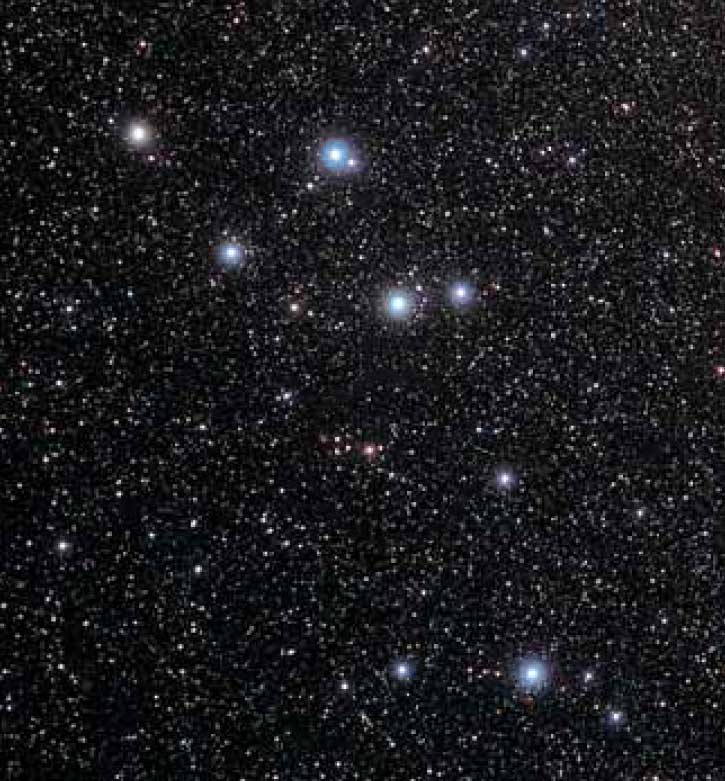
Delphinus, the constellation looks just like a tiny Dolphin that’s splashing its way through the sky amidst other famous summer sights. The head and tail of Delphinus, the Dolphin, shine in this image from Akira Fujii. The warm evenings of midsummer bring a variety of familiar night sky sights: the Summer Triangle, the Square of Pegasus, Sagittarius. There are also a few gems that may have gone unnoticed. One of these often-overlooked constellations is Delphinus — a tiny Dolphin splashing its way through the sky amidst those other summer sights, just east of the Milky Way. It’s a faint constellation but a worthwhile one nevertheless. The Stars of Delphinus Delphinus, the Dolphin Sky & Telescope / IAU Alpha (α) Delphini— Second-brightest in the constellation at magnitude 3.75 and forming the top of the Dolphin's head is the star Sualocin. The common name sounds convincingly ancient until you realize that it's the name Nicolaus backwards — the latinized name of astronomer Niccolò Cacciatore placed on a star map published in 1814. Saulocin is a B-class star about 250 light-years distant, orbited by a dimmer set of companions only 12 astronomical units away. Beta (β) Delphini — The similarly bright 3.72-magnitude Rotanev is the second half of the naming puzzle. Here we find the name Venator in reverse — this time the latinized last name of Niccolò Cacciatore. This is the brightest star in Delphinus. Rotanev is a twin system of two subgiant stars similar in mass and size, both slightly wider than the Sun. They orbit closely, but stargazers with access to large telescopes (8 inches or larger) may be able to split to the two visually under ideal conditions. Epsilon (ε) Delphini — Aldulfin gets its name for its location in the constellation, partially derived from an Arabic phrase meaning “the dolphin's tail.” Aldulfin is a blue giant. Gamma (γ) Delphini — For another binary pair that’s much easier to split with small optics, Gamma Delphinioffers an orange/yellow star and a gray/green companion that make a visually striking pair. The overall appearance without optical aid is orange, giving this "tip of the dolphin's nose" a golden color that stands out from the bluish/white hues of the others. Zeta (ζ) Delphini — This A-class main-sequence star fills in the dolphin’s dorsal fin, paired with a dim brown dwarf companion that’s much larger than a planet but too small to sustain hydrogen fusion. Mythology Delphinus is highlighted in blue in this star map from Alexander Jamieson / Celestial Atlas (1822) / U.S. Naval Observatory Library / Public Domain Sometimes, you'll find tiny, dim constellations that are late additions from within the last 400 years — such as Microscopium in the Southern Hemisphere sky. But this isn't the case with Delphinus, which is quite old and one of Ptolomey’s classic 48 groupings. Even though it's small, its stars are all similar in brightness and form a fine cluster, so it's easy to see why it was recognized early on. One of my favorite Greek myths involving Delphinus revolves around the mythical singer Arion. This poetic genius developed new types of music and was accomplished at the lyre, touring regions around Italy to perform. Pirates (or some say his own mutinous crew), seized him on the voyage home to Greece, attracted to his considerable wealth. After begging to sing a final song Arion jumped overboard. He would have drowned, were it not for a passing dolphin, who, impressed with the music, offered Arion a ride to safety. It’s this dolphin that the constellation Delphinus portrays. Outside of Greece, only a few cultures put the stars of Delphinus into their own constellation. One exception is the Boorong clan of the Wergaia of Australia. They used the brightest stars of Delphinus to form a constellation called Otchocut, the Great Fish. Specifically, the constellation depicts a Murray Cod, one of eastern Australia's most prominent freshwater fish. Finally, a more modern nickname is “Job's Coffin,” an asterism that refers to the four brightest stars of the constellation. It’s unclear where this name came from. How to See Delphinus When you seek out Delphinus for yourself, preferably under a dark sky, you’ll see these stars form a gentle arch that truly does resemble a leaping dolphin. Yes, the stars are on the dim side, and the constellation small. But someone long ago clearly knew dolphins and saw their shape in those stars. Maps and photos don’t quite do it justice. Summer is a prime time for seeking Delphinus in the Northern Hemisphere, though you'll have to work with the short nights. The stars of Delphinus aren't terribly bright, but a couple of waypoints can bring you close. Altair, in the constellation Aquila, is probably the brightest thing in the region; Delphinus is just east of that star and the band of the Milky Way. So many cultures throughout time have told stories about the Milky Way as a river; it would seem the little Dolphin is just on the river’s edge, perhaps fishing in the shallows.
Meet the Constellations: Delphinus, the Dolphin
Full Article
Original Source
Read the full article at Skyandtelescope →KhanList aggregates and links to publicly available news content. We do not host full articles from third-party sources. Always verify important information with original sources.