
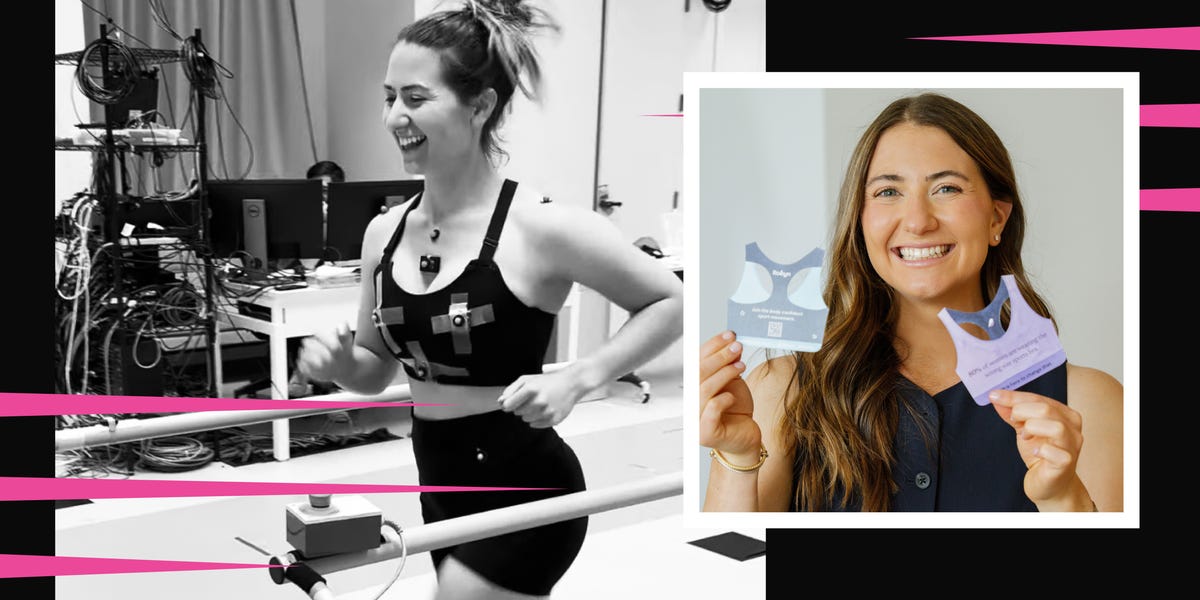
7 min readWhen an athlete suits up for competition, every piece of equipment matters. A shin guard that doesn’t fit or football pads that aren’t secured properly can affect performance. But one essential piece of gear is often overlooked: the sports bra.When shopping at top athletic retailers, female athletes are usually presented with around three options: small, medium, and large. The cup size grows with the band size, and there is little to no room for customization.Anyone with breasts can relate to struggling to find a comfortable bra, but it's an unfortunate reality many female athletes have come to accept. What may seem like a trivial aspect of an athlete’s uniform holds a much greater significance. According to a 2021 survey of 70 elite athletes conducted by the English Institute of Sport, 75 percent of athletes have never been fitted for a sports bra, and 26 percent reported that breast pain affects their athletic performance. This speaks to the bigger picture that 46 percent of school-aged women said their breasts were a barrier to exercise.Trying to find the solution for an ill-fitting sports bra often falls on the consumer—but Robyn founder Sara Falkson wants to change that.The Support GapFalkson grew up in a bustling home filled with love for sports and love for one another. In the middle with three older brothers and one younger sister, she tried almost every sport, but eventually settled on field hockey.Playing sports while going through puberty is something all adolescents have to deal with, and Falkson was no exception. Navigating a changing body and mind can be tricky, especially when you’re relying on that body to remember plays and execute drills.When it came time for the obligatory mall trip to shop for sports bras, Falkson says she found herself relying on her teammates.“My teammates were really the best sisters of all,” she tells Women’s Health. “I found such a family and community in sports.”Her teammates offered emotional support, but Falkson still struggled to find physical support.“I have a bigger chest, and when it came to finding a sports bra, I struggled so deeply,” she says. “I would either find some that would be over-sexualizing, or I would chafe, and I would get horrible scars and stabs.”A solution she and her mom came up with was for her to wear two sports bras while playing field hockey. Although this remedy did solve the support issue, Falkson says it came with another set of issues—teammates commented on it, and it wasn’t comfortable.“Early on, I just assumed that my body’s probably the problem,” she says. “This gear design came from huge companies. They know what they’re doing, and I’m probably the one not fitting the mold.”This prompted her to look toward other solutions, such as modifying her fueling regime to change her body, as well as the more permanent solution of a breast reduction.These experiences stayed with Falkson, including through her time on the Dartmouth College field hockey team. She says that even in college, a lot of her teammates were still navigating the same issues of pressure and appearance on the field.“We tried to do as much as possible to bring in the resources on the mental performance side and the nutrition side at Dartmouth and really switch the language [to] being more performance-focused, rather than appearance,” she says.After earning her undergraduate degree, Falkson moved to San Francisco and began coaching youth field hockey on the side. She loved coaching, but soon heard familiar concerns from her players.“The girls were saying the exact same things,” she says. “They were focused more on how they looked in their uniforms than how they were actually performing, and by that point, I’m like, ‘This is ridiculous. Why do so many of us feel this way?’”Motivated by her frustration, Falkson enrolled at Harvard University to pursue a master’s degree in design and engineering. While there, a single stat stayed on her mind: 50 percent of girls drop out of sport by age 14 due to low body confidence, according to research conducted by Dove.“It was so heartbreaking, but also in some ways validating knowing that there’s some research grounded in this, and we’re not alone,” she says.While at Harvard, Falkson started leading body confidence workshops in the Boston area where she sat down with young female athletes to get a better understanding on what could be done to help them feel better about playing sports.“We put the ownership in their hands, and that’s how we got Robyn,” she says of her company, an athletic brand dedicated to designing sports bras that elevate body confidence on and off the field. “Time after time, girls were so frustrated about sports bras, because they’re an essential piece of equipment, but so overlooked.”Robyn AthleticBeyond the BraRobyn started as a master’s thesis proposal. Falkson’s advisor, Karen Korellis Reuther, played a key role.Korellis Reuther is extremely familiar with the world of design. Now a Design Critic in Architecture in Harvard’s Graduate School of Design, she is a designer by training and practice for over 40 years and is a former creative executive at Nike and Reebok.Korellis Reuther’s passion for helping to redesign the world for women also was fueled by personal experience.“As designers, we really connect very much to the built world, and that’s where Sara really had a passion,” Korellis Reuther says, “We were trying to understand what around the built world—whether it’s what we put on our bodies, what we use, or what we surround ourselves with—that is causing girls’ body confidence to drop, and what could we do from a design perspective?”Korellis Reuther’s research in women-focused design goes far beyond sports. She is the author of Man-Made: How We Designed a World That Leaves Women Out, and How We Can Make It Right.In the book, Korellis Reuther explores how women are still grossly unaccounted for in the world of design, despite inhabiting the same world as men. Her research examines how components of everyday life inconvenience women—and sometimes endanger them.From poor locker room setups to unfit fire equipment gear for female firefighters and personal protection equipment, women are consistently thought of as an afterthought when it comes to design.“We think, ‘I can’t make this work,’” she says. “But the truth is, it wasn’t designed for us in the first place.”While working as a design executive for major brands, Korellis Reuther had a unique perspective being physically present where these decisions were made, but still not feeling like change was taking place. She speaks openly about feeling dismissed and looked over in important meetings, despite her high-ranking position in the company.“The story had to be told, and as a designer, I knew we could make it right.”Hatching RobynRobyn is set to release a high-support bra, the Game Day, and a medium-support bra, the Everyday. The principal component that makes Robyn bras different from other athletic brands is the adjustability features. Almost all components of the bra will be adjustable, including the shoulder straps and bottom band.In preliminary testing, subjects ran at 8 MPH pace while hooked up to machines to monitor their breast movement. The Robyn Bra demonstrated approximately 46 percent less vertical breast movement than a leading high-support sports bra.Robyn AthleticRobyn encompasses Falkson, including the brand’s name. She and her mother share Robyn as a middle name. It proved to have a double meaning after Korellis Reuther pointed out that the robin is one of the only species of bird with a distinct breast that is a different color then the rest of the body.“Just like the robin bird, we want our athlete to lead with color, joy, and strength,” Falkson says.Robyn has certainly been led with strength thus far. With the product set to launch this spring, Robyn has already amassed over 34,000 followers on Instagram as well as more than 100 brand ambassadors comprised of high school and college athletes.It has already been a part of five major collaborations, and was featured in Yankees Mag—another element that’s personal to Falkson, as her longtime boyfriend, Ben Rice, plays professional baseball for the New York Yankees.The couple went to high school together and began dating early in college. Rice will make the occasional surprise appearance on Robyn’s social media, like when Falkson handmade a coffee table to celebrate his anniversary with the team. She also filmed a series in which she 3D printed custom Yankees memorabilia for this year’s playoff season.Both athletes, Falkson says the two are able to push each other to be better, and seeing Rice’s career expand has made her more inspired about her own.“I think if anything, seeing his career has just inspired me to also push to see my dreams and take risks,” she says.Robyn isn’t just about apparel—it has its own mission, too. The company has hosted dozens of body confidence workshops, including a recent partnership with South Bronx United, a soccer nonprofit.. Robyn teamed up with South Bronx United as well as mental health organization The Hidden Opponent to create a four week-curriculum focused on empowering young athletes.Robyn AthleticRobyn also works with Shooting Touch, a basketball nonprofit out of Boston for body confidence-focused programming. Falkson also coordinated a partnership with a 3D printing company to bring the printers into local schools to encourage more girls to get into STEM.“For me personally, I’m glad our world has Saras, because we need to keep pushing forward,” Korellis Reuther says. “She pushes forward from her true, authentic self—with a sense of joy, with a sense of optimism, but also a sense of, ‘We haven’t done it right yet, and we need to make this right.’”Looking toward the future, Falkson says her dream scenario would be to have Robyn gear become part of a female athlete’s uniform. “Once I see Robyn in the real world and girls connecting and bonding over a body confident sport and feeling their best, celebrating lifelong movement, that’s my goal.”Through it all, Falkson has held on to the perspective she had as a young athlete.“Growing up and being a woman is hard,” she says. “What you’re going through is okay and normal, and you’re still going to be valued. Giving girls the resources to have that space is really important.”Alyssa Cruz is the social media editor at Women’s Health, where she drives social strategy and helps shape the brand’s voice across platforms. Prior to WH, she worked at CBS News and palabra. Originally from Toledo, she is a proud alumna of Ohio University, where she received two bachelor’s degrees in journalism and Spanish. When she is not creating social content, you can find her trying different restaurants in New York City or planning her next trip.
Meet the Athlete-Turned-Founder Rethinking the Sports Bra
Full Article
Original Source
Read the full article at Womenshealthmag →KhanList aggregates and links to publicly available news content. We do not host full articles from third-party sources. Always verify important information with original sources.