
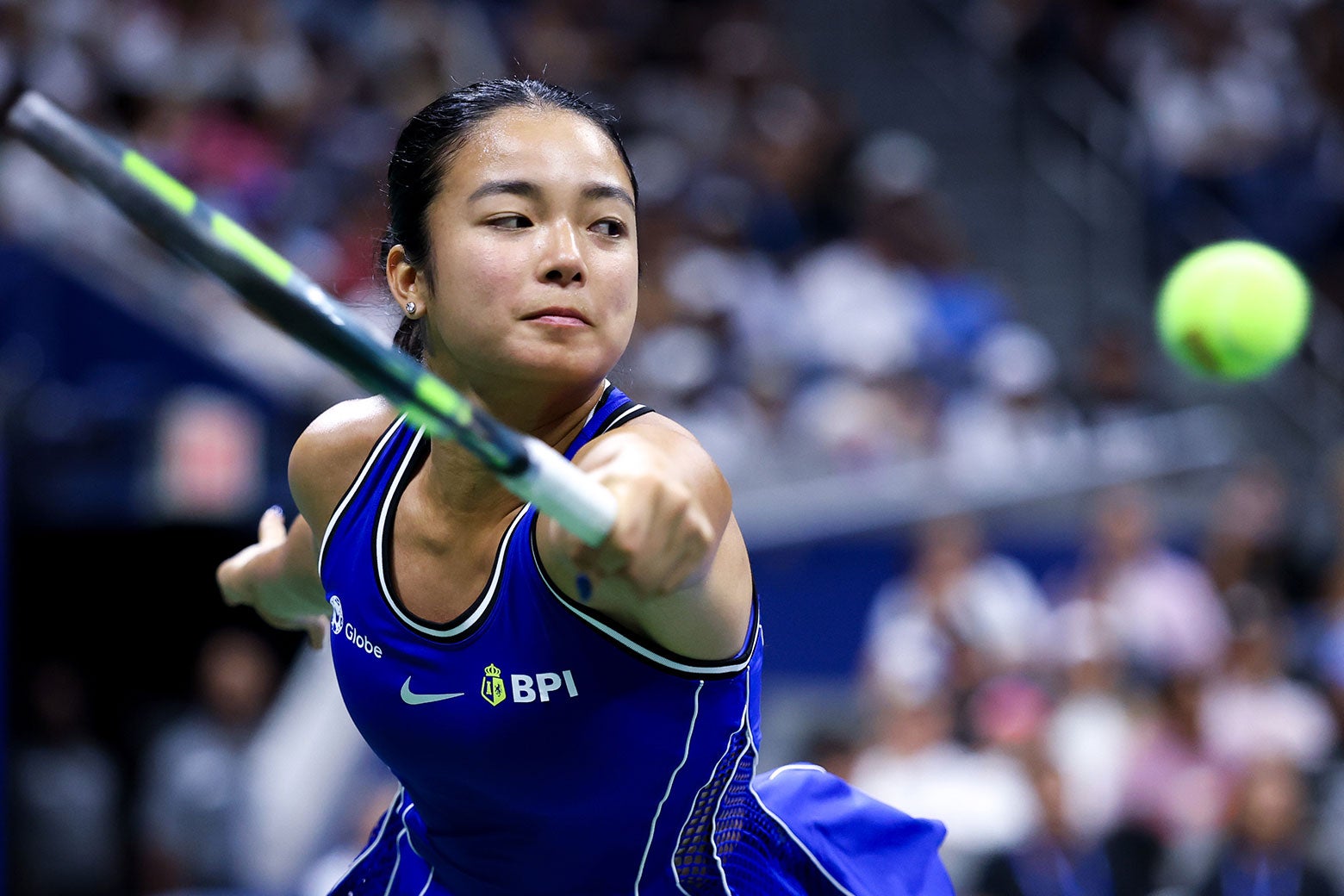
Sports The Tennis World Wasn’t Ready for Alex Eala—or Her Raucous Fans The Filipina phenom is remaking the country club sport for a new audience. Caleb Bowlin/Getty Images Sign up for the Slatest to get the most insightful analysis, criticism, and advice out there, delivered to your inbox daily. Before the year is out, tennis’s single-match attendance record is likely getting smashed. In December, an adoring crowd will pack into the 55,000-seat Philippine Arena to cheer on their countrywoman Alex Eala. If all goes to plan that day, the 21-year-old Filipina (and her opponent, Indonesia’s Janice Tjen) will outdraw the sport’s previous top attractions, Roger Federer and Rafael Nadal. In February 2020, those internationally beloved rivals played a charity exhibition in South Africa in front of 51,954 people. (The opening act that day, a doubles match that also featured Bill Gates and Trevor Noah, surely lured 10 or 11 of those paying customers.) Yes, Eala has zero senior-level major championship titles compared to 42 combined for Federer and Nadal. But at this point in her ascendant career, she could probably sell out the Circus Maximus (estimated capacity: 250,000) so long as it got teleported from ancient Rome to anywhere within shouting distance of Manila. I first encountered Eala and her devoted supporters earlier this summer in D.C., where she went on a glorious weeklong run that culminated in the biggest title of her career. In the month since, the 18th-ranked player in the world has packed stadiums in Toronto, Cincinnati, and New York; secured new sponsorship deals with the likes of Marriott and Panasonic; and been the subject of adulatory pre–U.S. Open coverage in the Wall Street Journal, Forbes, ESPN.com, the New Yorker, and Sports Illustrated, the latter of which called her “the pride of the Philippines and tennis’s next great superstar.” Eala, who plays her first singles match at the 2026 Open on Tuesday night, feels sui generis. She’s a precocious young talent, embraced by a country and a diaspora that’s at once wildly patriotic and massively underrepresented in major professional sports. In tennis specifically, Eala is the only player representing the Philippines who’s currently in the top 1,000 of the men’s or women’s rankings. But in addition to Eala’s significance to Filipinos, the rise of a singular player from a nontraditional tennis nation should serve as a bigger lesson for a sport that’s never been all that hospitable to outsiders. The always celebratory, often uninhibited scene at Eala’s matches is a vision of a truly global game, one that’s welcoming to anyone from anywhere. For most of the world, and even for most Filipinos, Eala’s emergence has felt close to instantaneous. For Dyan Castillejo, it’s been a long time coming. In the 1980s, Castillejo became the first woman from the Philippines to crack the Women’s Tennis Association rankings. Decades later, she told me, her son and Eala’s older brother started playing tennis together, a rare undertaking in a country with few public courts. Back then, Eala was 4 or 5 years old, a little kid tagging along to her sibling’s practices. “She was always very hardworking, very obedient, not complaining at all,” said Castillejo. She was also very talented, and her family had the resources to support her burgeoning career. At 8, Eala won a series of three tournaments, the “Little Mo” Slam, to earn what’s billed as the “tallest trophy ever given in junior tennis.” (It was definitely way taller than her.) As a teenager, she went abroad to train at Nadal’s academy in Mallorca. Every time she came back home, Castillejo noticed that some aspect of the young left-hander’s game had improved—that she was stronger, was more mobile, had a more effective serve. “I would always say to myself, I would tell my friends or my family, ‘Alex is going to make it. She has what it takes,’ ” said Castillejo. It’s not quite fair to say that everyone in the Philippines ignored that prediction. It’s more that nobody heard it. Castillejo, who’s been a well-known sportscaster since the ’90s, struggled to get stories about Eala on the air. “It’s not like basketball that Filipinos are crazy about or boxing, [with Manny] Pacquiao. Filipinos don’t really follow tennis,” she said. That changed last March, when Eala beat Grand Slam champions Madison Keys and Iga Swiatek at the Miami Open. Ever since, she’s been a national icon, a racket-wielding, caldereta-eating giant killer who finds every opportunity to proclaim, in Tagalog and English, that she loves her fans and loves being from the Philippines. “She’s probably the most popular Filipino right now,” Castillejo said. “She’s the one person that’s really giving us such good news.” Miguel Alfonso Caramoan, a sports writer for ESPN Philippines, told me that his stories on Eala get “the most views, the most clicks.” He said that his editors now “continually push me for not just the match recaps: ‘Maybe you can write previews for each tournament, maybe you can write side stories about her quotes.’ ” As Bounces’ Ben Rothenberg noted back in January, the booming Eala fandom caught tennis’s overlords off guard. At the Australian Open, her pretournament press conference got more than double the YouTube views of Novak Djokovic’s and six times as many as Carlos Alcaraz’s and Coco Gauff’s. Even so, the tournament scheduled Eala’s first-round match on a small, general-admission outer court, leaving thousands of Filipinos to watch her play on TV screens instead of in the flesh. The DC Open didn’t make the same mistake. The tournament’s chairman, Mark Ein, told reporters that “at least 80 percent, if not more” of the requests his ticketing staff fielded were about when Eala was taking the court. Given that demand, every one of her matches in Washington was played in the main stadium, and Three Stars and a Sun became something akin to the tourney’s unofficial logo. After one of Eala’s victories, I spoke with a group of women who had previously camped out overnight to see her play at Wimbledon. I also talked with a guy wearing Eala merch—a T-shirt featuring the Philippines’ national flower, the sampaguita, superimposed atop a tennis court—that had been sold exclusively at a Nike store in Metro Manila. And standing outside the players’ gym, I ran across someone hoping to catch a glimpse of Eala. This fan had first learned about her via a conversation with his uncle back in the Philippines. Now he was posted up at his first tennis tournament and making plans to come back the next day. Eala’s fans aren’t just plentiful—they make themselves heard. “The Filipinos go crazy when they support Alex,” Caramoan told me. “It can go borderline too noisy and sometimes violate some tennis etiquette.” Proper etiquette in this country club sport has always been straightforward: Sit down and shut up. A recent explainer from the Philippines’ GMA News advised spectators to “wait for the rally to finish,” to “stay quiet while the ball is live,” and to “hold the noise between serves.” Fun! The crowds in D.C. weren’t disrespectful, merely enthusiastic. And with only a couple of exceptions, Eala’s opponents have seemed to appreciate the noise she brings. “It’s not fun to play against, but I do appreciate the really fun atmosphere,” American Jessica Pegula said after losing to Eala in the D.C. final, a match played in her home country where she was decidedly not the home favorite. It makes sense that Pegula would have nice things to say about her Filipina competitor: Her podcast, The Player’s Box, got a surge in subscriptions after Eala appeared as a guest. It’s not just individual players who’ve gotten an Eala-related bump: ESPN reported that accounts from the Philippines now make up 18 percent of the WTA’s followers on Facebook. It was also clear watching Eala in D.C. that it’s not only Filipinos cheering her on. No matter where you’re from, she’s an easy player to root for—affable, tough-minded, and crafty on the court. At 5-foot-9, she’s far from the biggest hitter on the women’s tour, but her mobility, court sense, and lefty ground strokes make her very tough to beat. But even as Eala has busted inside the top 20, she has plenty of room for improvement. On return, she’s fantastic at earning break-point chances but not so great at converting them. And although her comically underpowered serve often flummoxes opponents—“I felt like she was serving slower and slower,” Swiatek said after losing to Eala at Wimbledon—it almost certainly needs to level up for her to become a major championship contender. Regardless of what titles she wins, Eala has already transformed the tour. The Canadian Open added chicken adobo and pork lumpia to its on-site menu, and the U.S. Open gave her (and her dad) a leading role in its pretournament Stars of the Open exhibition. Her singles match at the Open on Tuesday night is scheduled for Louis Armstrong Stadium, the second-largest venue at the USTA Billie Jean King National Tennis Center. The cheapest tickets for Eala’s night session are currently $351 on the secondary market. You can get into the big stadium, Arthur Ashe, that evening for just $115. That’s one way to measure the Eala effect. Another is to look around the stands. Along with Brazil’s João Fonseca, who’s got his own army of chanting, flag-waving supporters, Eala has shown what true internationalism could look like in a sport that has historically been dominated by Europeans, Americans, and Australians. More than Federer, Nadal, or Djokovic, it was the Williams sisters who changed the face of tennis by inspiring a generation of Black players. Eala’s ultimate impact won’t be clear for many years, but she has already sent racket sales soaring in the Philippines. In Manila, Caramoan will be pulling all-nighters if necessary to cover her matches at the U.S. Open. When I asked him to imagine what the reaction might be if Eala won the whole tournament, he paused to think it through. “Maybe the country would build a statue for her,” he said. “That would be bonkers.” Sports Tennis
Meet the 21-Year-Old Rising Tennis Star Who Could Draw a Bigger Crowd Than Roger Federer
Full Article
Original Source
Read the full article at Slate →KhanList aggregates and links to publicly available news content. We do not host full articles from third-party sources. Always verify important information with original sources.