
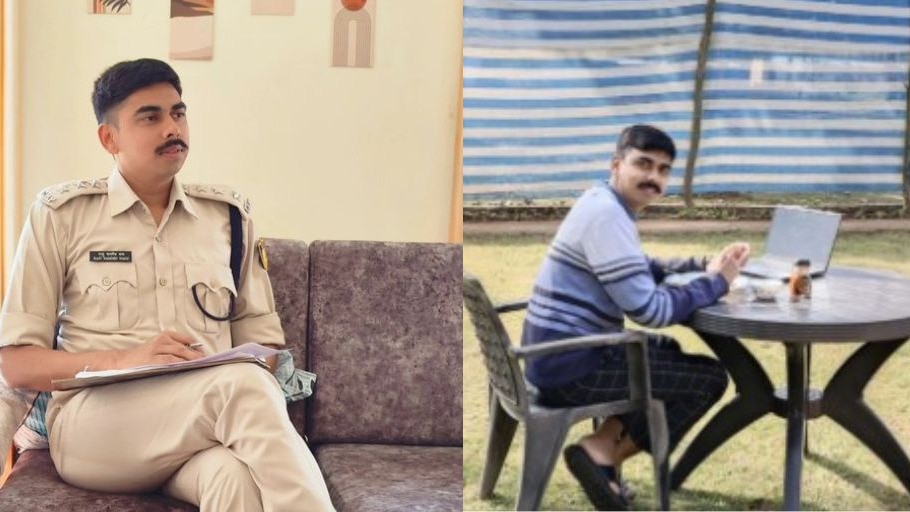
Raju Wagh's UPSC journey unfolded alongside his service in Maoist-affected Bastar, not away from it. As a CRPF Assistant Commandant, he faced operational challenges, worked with tribal communities and secured elections, while maintaining a disciplined study routine that ultimately led to AIR 871.He served as a CRPF officer in Maoist-hit Bastar, prepared for UPSC and secured AIR 871 (Image: Raju Wagh/Instagram (left), LinkedIn (right))At 4 am, when much of Bastar was still quiet, Raju Wagh was already studying. For most UPSC aspirants, the day is planned around the syllabus. Wagh had to plan his preparation around a job where the day rarely went according to plan. As a CRPF Assistant Commandant in Maoist-affected Bastar, operational duties came first, but he continued making room for the UPSC, returning to his books after long days in the field.Alongside security duties, Wagh recovered IEDs, secured elections, taught tribal children and helped remote villagers participate in democracy. In 2025, that difficult balancing act culminated in AIR 871 in the UPSC Civil Services Examination 2024.FROM A SMALL VILLAGE IN NASHIK TO VNIT NAGPURWagh’s journey began in Indori village in Nashik district, Maharashtra. He started his education at a Zilla Parishad school before moving to Jawahar Navodaya Vidyalaya, where he was exposed to students from different backgrounds and developed broader ambitions for his future.He later secured admission to VNIT Nagpur, where he pursued a BTech in Mechanical Engineering and graduated in 2014. Engineering, however, was only the beginning of a career that would eventually take him from the industrial sector to some of India's most difficult conflict zones. FIVE YEARS AT COAL INDIA BEFORE THE CRPFAfter graduating from VNIT Nagpur, Wagh joined Coal India as an Assistant Manager and spent around five years working in the organisation. During this period, his interest in public service began to grow, influenced in part by the example of an IAS officer from his district.He started preparing for the civil services while continuing with his professional responsibilities. His first UPSC attempt came in 2018, when he reached the interview stage but could not make the final list. He also appeared for the Indian Forest Service interview but was unsuccessful. The setbacks did not end his plans. Instead, Wagh continued looking for a way to combine his professional career with his larger ambition of serving in the public sector.FROM COAL INDIA TO THE CRPFIn 2018, Wagh cleared the Central Armed Police Forces examination and joined the Central Reserve Police Force as an Assistant Commandant. The move took him from the industrial sector into one of India's most demanding internal-security environments.His posting in Bastar, Chhattisgarh, placed him in the middle of the Maoist insurgency, where long operations, difficult terrain and the threat of improvised explosive devices were part of everyday duty. But his work was not limited to security operations. He also became involved in efforts aimed at improving relations between the security forces and communities living in remote and conflict-affected areas.IED OPERATIONS, ELECTION DUTY AND COMMUNITY WORKWagh's CRPF career included successful IED recovery operations, including one for which he received appreciation from the Inspector General of the CRPF. The work involved identifying and recovering explosives before they could cause casualties.His service also earned him a DG CRPF Commendation Disc for his role in peacefully conducting the 2024 Parliamentary Elections in Maoist-affected regions. Election duty in such areas is particularly challenging, requiring security forces to protect polling personnel and voters while operating in areas affected by insurgency.For Wagh, however, public service in Bastar went beyond security.While serving in the region, he encountered tribal children who had limited access to education. He responded by launching a “Jungle School”, using a CRPF security camp as a place where children could study. The initiative was later recognised by the District Magistrate of Bastar, who felicitated him for the effort.The idea reflected a broader approach to his work: building trust with communities through education and engagement, rather than viewing security and development as separate responsibilities.He also helped facilitate first-time voting by tribal villagers during the Chhattisgarh Assembly elections. These experiences shaped his understanding of public service, not just as maintaining security, but as helping communities connect with education, democracy and the state.THE UPSC PREPARATION HAPPENED AROUND HIS DUTYIt was against this demanding backdrop that Wagh continued preparing for the UPSC.He could not follow the routine of a full-time aspirant with an uninterrupted study schedule. His preparation had to fit around operational responsibilities, long working hours and the unpredictability of a CRPF posting.He therefore built his routine around consistency rather than long study marathons. He would wake up at around 4 am to study before duty, and after returning from work, he would often put in another few hours of preparation. The amount of time available each day varied, but the commitment to studying remained constant.That approach was particularly important because his UPSC journey had already included setbacks. Rather than waiting for ideal circumstances, Wagh continued preparing alongside the career he had already built.SUPPORT FROM FAMILYWagh's journey was also supported by his wife, Pournima Wagh, who is herself a government officer. Their shared understanding of competitive examinations and public service helped them navigate the demands of their respective careers.For Wagh, the UPSC preparation was never separate from the rest of his life. It had to coexist with his responsibilities as a CRPF officer, his family commitments and the realities of working in a conflict zone.AIR 871 CAME WHILE HE WAS STILL ON DUTYThe years of preparation finally translated into a result when the UPSC Civil Services Examination 2024 results were announced in 2025. Wagh secured AIR 871.What makes the achievement particularly striking is the circumstances in which he received the news. According to reports, he was preparing for another anti-Maoist operation when the result was declared.There was little opportunity for a long celebration. He acknowledged the achievement and returned to his responsibilities, a moment that neatly reflected the way he had prepared for the examination in the first place: without stepping away from his duty.FROM THE CRPF TO THE INDIAN AUDIT AND ACCOUNTS SERVICEThe UPSC result marked the beginning of another chapter in Wagh's public-service career. In August 2025, he joined the Indian Audit and Accounts Service (IA&AS).His LinkedIn profile now describes him as an Indian Audit and Accounts Service officer and former Assistant Commandant, CRPF, with a professional focus on public service, counter-insurgency, governance and development.The transition has taken him from the frontlines of internal security to the country's public financial administration. The nature of his work has changed, but the larger objective he describes for himself has remained consistent: serving the country and working to build stronger connections between the state and underserved communities.A CAREER BUILT AROUND PUBLIC SERVICEWagh describes his approach in simple terms: “lead with empathy, act with courage, and build bridges between the state and the underserved.”Those ideas can be seen across his career. They appear in the IED recovery operations that focused on protecting lives, in election duties that helped people safely participate in democracy, in the Jungle School that brought education closer to tribal children, and in his efforts to help remote communities engage with government institutions.That makes his UPSC success more than a conventional examination story. The significance of AIR 871 lies not only in the rank he secured but in the circumstances under which he earned it.THE REAL STORY BEHIND AIR 871Raju Wagh’s journey from a Zilla Parishad school in a small village in Nashik to VNIT Nagpur, Coal India, the CRPF and eventually the Indian Audit and Accounts Service was anything but straightforward. It involved career changes, setbacks, difficult postings and years of preparation squeezed into the hours left after duty.In Bastar, while serving in a conflict zone, Wagh continued studying for the civil services. His success, with AIR 871, was the result of years of consistency and determination.For Wagh, moving from the CRPF to the civil services was not a departure from public service, but a continuation of it, built on discipline, courage and persistence.- EndsPublished By: Apoorva AnandPublished On: Aug 12, 2026 16:41 IST
Meet Raju Wagh, CRPF officer who went from Bastar's frontlines to UPSC AIR 871
Full Article
Original Source
Read the full article at Indiatoday →KhanList aggregates and links to publicly available news content. We do not host full articles from third-party sources. Always verify important information with original sources.