
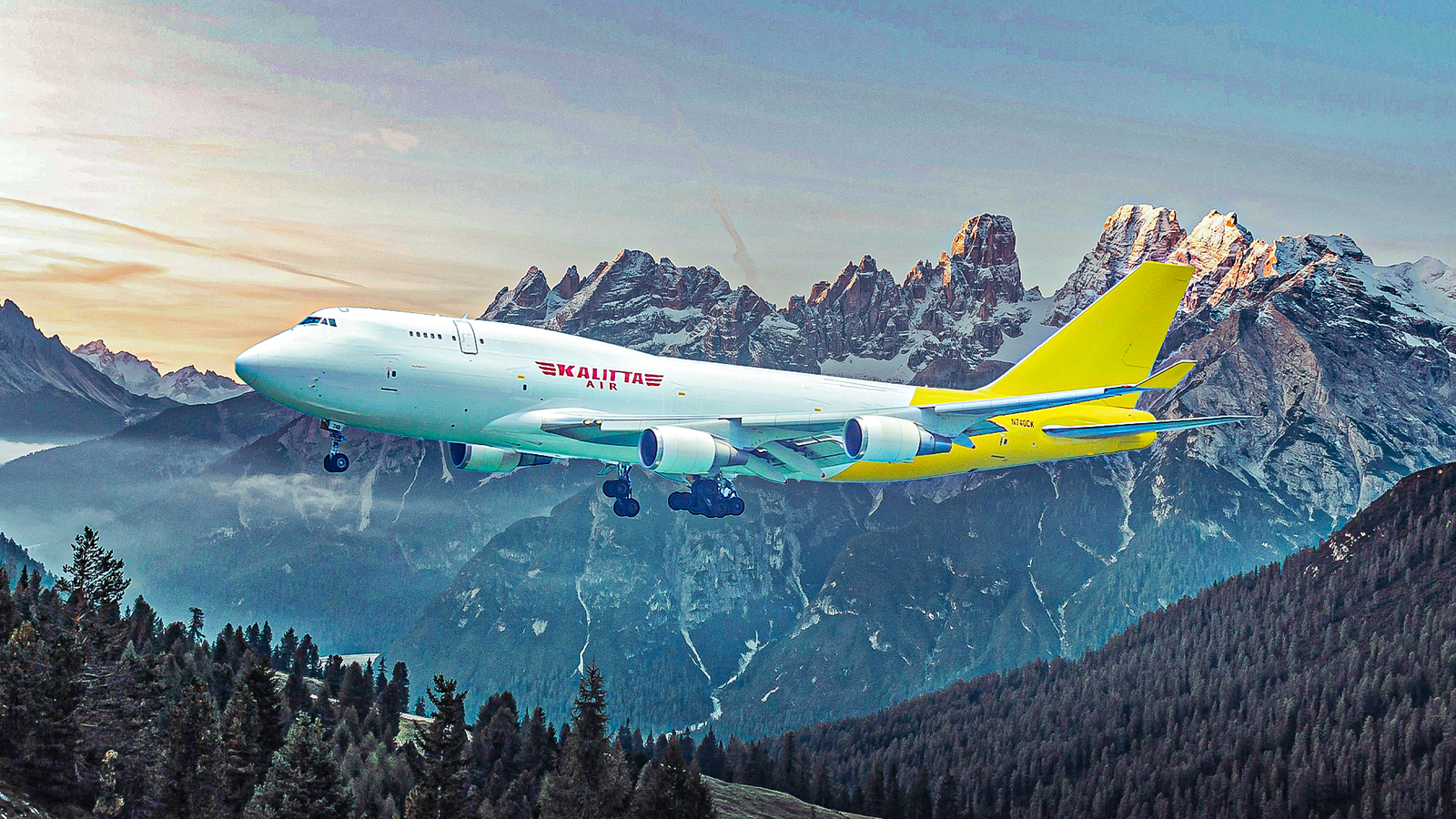
Published Nov 28, 2026, 12:00 PM EST Brandon's passion for aviation started at a young age. He became involved in the flight simulator and VATSIM communities, which sparked his interest in aviation and eventually led him to earn his private pilot license. Outside of work, he continues to build flight hours, explore new airports, and stay involved in the aviation community. Sign in to your Simple Flying account Kalitta Air’s N740CK left Boeing’s factory in 1989, the year the 747-400 entered service, and it still crosses the Pacific almost every day as a freighter. Between November 16 and 22, 2026, it made 17 flights through nine airports in Asia and North America: Chicago, Anchorage, Shanghai, Seoul, New York, Tokyo, Xiamen, Los Angeles, and Kuala Lumpur. Almost every crossing stopped in Anchorage. That week also shows how a jumbo jet of its age is still being used. The aircraft began its career as a Malaysia Airlines combi before being converted to carry cargo only. Kalitta flies a sister ship built the same year, and several older generations of 747s were flying the same week, but N740CK remains one of the oldest 747-400s still in the air. A Week On The Tracker: 17 Flights, 9 Airports Credit: United States Air Force Data from the Simple Flying Flight Tracker for November 16 to 22 shows N740CK flying 17 times. Sixteen flights appear in schedule records, and the tracker’s ADS-B receivers picked up one more: a Seoul to Kuala Lumpur leg on November 22 under the callsign CKS442, which appears in no schedule record. Measured in UTC, the aircraft took off at least twice every day of the week. The routing shows how cargo networks move a single aircraft around the Pacific. N740CK started in Chicago, flew to Shanghai via Anchorage, then went on to Seoul and back across the Pacific to New York before returning to Chicago. It next flew nonstop to Tokyo, returned to Chicago through Anchorage, and then repeated the pattern with Xiamen. From Xiamen it went to Seoul, back to Los Angeles through Anchorage, then to Seoul again, before ending the week in Kuala Lumpur. Date (UTC) Flight Route Distance November 16 K4912 Chicago –Anchorage 2,838 miles (4,568 km) November 16 K4912 Anchorage – Shanghai 4,299 miles (6,919 km) November 17 K4913 Shanghai – Seoul 511 miles (822 km) November 17 K4913 Seoul – Anchorage 3,789 miles (6,097 km) November 17 K4913 Anchorage – New York 3,377 miles (5,434 km) November 18 K4913 New York – Chicago 738 miles (1,188 km) November 18 K4550 Chicago – Tokyo 6,260 miles (10,074 km) November 19 K4551 Tokyo – Anchorage 3,426 miles (5,514 km) November 19 K4551 Anchorage – Chicago 2,838 miles (4,568 km) November 19 K4998 Chicago – Anchorage 2,838 miles (4,568 km) November 20 K4998 Anchorage – Xiamen 4,804 miles (7,732 km) November 20 K4997 Xiamen – Seoul 1,019 miles (1,640 km) Nov 21 K4997 Seoul – Anchorage 3,789 miles (6,097 km) Nov 21 K4997 Anchorage – Los Angeles 2,343 miles (3,771 km) Nov 21 K4442 Los Angeles – Anchorage 2,343 miles (3,771 km) Nov 22 K4442 Anchorage – Seoul 3,789 miles (6,097 km) Nov 22 CKS442 (callsign) Seoul – Kuala Lumpur Not recorded The 16 scheduled legs covered about 49,000 miles (78,860 km). The longest was the Chicago to Tokyo flight on November 18, which covered 6,260 miles (10,074 km) in 12 hours and 44 minutes. The shortest was the 511-mile (822 km) hop from Shanghai to Seoul. Credit: SF Flight Tracker Why Almost Every Crossing Stops In Anchorage Credit: Markus Mainka | Shutterstock Anchorage dominated N740CK’s week. Twelve of its 17 flights either started or ended at Ted Stevens Anchorage International Airport (ANC), and the aircraft passed through it six times in seven days. Six of its seven Pacific crossings stopped there. The only exception was the November 18 flight from Chicago to Tokyo, which flew 6,260 miles (10,074 km) nonstop. Location is the main reason. The airport describes itself as the midway point between New York and Tokyo, within 9.5 hours' flight time of “90% of the industrialised world”. A stop there splits a transpacific trip into two shorter legs, and that changes what a freighter can carry. As Flightradar24 explains, aircraft that stop in Anchorage carry far less fuel than a non-stop, and as a result can haul a lot more cargo. That trade matters on a 747, since FreightWaves puts the maximum payload of a factory-built 747-400 freighter at 249,000 pounds (113,000 kg). Every pound of fuel that a nonstop flight needs comes out of that limit. Anchorage has also built its business around cargo. The Anchorage Daily News reported that the airport became the largest cargo hub in the US last year, based on Airports Council International rankings. Its location is not the only draw. The state of Alaska promotes liberal cargo transfer rules that let a carrier connect any homeland city the carrier serves to any US city the carrier serves by transferring cargo in Alaska among two or more of the same carrier’s aircraft. For an operator like Kalitta, that turns Anchorage into both a refueling point and a place to reshuffle freight between aircraft heading to different cities in Asia and North America. Built In 1989, Rebuilt As A Freighter Credit: Buzz_v2 | Shutterstock N740CK is a Boeing 747-4H6(BCF), serial number 24405 and line number 745. The US Federal Aviation Administration registry lists its build year as 1989. The “BCF” stands for Boeing Converted Freighter, so the aircraft did not start out carrying only cargo. It was originally delivered to Malaysia Airlines as 9M-MHM, a Boeing 747-4H6M, the combi version that carried both passengers and freight on the main deck. One photo from its Malaysia Airlines years shows it wearing “Visit Malaysia Year 1990” promotional titles. That history adds weight to where the tracker found the aircraft at the end of the week, in Kuala Lumpur. After leaving Malaysia Airlines, the jet was converted to a full freighter and joined Kalitta. FAA records cited by Flycraft show that its airworthiness date is October 15, 2003, and its FAA certificate was issued March 20, 2008, with the aircraft registered to KALITTA AIR LLC (Ypsilanti, MI). It flies under the name Doug Kalitta Sr. I and has carried Kalitta Air / DHL International titles. Its build year places it at the start of the 747-400 program. The FAA certified the variant on January 9, 1989, and Northwest Airlines put it into service on February 9 that year. Boeing went on to deliver 694 747-400s between 1989 and 2009. N740CK is not the only survivor from 1989 at Kalitta. Its sister ship N741CK is also a 1989 build, and the tracker recorded it making 12 scheduled flights this week, plus one more seen only on ADS-B between Diego Garcia and Zhengzhou. Because the registry lists only the build year, the tracker data cannot show which of the two is older. Shrinking Role Credit: Kalitta Air Kalitta remains one of the largest 747-400 operators. The Air Line Pilots Association lists its fleet at 22 Boeing 747-400s and six 777s, with more 777s to come, and FreightWaves has named DHL Express and the US military among its key customers. The 747’s nose door and large main deck have kept the type in demand for outsized and high-volume freight long after passenger airlines retired it. That role is gradually shrinking. Kalitta has introduced seven Israel Aerospace Industries-converted 777-300ERSF freighters, and ch-aviation has reported the airline’s plan to gradually replace its legacy fleet of 747 freighters with new 777s. The economics favor the twin. IAI says its converted 777 has 14% more volume than a 747-400 converted freighter and is 21% more fuel-efficient. Converted aircraft like N740CK also face rising maintenance costs as they age, and every additional year in service requires more inspection and repair work. No new 747-400s are coming to replace older ones either. The final 747-400, the last of 694, was delivered in December 2009, so every example still flying is at least 16 years old. Neither of the newest airliner programs from China and Russia offers an alternative in this class: COMAC’s C919, of which China’s three largest airlines received 15 in 2025, and the Yakovlev MC-21, which launch customer Aeroflot does not expect to enter commercial service until the end of 2026, are both narrowbody passenger jets with nothing approaching the capacity of a 747 freighter. For heavy transpacific cargo, operators are choosing between aging 747s and Boeing’s own widebody twins. Older 747s Still In The Air This Week Credit: Ronen Fefer I Shutterstock N740CK’s distinction applies only to the 747-400. The same week’s tracker data shows several civil 747s from earlier generations still flying, not counting the US Air Force’s VC-25A and E-4B. They include five 747-200s, registered ER-BAQ, ER-BAR, ER-BAT, EX-47002 and EX-47004, and a 747-300, EW-465TQ. The tracker also recorded one 747SP, Pratt & Whitney Canada’s C-GTFF. Most of these older jumbos are registered in former Soviet states, with ER prefixes for Moldova, EX for Kyrgyzstan, and EW for Belarus. They also flew regularly during the week. The tracker recorded ER-BAR every day from November 16 to 22, under four different callsigns, and recorded EX-47002 throughout the week even though it transmitted no callsign. Build years for these aircraft are not in the data, because the registry information the tracker draws on covers only US-registered aircraft, so the article cannot rank them by age. The gap between these aircraft and N740CK is more than a few years on the calendar. The 747-200 and 747-300 rely on a flight engineer, while the 747-400 introduced a glass cockpit and a two-pilot crew, along with winglets and a longer wingspan. That change helped the -400 outlast its predecessors in mainstream fleets, and it explains why most remaining 747-200s and 747-300s fly with smaller operators while 747-400s like N740CK still work for carriers with global networks. Freight is now the main job for all of them, as passenger 747 service has largely ended.
Meet One Of The Oldest Boeing 747-400s Still Flying: Built In 1989 & Still Crossing The Pacific
Full Article
Original Source
Read the full article at Simpleflying →KhanList aggregates and links to publicly available news content. We do not host full articles from third-party sources. Always verify important information with original sources.