
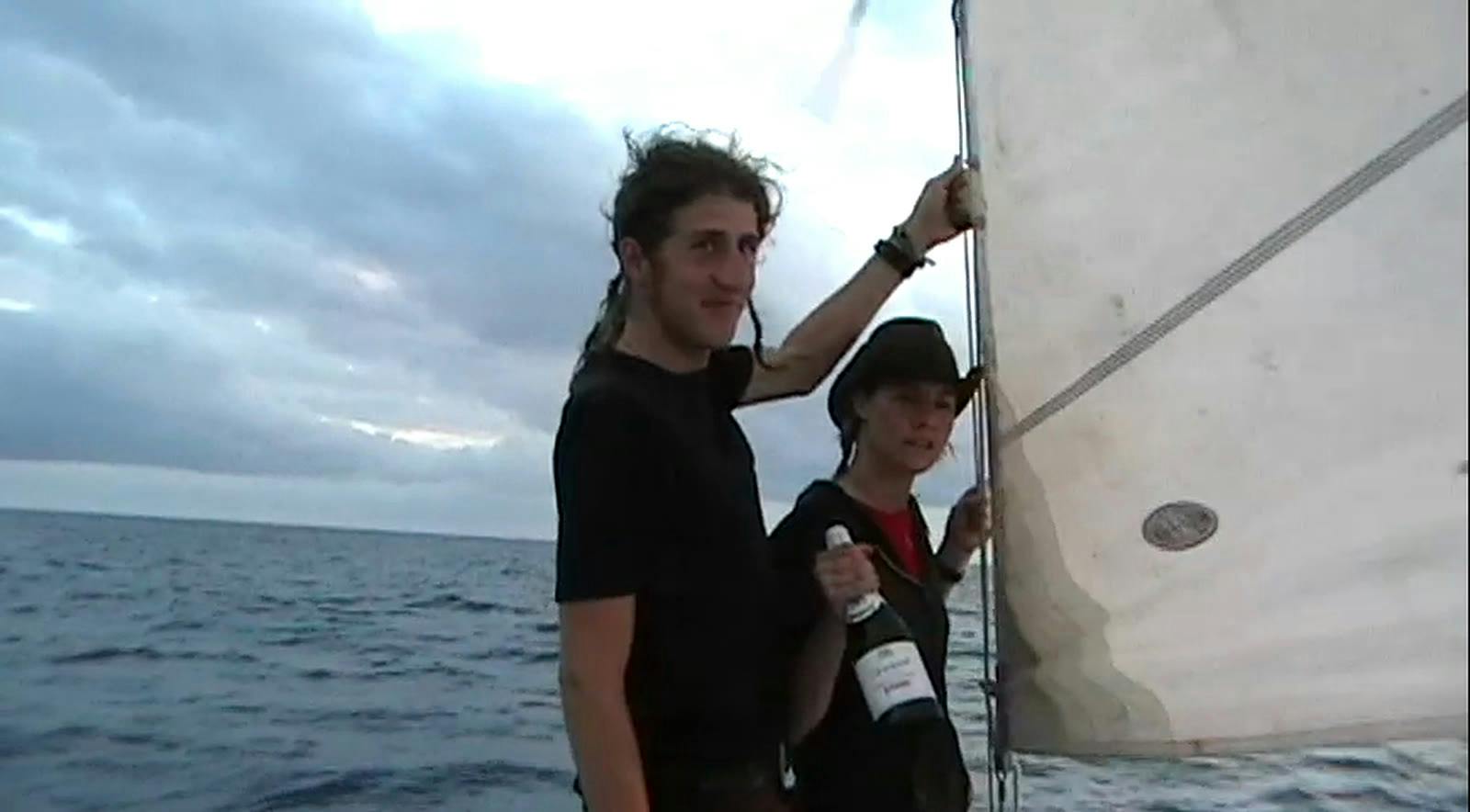
Moxie Marlinspike, a dreadlocked squatter who sailed a $1,000 wreck to the Caribbean with bags of bricks for anchors, built Signal and the encryption guarding billions of WhatsApp and Messenger chats, then got Facebook, Google, and Microsoft to run his code. The Bricks The spare anchor is a bag of bricks. Not a Danforth, not a plow, not one of those stainless-steel Rocna jewels the yacht-club people in Fort Lauderdale hang off their bows like cufflinks. Bricks. Red-clay, scavenged bricks, stuffed into a sack and tied to a line. Somewhere in the islands, off the side of a beat-up thirty-foot sailboat that a gang of broke kids bought as a wreck for a thousand dollars and named, with perfect punk logic, Pestilence, the sack goes over the side, ker-SPLOOSH, and everybody on deck watches the line pay out and thinks the same thing: Well. We'll see. Bricks go into a bag on the deck of Pestilence to become an anchor. A still from Hold Fast. On deck is a tall, lanky young man with dreadlocks and a name that sounds like a pirate made it up after three rums: Moxie Marlinspike. Moxie is a childhood nickname. A marlinspike is a sailor's steel spike for prying apart rope strands so they can be spliced. He was born in Georgia; his birth name, widely reported as Matthew Rosenfeld, is something he declines to discuss. Over two winters, Moxie and three friends calling themselves the Anarchist Yacht Club rebuild the gutted Pearson 30 with scavenged plywood, step its mast using the dinghy crane of an unattended superyacht, and sail it from Florida through the Bahamas toward Haiti and the Dominican Republic. They film everything. The result, a 2008 video zine called Hold Fast, becomes a cult classic: a manifesto for the idea that the world's systems are more fragile than they look, and that anybody with enough nerve and skill can sail straight past them. Now jump ahead a decade. The same man wrote the mathematics that protects the private conversations of billions of people. The Signal Protocol, which he designed with the cryptographer Trevor Perrin, runs inside Signal, WhatsApp, Facebook Messenger, and Google Messages. A teenager in São Paulo uses it. So does a reporter in Kyiv messaging a source. That's the paradox, and it's the whole story: an anarchist who distrusts technological power built the most important privacy technology on Earth, and the industry's biggest players ended up running his code. The Squats and the Sea San Francisco, the late 1990s, the dot-com boom at full fever. Moxie arrives at eighteen, sleeps his first few nights in Alamo Square Park, and lands a job at the dot-com WebLogic. It doesn't take. At the height of the bubble he quits and goes the other way, down: punk houses, squats, hacker collectives, hitchhiking and freight-hopping across America. He builds a life around one idea: autonomy above everything. He writes it down, too. In 2005, with Windy Hart, he co-authors An Anarchist Critique of Democracy, which goes after not dictators but democracy itself. Voting, it argues, hands your will to an outside power; majority rule is still rule. What he wants instead is "unmediated relations between free individuals." Keep that in mind. It comes back later in the strangest possible form. The sea is where the philosophy turns physical. Sailboats are supposed to belong to millionaires; Moxie finds marinas full of abandoned boats nobody wants. His sailing collective is called Blue Anarchy. Its creed is his creed: skip the gatekeepers, scavenge what others threw away, and trust your own competence. Years later he'd sum up his view of the pre-built world to The New Yorker: "Living in Venice is like living at the end of the world, the end of history. … All the decisions have been made. This is the world we get." For most people, that's a description of life. For Moxie, it's a provocation. "We Should All Have Something to Hide" June 2013. A week after The Guardian published the first Snowden story, everyone was repeating the same soothing line: If you have nothing to hide, you have nothing to fear. Moxie took it apart in an essay called We Should All Have Something To Hide. His argument: in the modern world, everybody is a criminal. Quoting law professor James Duane, he notes that federal crimes are spread across roughly 27,000 pages of the U.S. Code, plus nearly 10,000 regulations with criminal penalties. Then the punchline: owning an undersized lobster is a federal crime, even, he writes, "if you found it after it died of natural causes." It's funny until it isn't. If everyone breaks some law, and the state keeps a permanent record of everyone's communications, then enforcement becomes purely selective. The law looks wherever the powerful point it. He goes further. Progress, he argues, depends on people being able to break the law in private. Marijuana legalization and same-sex marriage didn't win in an abstract "marketplace of ideas." People lived differently first, until the law caught up. A surveillance state that enforces everything perfectly would freeze society solid. Moxie in 2013, the year of "We Should All Have Something To Hide" and of Open Whisper Systems.His call to action wasn't to vote or petition. It was to build user-friendly technology that stymies surveillance, because "it's going to take all of us." He had already started. The Man Who Broke the Locks Before he built the vault, he spent years proving that every other vault was made of cardboard. The web's entire trust model, every padlock icon and bank login, rested on SSL/TLS and the Certificate Authority system. Moxie pulled up the floorboards. Year Exploit What It Did 2002 BasicConstraints Internet Explorer never checked whether a certificate was allowed to vouch for others, so anyone with a valid certificate for one domain could forge others. 2009 sslstrip Unveiled at Black Hat DC. Silently keeps victims on plain HTTP so encryption never starts. It became the standard argument for HSTS. 2009 Null-prefix attack A hidden null byte (paypal.com\0.thoughtcrime.org) tricked browsers into accepting forged certificates for any site. Dan Kaminsky found the same flaw independently and presented it the same day. 2012 MS-CHAPv2 crack Turned a weakness flagged since 1999 into a push-button attack. With David Hulton's FPGA hardware, any captured handshake cracked in under a day, ending the case for PPTP VPNs. The null-prefix trick is almost beautiful. A certificate authority sees paypal.com\0.thoughtcrime.org, confirms Moxie owns thoughtcrime.org, and signs it. But the browser, written in C, hits the null byte, which in C means the string ends here, and reads only paypal.com. A forged identity, blessed by the system itself. The Black Hat Briefings stage, where researchers turn the industry's assumptions into live demos. That's when his reputation hardened: the researcher who doesn't just find the hole but hands you the crowbar. You can ignore a whitepaper. You can't ignore a working exploit in every script kiddie's toolkit. The Border and the Saudi Pitch November 2010, JFK airport. Returning from the Dominican Republic, Moxie is pulled aside by Customs and Border Protection for nearly five hours. Agents demand the passwords to his laptop and phones. He refuses, calmly and completely. They take the devices away to inspect them and hand them back before he leaves. He never trusts them again; they could have modified the hardware, he told Wired, or installed new keyboard firmware. Some governments wanted to hire him instead. In 2013 an email arrived about a project run by Yasser D. Alruhaily at Mobily, one of Saudi Arabia's largest telecoms. The subject line: "Solution for monitoring encrypted data on telecom." Under pressure from the Saudi regulator, Mobily wanted help intercepting its customers' Twitter, Viber, WhatsApp, and Line traffic. Most people would quietly say no. Moxie published it. He named the project's manager, quoted the emails, and described the design document on his blog. Mobily told Reuters that it had never communicated with him. The intelligence world got the message: this man is not for sale. That reputation bought trust. In November 2015, Edward Snowden, the man who knew better than anyone what the NSA could do, tweeted four plain words: "I use Signal every day." Building Signal Here's where the punk who breaks locks becomes the punk who makes them. Before Moxie, strong encryption was a hobby for the obsessed: PGP, command-line incantations, key-signing parties. His insight was moral as much as technical: privacy only experts can use isn't privacy for anyone. 2010: He and roboticist Stuart Anderson co-found Whisper Systems, launching TextSecure (encrypted texts) and RedPhone (encrypted calls) for Android. 2011: Twitter buys the company to bring Moxie in to run security. He persuades Twitter to open-source both apps. 2013: He leaves to start Open Whisper Systems, a grant-funded open-source project. Then, with Trevor Perrin, he builds the thing. It was first called the Axolotl Ratchet, after the salamander that regrows lost limbs, because the protocol heals itself. Steal a key, and the system grows new ones and locks you out again. Older schemes like OTR needed both people online at once; theirs works even when one phone is asleep in a pocket. Component Job Why It Matters X3DH First handshake Lets two people agree on a secret even if one is offline. Double Ratchet Message encryption Every message gets its own key. Past messages stay safe if a key is stolen, and future ones recover. Sesame Multi-device sessions Keeps your phone and laptop in step without breaking the ratchet. The Double Ratchet, from the specification by Trevor Perrin and Moxie Marlinspike. Academics led by Katriel Cohn-Gordon and Cas Cremers formally analyzed the protocol and proved the security of its core. In cryptography, where most clever ideas die in peer review, that's close to a miracle. Then came scale. In November 2014, WhatsApp announced it was adopting the protocol; by April 2016, more than a billion people had end-to-end encryption by default, and almost none of them noticed. That was Moxie's theology: the best security is the kind you never have to think about. Google Allo, Facebook Messenger, Skype, and later Google Messages followed. The biggest data-harvesting companies in history were now, for message content at least, running Moxie's code. By then TextSecure and RedPhone had merged into one app with one blue icon: Signal. In 2017, Moxie and Perrin won the Levchin Prize for Real-World Cryptography. The Anarchist King As Signal grew, the decentralization faithful made one demand: Federate. Let anyone run a server or write a client, like email or Matrix. Isn't that what anarchists want? Moxie said no. Signal stayed a walled garden, centralized and run largely on AWS. Third-party clients weren't welcome. He explained why in The Ecosystem Is Moving, a 2016 essay he later delivered as a talk at the 36th Chaos Communication Congress in Leipzig in 2019, to a hall full of the most hardcore decentralization believers on Earth. Federated protocols, he argued, are frozen in time: every upgrade needs agreement from countless operators, so progress stops. "My email is not encrypted," he told them, "and never will be." 36C3, Leipzig, December 2019, where Moxie told the decentralization faithful the ecosystem was moving. Centralization let Signal move fast, shipping features like Sealed Sender (2018), which hides who sent a message even from Signal. And federation leaks metadata from server to server. As former NSA and CIA director Michael Hayden had put it in 2014: "We kill people based on metadata." So Moxie accepted the paradox: to build the most anti-authoritarian tool on the planet, he had to run it with near-total authority. Then he designed away the need to trust him. When a U.S. grand jury subpoenaed Signal in 2016, the company could hand over just two things: when an account was created, and when it last connected. A king, maybe. But a king whose vaults are empty by design. It Fell Off a Truck April 2021. Israeli forensics firm Cellebrite, whose UFED devices pull data from seized phones for police and, according to Moxie's post, authoritarian governments, had boasted that it could access Signal data. Moxie's reply became instant legend: "By a truly unbelievable coincidence, I was recently out for a walk when I saw a small package fall off a truck ahead of me." A Cellebrite UFED device, the kind of kit that "fell off a truck."Then he did the forensics on the forensics company. Its software lacked industry-standard exploit mitigations and bundled FFmpeg libraries from 2012 that had missed more than a hundred security updates. Worse, a specially crafted file on a phone could run arbitrary code on the investigator's own computer and silently alter past and future reports. His video showed it popping a Windows message box. Within days, a defense lawyer in Maryland cited it in a motion for a new trial. The kicker: future versions of Signal, he noted, would periodically fetch files that served no purpose inside Signal, files he described as merely "aesthetically pleasing." He didn't say what was in them. He didn't have to. Money, a Coin, and an Exit Signal sells no data, shows no ads, and charges nothing, while serving tens of millions of users. In February 2018, WhatsApp co-founder Brian Acton, who had left Facebook over how to monetize WhatsApp and what that meant for privacy, put $50 million into the new Signal Technology Foundation, structured as an interest-free loan not due until 2068. The bills remain huge: in 2024 the foundation reported $29.4 million in revenue against $38.0 million in expenses. Moxie at TechCrunch Disrupt, San Francisco, September 2017, in his years as Signal's CEO.In 2021 Moxie led the integration of MobileCoin, a privacy cryptocurrency he had advised from its start, so users could pay each other as privately as they talk. It blew up. Bruce Schneier called it a mistake that invited regulators; critics called it a "funny-money" scheme. On January 10, 2022, Moxie stepped down as CEO, saying the team was strong enough that he felt "very comfortable replacing myself." The next day one headline read: "Shame on You, Moxie Marlinspike." Acton became interim CEO, and that September Meredith Whittaker, AI researcher and 2018 Google walkout organizer, became president. The kingdom kept running without its king. That may be what he was proudest of building. The Poop Emoji Heard Round the World Three days before stepping down, Moxie threw one more grenade: My first impressions of web3. At the height of the NFT frenzy, he actually built some decentralized apps and found a con of architecture. Phones can't run blockchain nodes, so "decentralized" apps quietly depended on a few companies like Infura, Alchemy, and OpenSea, without verifying what those services sent back. So he made an NFT that changed depending on who was looking. On OpenSea it looked like one thing; in your crypto wallet, the thing you supposedly owned forever, it was a poop emoji. 💩 When OpenSea delisted it, it vanished from his own wallets too, because they relied on OpenSea's API. The blockchain record never changed. One company flipped one switch, and the illusion was gone. Moxie in 2022, after Signal: still building, still sailing past the gatekeepers. The irony was rich. The man condemned for refusing to decentralize Signal had shown that much of what passed for decentralization was theater. Quantum Ratchets and Confer The architecture he left behind kept evolving. In 2023 Signal added PQXDH, a post-quantum handshake using CRYSTALS-Kyber (since standardized as ML-KEM), against agencies that "harvest now, decrypt later." In 2025 it added the Sparse Post-Quantum Ratchet, forming a Triple Ratchet. Moxie didn't write these upgrades, but the bones were his. The salamander grew a limb its creators never imagined. He didn't stay idle. In late 2025 he launched Confer, a private AI assistant. People confess things to chatbots they once told only priests and therapists, and Moxie sees mainstream AI apps, OpenAI's above all, as vast data lakes. Confer encrypts chat history with passkeys and runs the model inside sealed hardware enclaves, so the host can't read the conversation. Then, in March 2026, a twist worthy of his career: Moxie announced he would build Confer's privacy technology into Meta AI, with Confer staying independent, much as he once brought the Signal Protocol to WhatsApp. The anarchist was walking back into the house of Zuckerberg, carrying the lock. Hold Fast The contradictions are the man. An anarchist who ran the world's most important privacy infrastructure like an autocrat. A cryptographer who distrusts technology. A punk who never wore a suit and still got Facebook, Google, and Microsoft to run his code. A lock-breaker who built the strongest lock in the world. As security experts have long argued, tools like his change the economics of surveillance. Mass surveillance used to be cheap and invisible. For the billions whose messages now run on his protocol, spies are pushed toward expensive, risky, targeted attacks. He didn't end surveillance. He made it cost something. Hold fast is an old sailor's command: grip the line, don't let go. It was the name of his movie. It turned out to describe his life. The only way to protect human autonomy in an age of total visibility, he has argued all along, is to make sure everyone keeps the dangerous right to hide. He held fast. The anchor held. Key Sources Taking Back Our Privacy - Anna Wiener, The New Yorker (2020), https://www.newyorker.com/magazine/2020/10/26/taking-back-our-privacy Moxie Marlinspike - Wikipedia, https://en.wikipedia.org/wiki/Moxie_Marlinspike Sailor-Punk and the State of Cruising - SAIL Magazine, https://sailmagazine.com/cruising/waterlines-diy-punk-sailors/ "Hold Fast" a documentary by Moxie Marlinspike - Internet Archive, https://archive.org/details/holdFastADocumentaryByMoxieMarlinspike An Anarchist Critique of Democracy - The Anarchist Library, https://theanarchistlibrary.org/library/moxie-marlinspike-and-windy-hart-audio-anarchy-radio-an-anarchist-critique-of-democracy We Should All Have Something To Hide - Moxie Marlinspike, https://moxie.org/2013/06/12/we-should-all-have-something-to-hide.html Black Hat DC 2009: New Tricks for Defeating SSL in Practice, https://www.blackhat.com/presentations/bh-dc-09/Marlinspike/BlackHat-DC-09-Marlinspike-Defeating-SSL.pdf Mozilla Foundation Security Advisory 2009-42 (null-prefix certificates), https://www.mozilla.org/en-US/security/advisories/mfsa2009-42 Weaknesses in MS-CHAPv2 Authentication - Microsoft Security Response Center, https://msrc.microsoft.com/blog/2012/08/weaknesses-in-ms-chapv2-authentication Hacker Moxie Marlinspike detained at border - Wired (2010), https://www.wired.com/2010/11/hacker-border-search/ A Saudi Arabia Telecom's Surveillance Pitch - Moxie Marlinspike, https://moxie.org/2013/05/13/saudi-surveillance.html Saudis' Mobily denies asking for help to spy on customers - Reuters, https://www.reuters.com/article/saudi-telecoms-spying/saudis-mobily-denies-asking-for-help-to-spy-on-customers-idUSL6N0DW33M20130515 Edward Snowden on X, "I use Signal every day" (2015), https://x.com/snowden/status/661313394906161152 Whisper Systems - Wikipedia, https://en.wikipedia.org/wiki/Whisper_Systems Advanced cryptographic ratcheting - Signal Blog (2013), https://signal.org/blog/advanced-ratcheting/ A Formal Security Analysis of the Signal Messaging Protocol - IACR ePrint, https://eprint.iacr.org/2016/1013 WhatsApp's Signal Protocol integration is now complete - Signal Blog (2016), https://signal.org/blog/whatsapp-complete/ The Ecosystem Is Moving - Signal Blog (2016), https://signal.org/blog/the-ecosystem-is-moving/ The Ecosystem Is Moving - 36C3 talk recording, https://media.ccc.de/v/36c3-11086-the_ecosystem_is_moving Grand jury subpoena for Signal user data - Signal, https://signal.org/bigbrother/eastern-virginia-grand-jury/ Exploiting vulnerabilities in Cellebrite UFED and Physical Analyzer - Signal Blog, https://signal.org/blog/cellebrite-vulnerabilities/ Signal Foundation announcement - Signal Blog (2018), https://signal.org/blog/signal-foundation/ Signal Technology Foundation Form 990 filings - ProPublica, https://projects.propublica.org/nonprofits/organizations/824506840 Signal Adds Cryptocurrency Support - Schneier on Security, https://www.schneier.com/blog/archives/2021/04/wtf-signal-adds-cryptocurrency-support.html New year, new CEO - Signal Blog (2022), https://signal.org/blog/new-year-new-ceo/ My first impressions of web3 - Moxie Marlinspike, https://moxie.org/2022/01/07/web3-first-impressions.html The PQXDH Key Agreement Protocol - Signal Blog (2023), https://signal.org/blog/pqxdh/ SPQR: Signal's Sparse Post-Quantum Ratchet - Signal Blog (2025), https://signal.org/blog/spqr/ Confessions to a data lake - Confer Blog (2025), https://confer.to/blog/2025/12/confessions-to-a-data-lake/ Encrypted Meta - Confer Blog (2026), https://confer.to/blog/2026/03/encrypted-meta/ Image Credits Moxie Marlinspike aboard S/V Pestilence, still from Hold Fast — Moxie Marlinspike / Anarchist Yacht Club, CC BY-NC-SA 3.0, via Internet Archive — https://archive.org/details/holdFastADocumentaryByMoxieMarlinspike Bag of bricks used as an anchor aboard S/V Pestilence, still from Hold Fast — Moxie Marlinspike / Anarchist Yacht Club, CC BY-NC-SA 3.0, via Internet Archive — https://archive.org/details/holdFastADocumentaryByMoxieMarlinspike Moxie Marlinspike, 2013 — Knight Foundation, CC BY-SA 2.0, via Wikimedia Commons — https://commons.wikimedia.org/wiki/File:Moxie_Marlinspike.jpg Black Hat Briefings, Las Vegas, 2005 — Alexander Marks, Public domain, via Wikimedia Commons — https://commons.wikimedia.org/wiki/File:Michael_Lynn_Black_Hat_Briefing_Las_Vegas_2005.jpg Double Ratchet diagram — Trevor Perrin and Moxie Marlinspike, Signal Double Ratchet specification, Public domain — https://signal.org/docs/specifications/doubleratchet/ 36C3, Leipzig — SimonWaldherr, CC BY-SA 4.0, via Wikimedia Commons — https://commons.wikimedia.org/wiki/File:36c3_-_FairyDust_07.jpg Cellebrite UFED device — jon crel, CC BY 2.0, via Wikimedia Commons — https://commons.wikimedia.org/wiki/File:Ufed_mobile_phone_imaging_device_(8661348282).jpg Moxie Marlinspike at TechCrunch Disrupt SF 2017 — Max Morse for TechCrunch, CC BY 2.0, via Wikimedia Commons — https://commons.wikimedia.org/wiki/File:Moxie_Marlinspike_TC.jpg Moxie Marlinspike, 2022 (color) — Christopher Michel, CC BY-SA 4.0, via Wikimedia Commons — https://commons.wikimedia.org/wiki/File:Moxie_Marlinspike_in_2022_05.jpg
Meet Moxie Marlinspike: The Anarchist Sailor Who Built Signal and Encrypted Billions of Chats
Full Article
Original Source
Read the full article at Hackernoon →KhanList aggregates and links to publicly available news content. We do not host full articles from third-party sources. Always verify important information with original sources.