
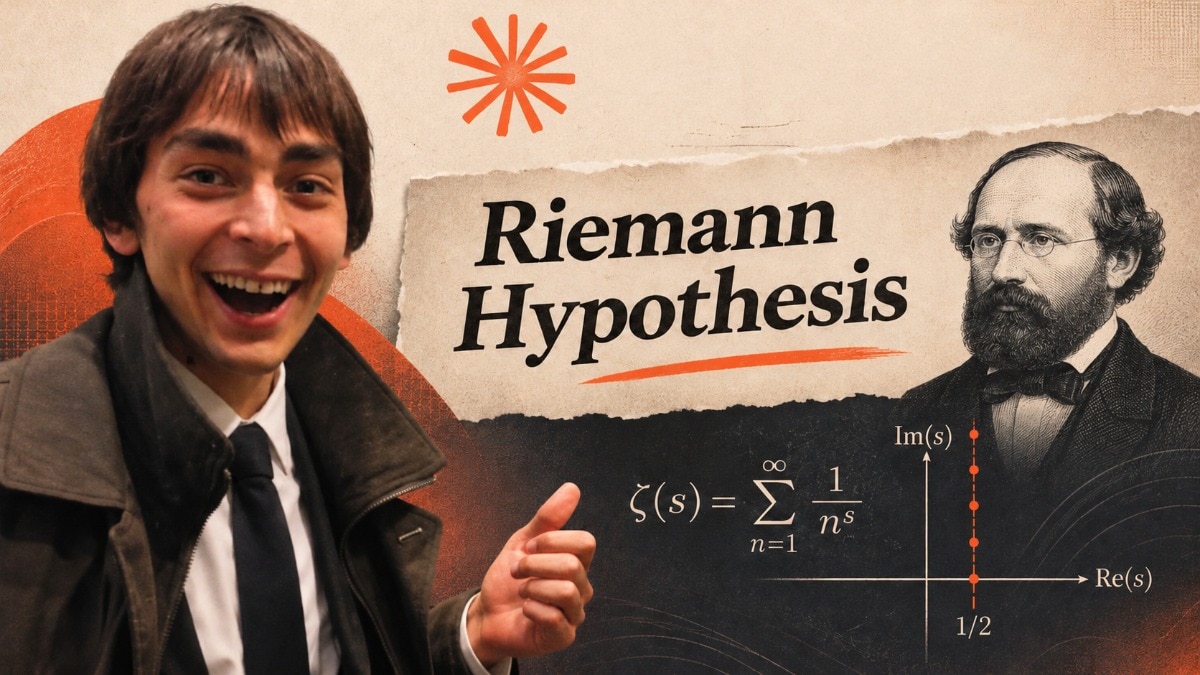
Levent Alpoge is a maths genius who recently claimed to have solved the 167-year-old Riemann Hypothesis with the help of Claude AI. But, like many geniuses, he is not exactly your usual nerd. People close to him reportedly describe him as eccentric, fiercely competitive and anything but someone who backs down from a challenge. A Harvard and Princeton alumnus, he has also won several accolades, including the prestigious Morgan Prize for his undergraduate research on elliptic curves. And right now he is fooling around with AI models under the roof of Anthropic and trying to solve the mysteries of mathematics.And mind you, the Riemann Hypothesis is not the first mathematical problem Alpoge has taken on with AI. Earlier this year, he claimed to have solved the Jacobian conjecture. Rumour has it that Alpoge was also working towards solving the Navier-Stokes problem alongside NYU mathematician Tristan Buckmaster. But just as the pair appeared to be closing in on the problem, OpenAI reportedly got wind of their progress and swooped in, throwing its computing power at the challenge in a bid to get there first – that’s what the rumors say.But anyways, let's get back to our maths genius, Levent Alpoge. Who is he, really? Well, he currently works at Anthropic as a member of technical staff. Now, not much is known about his exact role at the company, but what we do know is that he has found quite an unusual way to put its AI models to work. Alpoge uses multiple AI agents to explore mathematical ideas, run calculations and work through possible solutions. These agents can churn out thousands of pages of results, much of which is difficult for humans to make sense of. And then Alpoge steps in to make sense of it all, working with the AI and other mathematicians to figure out what the results actually mean.The little geniusBut Alpoge's journey with maths began long before he started experimenting with AI. So, let's rewind the clock to Long Island, New York, where Alpoge was born on April 1, 1992, to Turkish immigrant parents. His family realised early on that he was no ordinary child. In fact, he was enrolled in a programme for gifted children at a young age. As he grew older, he also developed an interest in technology. At 17, he worked with Yale University professor Xenophon Papademetris on a project that used Nvidia GPUs to identify blood vessels in medical images. Speaking to Scientific American, Papademetris described Alpoge's enthusiasm as contagious and his confidence in overcoming obstacles as almost frightening.After his early schooling, Alpoge went on to study at Harvard University, where his undergraduate research on elliptic curves won him the prestigious Morgan Prize. He later earned a PhD from Princeton University under Fields Medal-winning mathematician Manjul Bhargava and returned to Harvard for a postdoctoral position. And throughout his academic journey, Alpoge was known for his determination and competitive streak. But it was not all maths and books. He was also a keen athlete, with a love for distance running and football. In fact, he is said to have brought the same energy and competitive spirit to sports as he did to solving difficult maths problems.And this genius is not exactly a media-friendly personality. There are barely any photographs of him online, and he rarely speaks to the media. But seeing his limited online presence, and what people have to say about him, he is quite the character – quirky, mischievous and fiercely competitive. And in 2026, this genius gave the mathematics world quite a shock when he claimed to have solved the Riemann Hypothesis.Working with Anthropic to take on maths’ biggest mysteriesAlpoge joined Anthropic in 2024 as a member of technical staff. While his exact role is not known, he was reportedly not hired specifically to work on maths. His interest in AI grew after he tried OpenAI's GPT-4 in 2023. At Anthropic, he reportedly got access to powerful versions of Claude, including models not yet available to the public, and began using them to tackle difficult maths problems.His first big public claim came in July 2026, when he announced that he had solved the Jacobian conjecture. The claim got people talking, although some mathematicians questioned how he had presented his findings.But Alpoge wasn't done. He continued exploring other problems with Claude, using multiple AI agents to test ideas and run calculations.Solving the 167-year-old Riemann HypothesisAnd Riemann Hypothesis is said to be a particularly personal challenge for Alpoge.Proposed by German mathematician Bernhard Riemann in 1859, Riemann Hypothesis concerns the distribution of prime numbers. In simple terms, it tries to explain a hidden pattern in how prime numbers are spread out. It is one of the seven Millennium Prize Problems, each carrying a $1 million reward for a verified solution.And on November 20, Alpoge uploaded a paper on his website announcing “I believe I have, working with Claude, discovered a proof of the Riemann Hypothesis.”Alpoge says he had been thinking about the Riemann Hypothesis since his student days and had spent years preparing himself with mathematical tools that could help him crack it. And when he finally took it on with Claude, the AI helped him push towards a solution. But it wasn't all the AI. Alpoge says he guided Claude towards the right mathematical approach before it began producing results that amazed him. “Claude flew, and danced, and sparkled near that finish line,” he wrote.Alongside the announcement, Alpoge released around 17 million lines of Lean code. Lean is a programming language that allows mathematical arguments to be formally checked by computers. The Lean FRO and Mathlib Initiative later checked the proof using computer tools and said they were confident that its mathematical steps were correct.Alpoge says the proof was a jokeWhile his announcement sent ripples through the mathematics world, one detail soon went viral on social media. In a footnote, Alpoge had claimed that the written proof ran to more than 250,000 pages. The staggering figure caught people's attention, with many questioning how a proof could be that long. But Alpoge later clarified on X that he was only joking. “250,000+ pages was a joke guys! I find big numbers extremely hilarious,” he wrote.Stupid things I did: 1. 250,000+ pages was a joke guys!, I find big number extremely hilarious. I tried to make it clear by the level of pedantry of the reals total ordered statement in the main theorem, but people ran with it unfortunately and I didn’t feel like talking on social media in the days after the announcement, though I did have a good time with the memes. Sorry!!! (Similarly with our YM4 existence I found it extremely funny that we were slowly working through 60,000 pages of slop, though the committee asking for Lean made me feel dumb about wasting our time with that. But 60,000 funny.) Tao advises to not joke in papers, see also the Big Lebowski reference I shoehorned, I now understand why I didn’t feel comfortable having any slop writeup attached to this problem, and I figured I can’t produce anything readable anyway, so I went off the Lean to lengthmaxx. 2. The Lean is full of garbage obviously, but compiles, but all criticism of such garbage is totally reasonable and accepted, I should have cleaned it up but it was randomly difficult to for various strange reasons. Mea culpa 3. @scottnarmstrong clocked me, indeed even as a student there were theorems that took me the better part of a decade to write up, but with this one I should hopefully be more responsible. (I really was yoloing a lot in there, I bet most is unnecessary in the end, admittedly the lazy thing to do would be to wait because it’ll simplify massively) 4. I forgot to emphasize what I think is the point. Arguments like these, cool, but they are the raw inputs when interpolating definitions. We don’t have the / an “H^1 object” over number fields, and probably for a layperson the fact that we fight hard for these arguments for the purpose of definitions is not clear a priori (that’s at least my philosophy). Just like I knew I must fight for an utterly simple Weil / Deligne, I feel Riemann should be easy, and any real difficulty is an indication our setup is just dumb at the moment.— levent (@__alpoge__) November 23, 2026But while the 250,000-page figure was a joke, the work itself was not. Alpoge has acknowledged that the argument is extremely long and said he still wants to understand it better, simplify it and write it up properly.- Ends
Meet Levent Alpoge, the Anthropic researcher used Claude to solve a 167-year-old math mystery
Full Article
Original Source
Read the full article at Indiatoday →KhanList aggregates and links to publicly available news content. We do not host full articles from third-party sources. Always verify important information with original sources.