
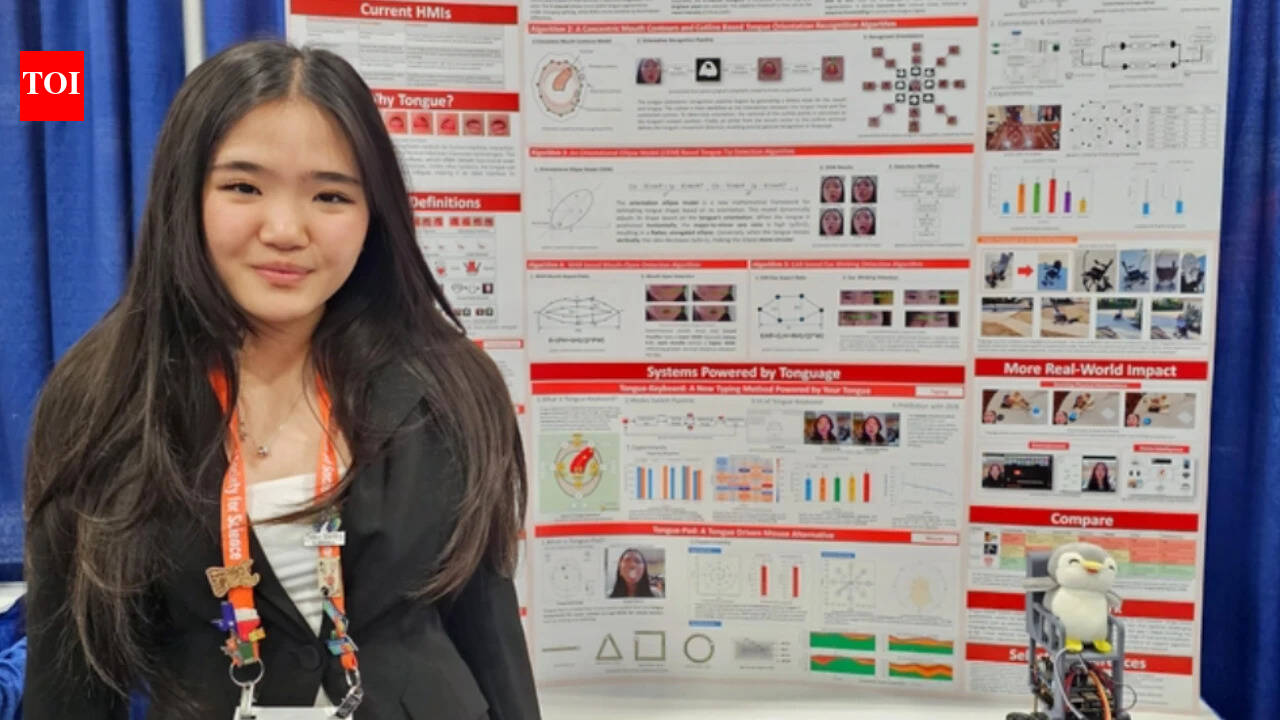
Hollie Tang's technology enables users to navigate devices through tongue movements and eye blinks (Photo: IEEE)A California high school student has won the top $10,000 IEEE Presidents’ Scholarship for 2026 after developing a system that allows people with movement-related disabilities to control computers and other devices using their tongue and eye movements.Hollie Tang, a sophomore at Wilson High School in Hacienda Heights, created Tonguage, a camera-based technology that can be used to operate a computer, control a wheelchair and perform other tasks without using hands. Her project received the award at the Regeneron International Science and Engineering Fair (ISEF), held in Phoenix in May.Tang was among three students recognised for developing technologies that could help people with disabilities or improve access to difficult environments. The awards were presented by 2026 IEEE President Mary Ellen Randall during the science fair.According to Institute of Electrical and Electronics Engineers, Tang wanted to develop a technology that people could use without buying expensive equipment. Her system works with a standard laptop camera and does not require sensors to be implanted in or attached to the body.The project addresses a problem faced by many people with limited physical movement. According to the World Health Organisation, more than one billion people worldwide, or around 16% of the global population, live with some form of disability. For some, using a conventional keyboard, mouse or other control device can be difficult.How Tang's tongue-controlled system work?Tang's invention uses computer vision, a technology that allows computers to interpret information captured by cameras. Her system tracks tongue movements and eye blinks, converting them into instructions that digital devices can understand.One feature is a tongue-based directional control that works like a computer cursor. Users can move their tongue to control direction, while blinking their eyes allows them to make selections, much like clicking a mouse.The technology can identify the tongue's position, direction and movement patterns. It also uses other facial signals to understand what the user wants to do. The project describes this approach as a multimodal human-machine interface, meaning it combines different forms of input to control a device.Tang also included a safety feature that identifies the intended user. If another person enters the camera's view, the system is designed to ignore that person's movements. This is particularly important when the technology is used to control a powered wheelchair, where an incorrect command could affect movement.According to a project overview published on Fairfolio, Tonguage has been developed for several applications, including typing, cursor control, powered wheelchairs and robotic arms. The system uses a common recognition and control framework across these applications.What inspired Tang to create TonguageTang initially planned to create an alternative to a keyboard and mouse. However, while researching the difficulties faced by people with motor disabilities, she realised that the technology could be useful for several other activities.Apart from helping users operate wheelchairs and robotic arms, she wanted the system to support gaming and entertainment.“We’re so focused on trying to give people autonomy over just basic human tasks that we often leave out things like gaming,” she told IEEE Spectrum. “They deserve the freedom to play games and enjoy entertainment as well,” she added.Keeping the technology affordable was another important part of her work. Instead of depending on specialised equipment, she designed it to work with cameras commonly available on laptops.“Mobility conditions don’t discriminate. They can affect anyone of any income, gender, and socioeconomic status,” she said.Tang, who hopes to study biomedical engineering, said visiting a rehabilitation centre helped her better understand the people who could benefit from her invention.“Including empathy in your technological solution is so important. Empathy is hard to teach in a classroom, but it can be learned through experience, and through actually meeting people whose lives your work might change,” she said.Two other students recognised for their inventionsTang received the top scholarship, but two other high school students were also recognised at the fair. Partap Sidhu, a junior at Bethpage High School in New York, secured second place and a $600 scholarship for NeuroGait, a lower-limb exoskeleton controlled by brain signals.His system uses an electroencephalogram (EEG) headset to detect electrical activity associated with intended movement. A convolutional neural network (CNN) interprets these signals and sends instructions to a 3D-printed exoskeleton fitted with pneumatic artificial muscles.According to Sidhu's results from 500 trials, the system achieved 95.2% accuracy in converting brain signals into physical movements. He developed the device for approximately $276.Third place went to Calvin Shang Hung, a sophomore at El Cerrito High School in California, who received $400 for developing a six-legged robot designed to travel across difficult terrain.Inspired by planetary rovers and later by disaster situations, Hung designed the robot to move through unstable areas, including collapsed buildings. Its walking system keeps three legs on the ground while the other three move, helping maintain stability.Tang's $10,000 scholarship will be paid over four years of undergraduate study. All three students also received complimentary IEEE student memberships. The scholarship programme, established by the IEEE Foundation and administered by IEEE Educational Activities, recognises high school students for their work in engineering, computer science and related fields.
Meet Hollie Tang, who built blink-and-tongue computer control, won $10,000
Full Article
Original Source
Read the full article at Timesofindia →KhanList aggregates and links to publicly available news content. We do not host full articles from third-party sources. Always verify important information with original sources.