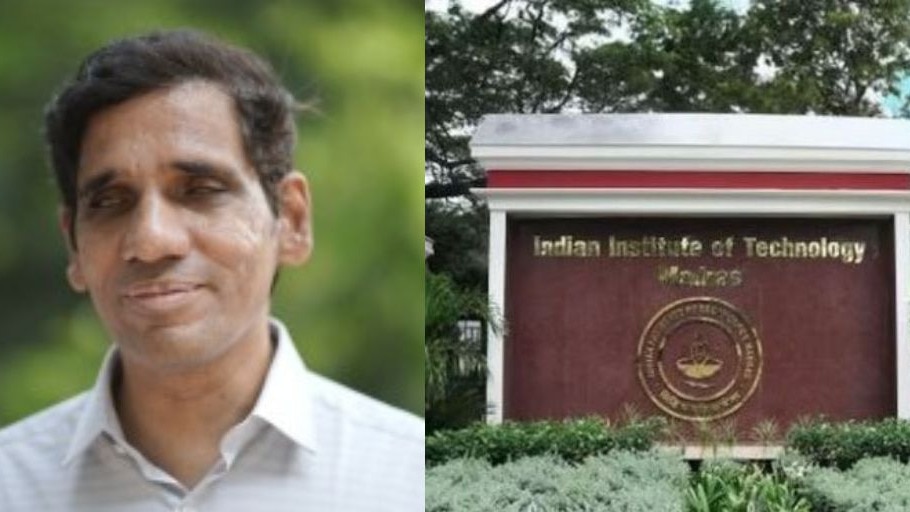
Professor Hemachandran Karah's inspiring journey from a blind school in Chennai to Cambridge and IIT Madras shows how one teacher's belief can transform a child's future. His work in disability studies and accessibility challenges assumptions, proving inclusion means removing barriers, not limiting ambition.His teacher saw potential, not disability. He went on to Cambridge and IIT Madras (LinkedIn/@Hemachandran Karah)What happens when a teacher refuses to let disability define the limits of a child's future? For Professor Hemachandran Karah, one teacher's faith in his potential became the first step in a remarkable journey, from the Little Flower School for the Blind in Chennai to the University of Cambridge, and ultimately to the classrooms of IIT Madras.Today, Karah is an Associate Professor in the Department of Humanities and Social Sciences at IIT Madras, where he works in Disability Studies and accessibility. But his journey is about more than academic milestones. It is about challenging the assumptions that quietly tell people with disabilities what they cannot become.Among the teachers who influenced Karah during his school years, Vincent Sir holds a special place.Instead of allowing visual impairment to define the boundaries of his future, the teacher encouraged him to think bigger, even about studying abroad. That encouragement stayed with Karah as he pursued higher education and eventually earned his PhD from the University of Cambridge in the UK. The lesson was simple but powerful: sometimes, the first barrier a student must overcome is not a physical one, but the belief that a particular dream is beyond their reach.AT IIT MADRAS, HE IS CHALLENGING THE BARRIERS BEYOND THE CLASSROOMKarah's academic work now focuses on Disability Studies, accessibility, aesthetics, literary criticism and audio description. He is a founding member and principal investigator of IIT Madras' Accessibility Research Centre (ARC), and was instrumental in securing CSR funding for the centre.Through ARC, Karah and his colleagues work on practical questions of inclusion, from developing teacher tutorials on disabilities and academic disciplines to examining how museums and other knowledge spaces can become more accessible.For Karah, accessibility is not about lowering expectations for people with disabilities. It is about removing the barriers that prevent them from meeting those expectations.Society often has an unwritten idea of what a disabled person can study, where they can work or what career they can pursue. Karah's work challenges precisely those assumptions.INCLUSION MEANS INDEPENDENCE, NOT ISOLATIONKarah also sees education as a pathway to independence.He has described his role as a teacher as being more of a guide than a parent. Universities, he believes, must do more than help students earn degrees. They must also create spaces where students can participate fully in academic and social life.That perspective is especially important for students with disabilities. True inclusion, he argues, cannot mean placing students on the margins and simply providing separate facilities. It means ensuring that they belong in the centre of university life.Karah's own career is a powerful example of what can happen when opportunity replaces assumption.WHY BLIND PHOTOGRAPHY CHALLENGES THE WAY WE SEE DISABILITYOne of the most distinctive areas of Karah's work is blind photography, an idea that immediately challenges conventional notions of what photography requires.Photography, he points out, does not have to begin and end with sight. It can involve sound, touch, conversation, technology, collaboration and personal interpretation.For visually impaired people, photography can become a creative and therapeutic experience, a way of documenting places, moments and memories. It can also involve sighted collaborators, or "co-creators", who work with visually impaired photographers to produce and narrate images.In doing so, blind photography asks a larger question: who gets to create, interpret and participate in visual culture?FROM RESEARCH TO A WIDER VISION OF ACCESSIBILITYKarah's work extends well beyond the classroom.He co-edits the global section of the Review of Disability Studies and has published peer-reviewed essays in academic journals and books. He has also received an Indian Foundation for the Arts fellowship for a collaborative project on theological accessibility.He was previously involved as a principal investigator in a global Covid-19 and mental-health project organised by Ohio State University and is now working on a companion volume on Disability Studies. He has also taught courses in the field through NPTEL.At the heart of all this work is a belief that knowledge should not be restricted by the assumptions society makes about disability.'THEY HELP ME FINETUNE MY EXPERTISE'For Karah, students are not simply recipients of knowledge; they are an important part of his intellectual journey. Their questions and conversations continually shape his thinking in Disability Studies, aesthetics, literary criticism and audio description.His own journey was shaped by a teacher who encouraged him to look beyond the limitations others had placed on him. From a blind school in Chennai to Cambridge and IIT Madras, Karah's story shows that accessibility should never mean lowering ambition. It should mean creating the support and opportunities needed to pursue it.His journey is ultimately a reminder of what the right teacher can make possible.- EndsPublished By: Apoorva AnandPublished On: Aug 13, 2026 10:11 IST
Meet Hemachandran Karah, who defied disability limits to reach Cambridge, IIT Madras
Full Article
Original Source
Read the full article at Indiatoday →KhanList aggregates and links to publicly available news content. We do not host full articles from third-party sources. Always verify important information with original sources.