
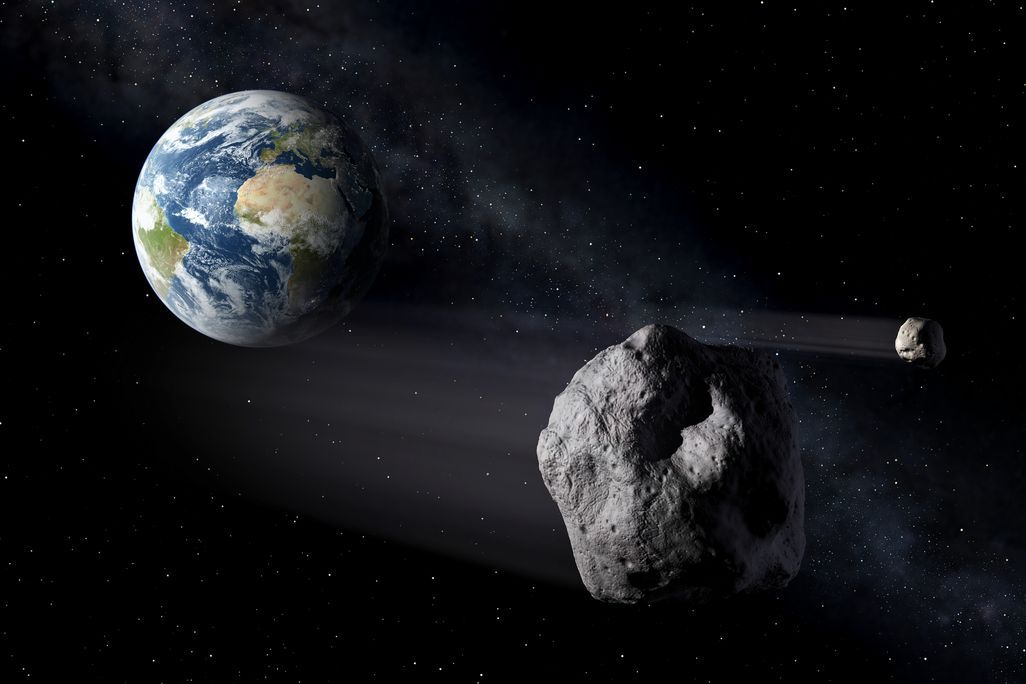
An astronomer first spotted the object in August, but scientists needed several weeks to determine whether it was natural or human-made. Earth’s gravity captured 2026 QQ8 in April, and the space rock will leave us in December or January November 25, 2026 9:00 a.m. An artist's concept of asteroids near Earth ESA / P. Carril under CC BY 3.0 Earth has a new “mini-moon”—at least for another few weeks. The temporary companion, dubbed 2026 QQ8, entered orbit around our planet in April. Though it was first observed back in August by Hungarian astronomer Krisztián Sárneczky, scientists needed time to confirm whether the object was human-made or celestial. People previously mistook the European Space Agency’s Gaia observatory for a mini-moon, after all, according to Asa Stahl at the Planetary Society. Finally, on October 29, the International Astronomical Union’s Minor Planet Center announced that the object is, indeed, a space rock. It’ll keep circling Earth until sometime in December or January, after which it will continue its regular orbit around the sun. According to the Minor Planet Center, the object is only about six feet in diameter. Astronomers doubt it poses any danger to Earth, but even if it did get too close, it’s so small that it would probably burn up in our planet’s atmosphere. It’s also orbiting us from fairly far away—roughly 1.5 times the average distance of the moon, Joanna Thompson reports for Live Science. This tiny traveler isn’t our first mini-moon, which is an informal term. When little objects pass by Earth, they occasionally get captured by our planet’s gravity. They spend less than a year, on average, orbiting us before being flung back into space. Many scientists speculate that we always have at least one mini-moon. A study published last year even suggests Earth hosts at least six of them at any given time. Despite those postulations, only four other mini-moons have previously been observed, since they’re so small and hard to detect, per the Planetary Society. Sárneczky, a research coordinator at the Konkoly Observatory in Hungary, says he spotted 2026 QQ8 while “searching for near-Earth asteroids, as I have done on every clear night since 2020.” “At the time of its discovery, it appeared just like the nearly 400 other near-Earth asteroids I had found,” he tells Jacopo Prisco at CNN. “Its unique nature only became apparent later, following the precise orbital calculations.” That triggered a weeks-long study by astronomers trying to determine the object’s nature, per the outlet. With the help of the Lowell Discovery Telescope in Arizona and the University of Hawaii’s telescope on Mauna Kea, they confirmed it was born in space. Fun fact: Quasi-moons These objects are asteroids that, from a certain point of view, appear to behave like a moon of Earth, according to the Planetary Society. However, they’re actually orbiting the sun—their orbital paths are just very similar to our planet’s. According to Live Science, the current mini-moon is classified as an Aten asteroid, a type of space rock whose orbit around the sun occasionally brings it close to Earth. 2026 QQ8 cozies up with our planet around once every ten years. Although this object’s exact origins are unclear, scientists believe most near-Earth asteroids originate in the main asteroid belt, between Mars and Jupiter. With new telescopes scanning the heavens, scientists expect many more mini-moons to be discovered. For instance, the Vera C. Rubin Observatory in Chile started its decade-long Legacy Survey of Space and Time (LSST) over the summer, and the telescope has already detected thousands of new asteroids as it watches the Southern Hemisphere sky. “When the LSST survey starts operating fully, it’s expected to discover lots and lots of things,” says Matthew Payne, director of the Minor Planet Center and an astrophysicist at the Center for Astrophysics, Harvard & Smithsonian, to CNN. “The expectation is that we’ll go from knowing 1.5 million objects to knowing 5 million.” You Might Also Like Get the latest stories in your inbox every weekday. More about: Asteroids Astronomy Center for Astrophysics, Harvard and Smithsonian Moon Outer Space Smithsonian Smithsonian Affiliations telescope
Meet Earth's New 'Mini-Moon' 2026 QQ8, a Six-Foot-Wide Asteroid That's Temporarily Circling Our Planet
Full Article
Original Source
Read the full article at Smithsonianmag →KhanList aggregates and links to publicly available news content. We do not host full articles from third-party sources. Always verify important information with original sources.