
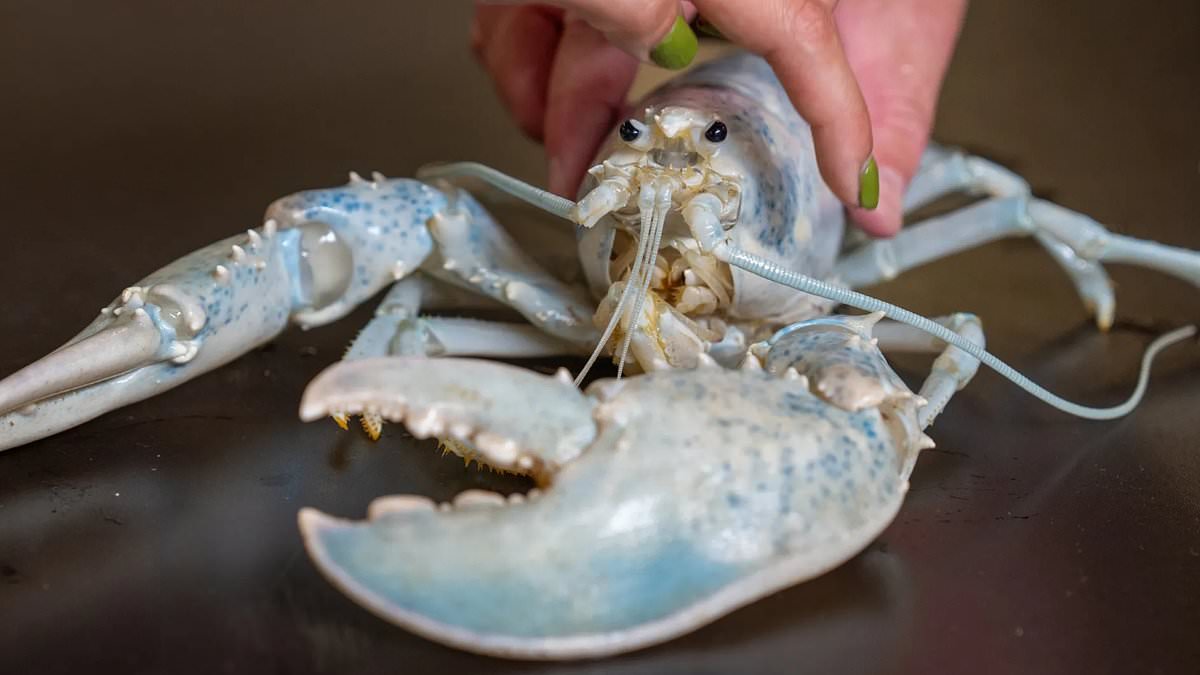
Published: 06:57 EDT, 28 September 2026 | Updated: 06:58 EDT, 28 September 2026 A 'ghost lobster' has made an appearance just in time for spooky season. The crustacean, named Casper, is startlingly white, with pale blue dots scattered across its hard shell.Its unusual colouring is because it lacks the pigment–producing proteins that give other lobsters their mottled brown colour.And the specimen is so rare that scientists estimate the chances of finding one are just one–in–100–million – the same odds as winning the lottery several times.Casper, who now lives at the University of New England (UNE) after being donated by the Maine State Aquarium, will play a key role in a project decoding the genetics of lobster colour. 'Animals like Casper capture people's attention because they are so rare and beautiful,' Markus Frederich, professor of marine sciences at UNE, said.'But, for us, they also provide an amazing opportunity to ask fundamental biological questions.' Casper lacks the pigment–producing proteins which give other lobsters their mottled brown colour The animal is so rare that scientists estimate the chances of finding one are just one–in–100–millionScientists at UNE have been researching the genetic causes of rare lobster colouration for several years.Casper will join a lobster collection that has included unusual orange, blue, yellow, purple, calico and split–coloured crustaceans.Researchers are working to uncover the molecular mechanisms that cause some lobsters to develop dramatically different shell colours from the species' typical brown appearance.Most American lobsters are a muddy brown colour to help them blend in with the murky depths of the ocean.However, rare genetic defects can result in more colourful crustaceans. These mutations cause the lobsters to produce too much or too little of certain pigments.Blue lobsters, which occur at a rate of one–in–two–million, have a defect causing overproduction of crustacyanin.One–in–30–million orange lobsters only show the carotenoid pigment, which is bright red, meaning they appear to already be boiled.At one–in–100–million, albino lobsters are the rarest. They are born completely white and don't even turn red when you cook them.The 'ghost lobster' is startlingly white, with pale blue dots scattered across its hard shell. These animals are also referred to as albino lobsters Other unusual lobster colours include orange, blue, yellow, purple, calico and split–coloured (pictured) Rare genetic defects can result in more colourful crustaceans. These mutations cause the lobsters to produce too much or too little of a certain pigments. Pictured: A 'cotton candy' lobster UNE's first–of–its–kind research programme uses non–invasive methods to collect and analyse genetic material without harming the lobsters.Casper will similarly be studied without injury.The project launched in 2024 after several rare–coloured lobsters arrived at the university, including Peaches, an orange lobster estimated to occur in just one in 30 million animals.Peaches later produced offspring ranging in colour from typical brown to orange and blue, giving UNE researchers an unusual opportunity to study how rare coloration may be inherited.Researchers subsequently collected genetic samples from Peaches' juvenile lobsters and are analysing more than 15,000 genes as they work to identify differences associated with shell colour.Casper's arrival now gives the research team an opportunity to examine the rarest coloration represented in the study to date.
Meet Casper, the one-in-100 million 'ghost' lobster! Incredibly rare crustacean is bright white thanks to rare genetic mutation
Full Article
Original Source
Read the full article at Dailymail →KhanList aggregates and links to publicly available news content. We do not host full articles from third-party sources. Always verify important information with original sources.