
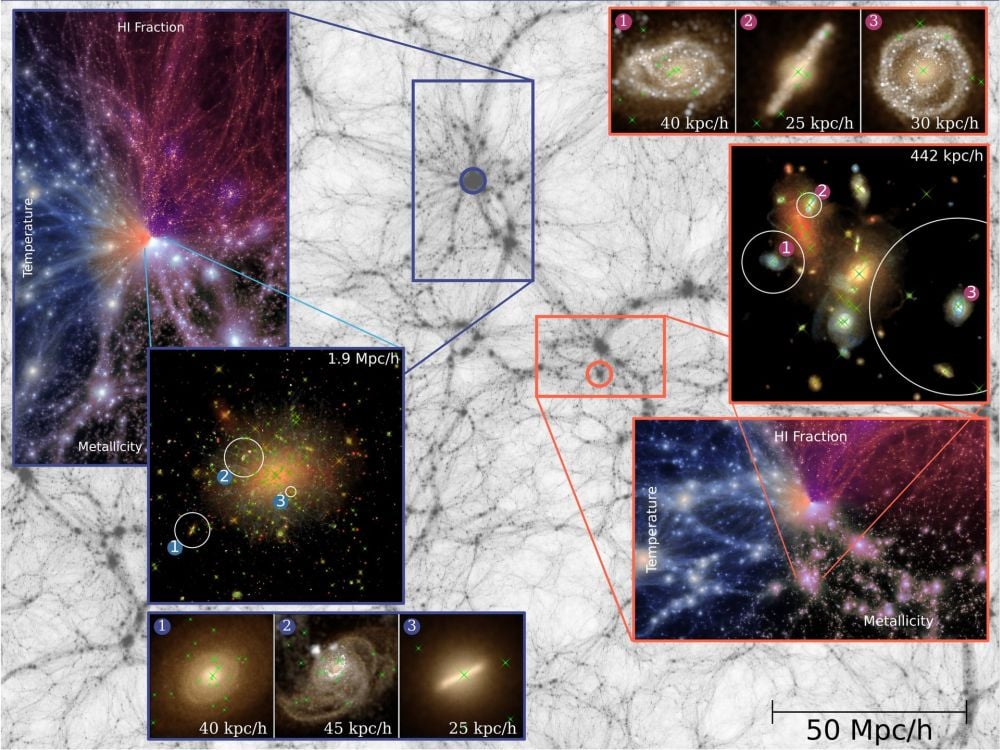
The JWST examined ancient light from the Universe's first galaxies and black holes and uncovered some puzzles. Galaxies and SMBH from the Universe's early days were much more fully-formed than cosmologists thought they might be. Finding an explanation for these observations requires more than further observations. This is where simulations come in. Cosmologists use massive simulations run on the world's fastest supercomputers to tackle these challenges. The ASTRID simulation is one of them, and it's been pushed to its limits. In new results, ASTRID has run simulations from the Universe's earliest days up until the present. The results are in a new paper published in The Astrophysical Journal titled "The ASTRID Simulation at z = 0: From Massive Black Holes to Large-scale Structure." The lead author is Yihao Zhou, a PhD student in Carnegie Mellon University's (CMU) Department of Physics. "We present the z = 0 results for the cosmological simulation ASTRID," the authors write. "Hosting 2 × 55003 ≈ 0.33 trillion particles in a box of 370 Mpc per side, ASTRID is one of the largest cosmological hydrodynamic simulations evolved to z = 0." z is a measure of the redshift of light. As the Universe expands, light sources like galaxies move further from us, and the light is more strongly stretched or redshifted. In terms of z, the Big Bang has a z of infinity, since it's a singularity. The highest redshift we can observe is z ~ 1090, which marks the Epoch of Recombination and the appearance of the cosmic microwave backround (CMB). This is when light, or photons, could travel freely through the cosmos. Prior to that, the Universe was opaque. So when the authors say ASTRID ran to z = 0, that's the present day. "Large-scale cosmological simulations are continually pushing computational frontiers to understand galaxy formation in a cosmological context," the authors write. They mention simulations like IllustrisTNG, Eagle, and MassiveBlack-II. ASTRID isn't the largest of its type of simulations. MillenniumTNG's flagship simulation covers about 740 Mpc per side compared to ASTRID's 370 Mpc per side. That's about eight times more volume. But ASTRID is larger than other simulations like TNG300, and is also powerful in another way: It has a much higher particle count than others, giving it greater resolution. ASTRID also contains a significant population of black holes. "ASTRID features a large population of massive black holes (MBHs), covering a wide mass range 4 × 10⁴ ∼ 2 × 10¹¹ M⊙," the authors write. Now, ASTRID's results are available to the research community. “The most important information about our recent study is that we’ve evolved the ASTRID simulation to z = 0, and that this data is available,” lead author Zhou said in a press release. Zhou and his collaborators started their simulation at z = 99, beginning at the Universe's Cosmic Dawn. This illustration shows ASTRID's simulation at z=0.5. The background shows the cosmic web of size 250 Mpc/h. The orange inset zooms into a massive cluster region, illustrating the gas density field colored by temperature. Red and yellow spikes mark massive black holes larger than 100 million solar masses. That threshold is important in cosmology. BH more massive than that are good tracers of large-scale structure. Yellow indicates BHs in high-accretion quasar mode, usually found in star-forming galaxies, while red indicates BHs in low-accretion jet mode, usually found in quiescent galaxies. The yellow and red insets show examples of the host galaxies. Credit: Zhou et al. 2026/astrid.psc.edu “We have this very large simulation and piece of the universe, which captures the growth of black holes from the time at which they were formed all the way to today, as well as the galaxies that form, also from a very early time,” said study co-author Tiziana Di Matteo. Di Matteo is the ASTRID principal investigator, and professor of physics and director of CMU’s McWilliams Center for Cosmology & Astrophysics. So how will this large, high-resolution simulation address our questions about the Universe, especially the early Universe as revealed by the JWST, with its surprisingly massive black holes? “We can look into the questions posed by JWST data using this very large volume of ASTRID simulations, with quite amazing resolution and physical realism, that allows us to make predictions and understand some of the current puzzles that are coming through,” Di Matteo said. “We care about black hole mergers because even if we don't see the light or the accretion, we now have detectors that can see an event such as black hole mergers,” Di Matteo explained. “The Laser Interferometer Space Antenna (LISA), which will be launched in 2035, will find most of the massive black hole mergers in the early Universe.” Every cosmological simulation has strengths and weaknesses. One of ASTRID's strengths is dynamical friction models. The bring greater resolution to understanding how black holes slowly sink into galactic center, and when mergers occur. “Our simulations have realistic black hole merger orbits, and a better estimation of the black hole merger timescales,” Di Matteo added. This is where ASTRID dovetails nicely with gravitational waves (GW). GW are like little ripples in spacetime, created when two massive objects like black holes merge. Einstein predicted GWs a century ago, but they were first observed only a decade ago. GW observations are important to understand the growth of black holes through mergers over cosmic time. ASTRID can help in the study of GWs by showing the best places to look for them with future GW observatories like LISA. “With ASTRID, we make predictions for which environments would host gravitational wave sources that are most likely to be detected. In the future, people can use our predictions to discover gravitational sources,” Zhou explained. “For the first time, ASTRID allows us to capture this piece of the process where galaxies merge,” Di Matteo said. ASTRID simulates black holes at the center of merging galaxies, which approach each other and spiral toward one another. “Eventually they merge, and they produce this gravitational wave signal that we can produce in the simulation, as if we are already, observing a gravitational wave signal." "ASTRID includes MBHs in a mass range spanning nearly 7 orders of magnitude, and records over 3 million MBH mergers, encompassing the GW sources targeted by LISA and PTA (Pulsar Timing Array) experiments," the researchers write in their paper. “Massive black holes are the key to the structure of the universe, and I would say the most interesting part of our universe,” Zhou said. Astrophysicists are interested in black hole seeds, objects that grew into SMBH over time. The JWST's Little Red Dots are candidate black hole seeds. This figure shows a slice from ASTRID at z=5. It also shows false-colour Little Red Dots (LRD) from Astrid. The LRDs are another puzzling finding from the JWST, and may be the seeds of supermassive black holes. Image Credit: Zhou et al. 2026. ApJ “Our biggest question is about how, or what physical processes formed the ‘seeds’ of the early universe black holes,” Di Matteo said. “The simulations allow us to experiment with the seed models and look at the consequences that reveal the physical mechanisms that give way to predictions, something that the current generation and next generation telescopes or gravitational wave detectors can observe.” Black holes are known as singularities with massive appetites that can't be sated. But they're not one-way objects. Their powerful feedback has a profound effect on the galaxies they reside in. Their radiation and powerful jets, which can extend for millions of light-years, affect star formation and shape the characteristics of their host galaxies. So understanding their mergers are vital to understanding the cosmos. ASTRID zooms in from the large-scale structure of the Universe down to SMBH in galaxies and their mergers. It's high-resolution lets it model processes in greater detail than other cosmological simulations. Image Credit: astrid.psc.edu In their paper, the authors explain that ASTRID "... provides an improved description of MBH dynamics than earlier large simulations, and provides realistic MBH velocities and trajectories, improving the predictions for merger environments and event rates." Supercomputer simulations like ASTRID take what we know about the Universe and let researchers watch as processes play out. If a simulation produces what we see around us today, it's an indication that we're on the right track to understand the cosmos. "We can’t replay the universe to study the deep past, and we’re limited in observing distant galaxies very directly because we don't yet have very good resolution," Zhou concludes. "With supercomputers, we can build the numerical universe that follows the gravity and evolution of stars and massive black holes over the entire cosmic time. Supercomputers help us to bridge our theory to real observations.”
Meet ASTRID, the New High-Resolution Cosmological Simulation
Full Article
Original Source
Read the full article at Universetoday →KhanList aggregates and links to publicly available news content. We do not host full articles from third-party sources. Always verify important information with original sources.