
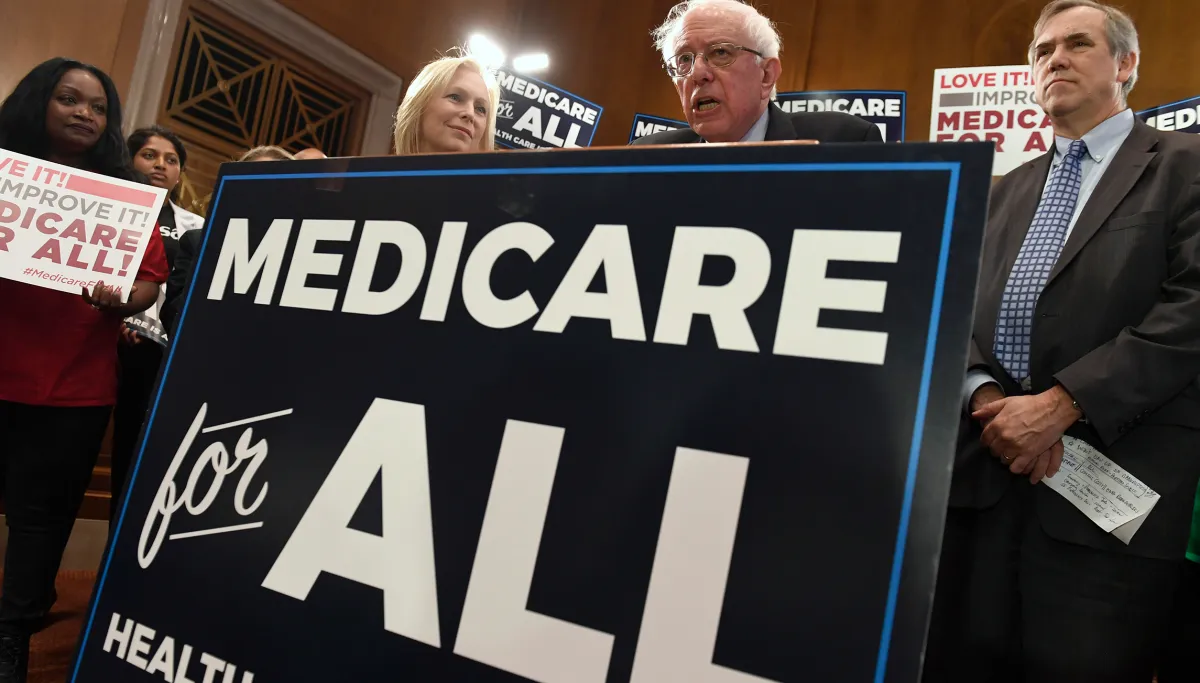
House Minority Leader Hakeem Jeffries (D-NY) may have refused to commit to bringing Medicare for All to a vote and distanced himself from his own past support of socializing the entire healthcare sector of the economy, but candidates winning Democratic Party primaries across the country are not as shy.Over the past two weeks alone, Abdul el Sayed in Michigan, Peggy Flanagan in Minnesota, Troy Jackson in Maine, and Angie Nixon in Florida have all emerged as Democratic Senate nominees who have made Medicare for All a central part of their campaigns.At a time when the national debt has surpassed $40 trillion and affordability tops voters’ concerns, it is worth reviewing what Medicare for All actually entails — and what it would mean for federal spending and the quality of American healthcare. Medicare for All is not simply a proposal to let more people buy into Medicare. The current Senate bill, sponsored by Sen. Bernie Sanders (I-VT), would create a federal health plan covering every American, eliminate premiums and cost-sharing, and make it unlawful for existing private and employer plans to exist. Medicare, Medicaid, and the Obamacare exchanges would largely be folded into the new system.The price tag would be enormous. A 2024 Center for Health and Economy analysis estimated that Kamala Harris’s version of Medicare for All would increase federal spending by $43.9 trillion from 2026 through 2035, while CBO has separately found that similar single-payer systems would dramatically shift health spending onto the federal budget. Meanwhile, the existing Medicare program is projected to exhaust its Hospital Insurance Trust Fund reserves in 2033.Supporters answer that Americans would no longer pay private premiums. True, but replacing premiums with taxes does not make healthcare free. The federal government would become responsible for financing the entire system.That is an important caveat to polling. Reuters polling found this month that 60% of independents support “government-provided healthcare.” But that wording does not tell voters what Sanders’s proposal means. Under Medicare for All, Americans could not simply keep their employer plan if they preferred it. Duplicative private insurance would be illegal. Washington would not merely compete with private insurance; it would replace it.Once government becomes the healthcare monopolist, controlling spending means controlling what providers are paid and, ultimately, how much care is supplied. CBO has found that lower provider payments are the principal source of single-payer savings and warns that increased demand would exceed increased supply, producing “delays and forgone care.”Britain and Canada show what that reality looks like. England’s National Health Service had over 7 million cases awaiting elective treatment in June, with more than a third waiting longer than 18 weeks and more than 105,000 waiting over a year.Canada fares little better. In an international survey, 58% of Canadians needing elective surgery waited at least two months, compared with 26% of Americans. Those who can afford to escape sometimes do: One study estimates more than 105,000 Canadians traveled abroad for nonemergency medical care in 2025.Americans do not need to speculate about whether politicians will accept the taxes needed to build such a system. Vermont already tried. Back in 2014, Democratic Gov. Peter Shumlin abandoned Green Mountain Care after his administration concluded that financing it would require an 11.5% payroll tax and an income-based charge of up to 9.5%, warning that the “risk of economic shock” was too high.California has reached the same conclusion in practice. Democrats have controlled the governor’s mansion since 2011 and have had supermajorities in both legislative chambers since 2018, yet they have failed to advance single-payer healthcare even to a floor vote.If Medicare for All is such an obvious bargain, reducing costs while preserving quality without taxing the middle class, then why have Sanders’s Vermont and Rep. Ro Khanna’s (D-CA) California refused to enact it?CALIFORNIA’S WEALTH TAX IS ALREADY FAILINGThe reason is simple: Once Medicare for All stops being an empty promise and becomes a real plan with higher spending, lower provider pay, higher taxes, and rationed care, support for it, even in overwhelmingly Democratic states, collapses.Self-identified socialist Democratic candidates are putting Medicare for All back on the ballot. Republicans should make sure voters understand that this means trillions in new federal spending, sweeping new taxes, the elimination of existing private coverage, and a government monopoly with the power to ration care. Democrats running this fall should answer for it.
Medicare for All is back on the ballot
Full Article
Original Source
Read the full article at Washingtonexaminer →KhanList aggregates and links to publicly available news content. We do not host full articles from third-party sources. Always verify important information with original sources.