
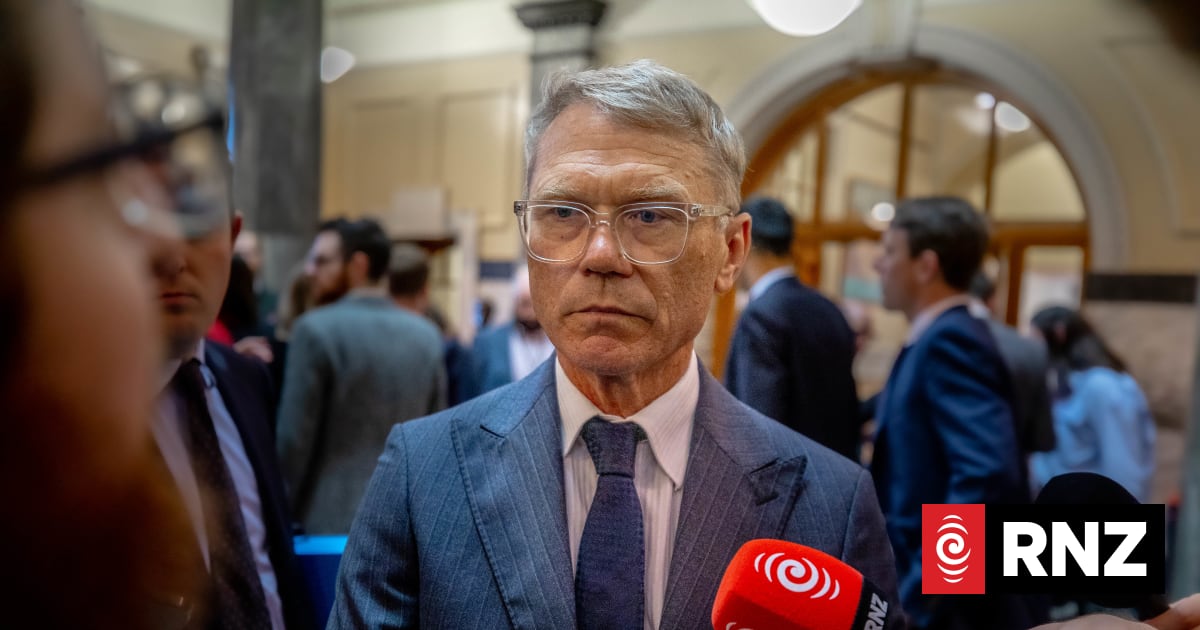
Media Minister Paul Goldsmith has ruled out coming to RNZ's financial aid, describing the broadcaster's budget blowout as "pretty shocking"."They obviously haven't been paying attention properly to their money," he said."It's their problem. They broke it. They need to fix it."The public broadcaster on Monday revealed an $11.8m loss, more than 25 times the $470,000 RNZ had expected to lose over the year to June.CEO Paul Thompson, who is departing at the end of the year, took responsibility for the result.He said internal reports gave an inaccurate picture of the finances, meaning the scale of the loss only became clear in October.Nick MonroRNZ's former chief financial officer Hilary Parker resigned unexpectedly in early October. The board said it would commission an independent review into what went wrong.Asked whether anyone in management or on the board should go, Goldsmith said he had confidence in the new chair Brent Impey and pointed to Chief Executive Paul Thompson's planned departure.He said existing board members who had been there for the past few years, including those on the audit committee, would be in a "pretty difficult position", but that was a matter for the next government.Goldsmith said RNZ had made "some basic mistakes" in accounting and appeared to have done too little to reduce staff numbers.He said his "strong impression" was that RNZ had simply carried on as usual despite a reduction in its funding."Maybe they were just hoping that something would come up. Well, it didn't."Associate Finance Minister David Seymour is also a shareholding Minister of RNZ.RNZ/Nick MonroAsked whether he thought management had been banking on a change of government, he said, "I wouldn't read that too much into it. No, I think this is just a colossal mistake."Speaking to Morning Report on Tuesday morning, Associate Finance Minister David Seymour said the deficit was a shock.Seymour - who is also a shareholding Minister of RNZ - said it seems there's been an "illusion of calm" maintained by poor financial reporting.He said the victims of this deception are taxpayers, RNZ employees and audience."That is very sad for many people who work in the organisation," he said."A lot of good people work there, and they're being shielded from a reality and then abruptly exposed to it."He acknowledges it was a strange situation given there is a caretaker government in place, and the Broadcasting Minister was not returning to Parliament.Seymour said that businesses must work within the revenue they're able to earn, which requires managing costs sustainably, "that simply hasn't been done."He said normally the resolution in this case would be that "people need to go." But the Chief Financial Officer's departure was what initially revealed the problem, he said, the CEO's already announced his departure and the Chair has recently been replaced."So, all of the things that a government would look to do in a circumstance like this, are already happening."Checkpoint's Lisa Owen spoke to RNZ CEO Paul Thompson as he arrived at the Auckland building on Tuesday morning and asked how he could not have known that the company was in such financial trouble."We were relying on incorrect information and I don't really have much more to say," Thompson said."I've taken responsibility which I know I need to do as chief executive. I've got a job to do to move the organisation forward and ... [RNZ board chair Brent Impey] gave you those interviews yesterday."Owen asked if Thompson would leave the organisation now, given jobs would be lost."Look Lisa, the situation around the jobs is about our underlying funding position. It has gone down by ... $6 million a year. We thought we were addressing that. We weren't. So the changes to the jobs at RNZ are about adjusting to our funding that's been set by the government."Asked whether the CEO should leave earlier, Seymour acknowledged he'd been a critic of Thompson for a long time, "if the board was to make a decision, they certainly should."But he pointed to the current caretaker government as a complicating factor as well. He said with Paul Goldsmith - the Broadcasting Minister - not returning to Parliament, other ministers may have to take a role in it over the next few days and weeks."Suffice it to say that we do find ourselves in a strange sort of interregnum where, nonetheless, these matters must be dealt with to the extent they can be by a caretaker government and then properly by a newly installed government."Seymour wouldn't rule out the ACT seeking ministerial oversight of public broadcasters in a new government it was part of.He wouldn't specify if RNZ needed to make more cuts because making a judgement on what the appropriate level of funding was required an understanding of what services will be available for that level of funding."As it turns out, there was a loose joint in the steering mechanism of accounting that has prevented us from knowing that. So, I think without having the information required, because it has been so spectacularly mis-provided, it would be difficult to answer that question at the moment."Seymour acknowledged RNZ was a Crown entity that had emergency broadcasting requirements and its own content production, and was largely funded by New Zealand on Air for that reason."But I generally take a sceptical view about the role of government as an owner and management of commercial enterprises, and not to be churlish, but I think this episode we're discussing this morning is a very good reminder to anybody who thinks that government or public sector management is always good or better. This is the kind of thing that can and does happen when people are largely spending other people's money."Job cuts 'detrimental to the service'E tū director Amy Hansen agreed with Seymour that there had been victims but said the situation was part of a much bigger issue around investment in the media industry.RNZ / Nate McKinnon"This is where I disagree with Seymour... the funding that has gone into such an important public infrastructure like broadcasting, it's been underinvested in years."While there has been mismanagement, it has also been not enough money in the first place to be able to deliver the great work that you do."She told Morning Report the news had come as a " shock and disappointment"."I think walking into the studio this morning, it has been a sombre environment to walk into."She said there had been little opportunity for employees to process what was happening.She said of the 58 jobs that need to be cut, 18 had already gone through the voluntary redundancy process.Hansen pointed out that through a busy election time, the workforce had already been running short."People have been working really, really hard with less, and so to hear that further cuts are on the way, it's just going to be detrimental to the service."She said it was too soon to be making decisions around staffing with the country still under a caretaker government and former broadcasting minister Paul Goldsmith yet to be replaced.Hansen urged a slowing down in immediate decision-making until a new broadcasting minister was in place."There needs to be a proposal made, a consultation process where the workers get time to digest the news and they get time to ask questions."
Media Minister rules out coming to RNZ's aid after budget blowout: 'A colossal mistake'
Full Article
Original Source
Read the full article at Rnz →KhanList aggregates and links to publicly available news content. We do not host full articles from third-party sources. Always verify important information with original sources.