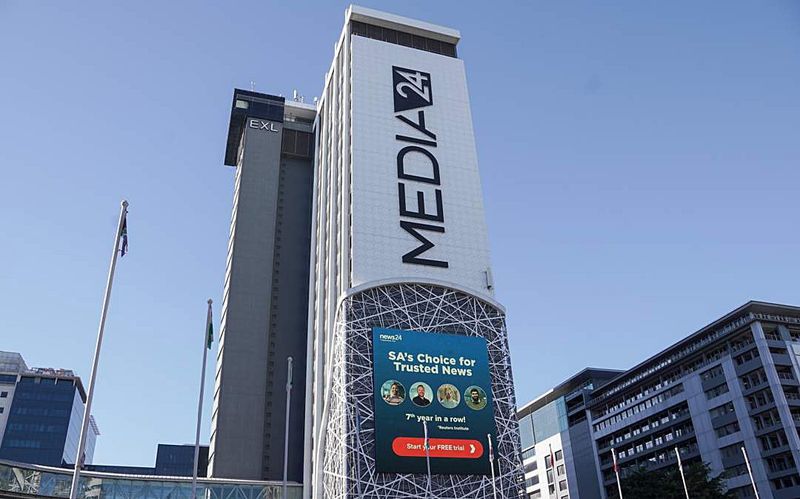
On Friday, 31 July, Media24 staff began consultations on what the company calls “a new editorial operating model for its newsrooms”. The language was careful: a “highly sensitive process”, handled with “compassion” and “within the law”.Anyone who has worked in a South African newsroom knows that consultation is really a euphemism for retrenchments. The temptation is to read this as a Media24 story. It is another blinding data point on the status of a broken and failed market and it should alarm anyone who believes democracy needs journalism.In their latest annual accounts, Media24’s adjusted Ebitda loss widened by 60% to $16-million (about R263-million). Revenue fell 28% to $102-million, and just three years earlier that figure was $207-million. When a market leader is haemorrhaging like this, it is impossible to deny the market failure argument.The longest cutConsider what has already been cut away. Between 2018 and 2023, Media24 stopped the presses at Volksblad and Die Burger Oos-Kaap, put its Auckland Park offices up for sale and thinned the newsrooms it kept. Die Son went from 27 journalists to seven and Daily Sun from 72 to 14.But the scalpels weren’t done yet. Since then, Media24 has sold M24 Logistics and On the Dot (print distribution), its community newspapers and its sports titles including Soccer Laduma and Kick Off. They closed the print editions of titles including Beeld and Rapport, and shut City Press entirely. These disposals caused headcount to shrink 40% from 1,967 in 2024 to 1,194 in 2026 – after Covid had already claimed a swathe of jobs, when more than 3,300 people were employed by the group.As far as pivots go, and “on paper”, this might look like a digital transformation success story. News24, Netwerk24 and Landbou.com held 221,872 paying subscribers at end-March 2026, up more than 4% on the year. Strong digital brands with real subscription revenue and a parent company with deeper pockets than any other owner in African media. These are ingredients many media execs dream of. But the losses widened anyway.If the best-resourced news operator on the continent, having done everything the turnaround manual prescribes, still cannot make the sums work, what exactly is the next restructuring supposed to achieve? You cannot cut your way out of a market that no longer economically supports the thing you make. The manual assumes a functioning market, as do all media critics. This is not a business model problem, rather a market context disaster. The environment in which we operate is inhospitable to the creation of public interest journalism. The tellThe Competition Commission found in the final report of its Media and Digital Platforms Market Inquiry, published in November 2025, that “even where news media has innovated and changed the business model to adapt to the new online environment, they still face financial losses (e.g. News24) or need to cut costs and staff to prevent losses (e.g. Daily Maverick)”. At the time, Daily Maverick had announced its own retrenchment and downsizing plan. The commission heard that News24 and Netwerk24 led the subscription market with more than 200,000 subscribers, while “many who do subscribe to News24, do so at heavily discounted rates”.Media24 had already told the inquiry in its January 2024 submission that News24’s subscriber base was 35% up, year on year, to 85,185. “However, this did not translate in commensurate growth in advertising revenue, which declined over this period.” Technology costs on its digital-only brands more than doubled between 2018 and FY2023, and “these costs alone are not nearly recouped by the revenue levels generated through subscriptions and advertising”. The same submission estimates publishers’ total share of South Africa’s R14.5-billion digital advertising spend at about 4%, with the overwhelming majority going to paid search and social. And as even more media consumption migrates to video, publishers are scrambling to once again pivot to a format with even more challenging monetisation options for the producers of original journalism. Despite publishing many hundreds of videos to YouTube in 2023, Media24 submitted their stated revenue share was only worth about R60,000 a month. That is the entire platform income of South Africa’s largest digital news publisher.Subscriptions, even executed brilliantly, are not filling the advertising-shaped hole that once sustained the sector. In Daily Maverick’s own submission to that inquiry we put a market price on the gap: at open-exchange advertising rates, a #GuptaLeaks story averaging 50,000 page views was worth about R1,500 using open market advertising rates. A fraction of what it cost to produce, and a rounding error against the value it created for society. And that is how we can begin to define the problem statement, which is one of value transfer, not value creation as critics will claim. Ultimately, journalism is a public good but it’s not funded like other public goods. What market failure actually meansA market fails when it cannot sustain something valuable society needs at necessary levels of output. This is different from, say, creative destruction, when one industry is replaced by a new, more useful one. The famous business school example is Kodak, once the camera film colossus of the world. While critics may point out that journalism is experiencing its own version of the declining Kodak moment, their argument falls flat when we showcase the South African examples of what public interest journalism helped achieve in the State Capture years and beyond where high-profile firings and arrests also led to billions in criminal asset recoveries and fines. The free market is notoriously poor at creating enough public goods. There is a reason governments pick up the tab for defence, clean air and water, roads and street lighting. Journalism, the public interest kind, sits squarely in that category. Whether you use it or not, society still benefits when an investigation leads to a corrupt tender being cancelled or a minister being replaced. For a century the vulnerability was masked by an accident of bundling. Advertisers never paid for journalism; they rented the audience gathered around it. Big tech platforms now rent the audience directly, minus the journalism, and the accident has been unbundled.Paywalls are the symptom, not the cureIf this was any other industry, a paywall would be the obvious and rational response to a failed market. There are few other options to try to sustain oneself, alongside philanthropy and grants which are barely a trickle compared with the information needs of a country this large and largely plagued by corruption. But there is a societal cost that comes with this approach, and we’re seeing it play out, not just in developing nations.While mis- and disinformation circulates free on the platforms and in turn get sourced into AI-generated answers, we are left with a society that gets the propaganda for free and the professional journalism on subscription.Since October 2023, 70% of News24’s content sits behind the paywall; Netwerk24 launched fully paid-for in 2014, with 80% of its content locked. The wall is high, well built and professionally run and yet the losses continue to escalate. Daily Maverick refuses to erect a paywall because a country this unequal cannot afford an information class system. Journalism behind a paywall is not a public good by definition, even though it may still generate societal value once others pick it up and extend it on to other platforms. We need a system that makes it more viable to make more journalism freely accessible to the public, and books more accessible to readers.Naspers says it will keep investing in Media24’s tech strategy: content personalisation and an AI contextual-advertising tool. Decent tools, probably. But unlikely to be anything more than a plaster on a market-sized bullet wound. Adam Smith listed the exceptions to the invisible hand theory in the The Wealth of Nations; public goods were on the list. Information-based goods also fare poorly at the hands of the market, so as an information-based public good we are doubly screwed. Fix the market, not just the newsroomOnly a policy intervention can fix a failed market. The commission’s final report already imposes binding remedies, including monetary compensation from Google, with eligibility gated on Press Council membership. (Inexplicably, Meta was let off the hook, a decision that is being appealed by industry players). For the past four years the Government Communication and Information System has been working on a revitalisation framework with industry members, including Daily Maverick. Proposals include tax credits, zero-rated VAT on reader contributions, investor allowances, advertising rebates and a host of other necessary interventions and incentives. Earlier this year, a submission was made proposing to compensate whistleblowers and investigative media with a percentage of assets recovered or fines imposed from that work, under the Protected Disclosures Act. To be clear, none of this would be a bailout. It is the state doing for journalism what it has previously done for film, renewable energy and venture capital: revitalising an important market that cannot correct itself in oppressive market conditions. The state has restored failed markets before, and jump-started others in need of a boost. There is precedent, locally and globally, for an intervention. In the meantime, Media24’s consultations will run their course. More jobs will be lost and titles closed. The model will be redesigned, and they may well end up running the leanest operations this country has seen. But it will almost certainly not be enough, because very few operating models survive the brutality of a failed and failing market.Our only hope is an urgent policy intervention. Alas, South Africa’s track record for executing impressive policy plans is terrible – at best. Hopefully, we can be served a miracle like the ones we’ve conjured for South Africa, time and time again. DMStyli Charalambous is CEO and co-founder of Daily Maverick.
MEDIA ANALYSIS: Another Media24 restructuring won’t fix a broken market
Full Article
Original Source
Read the full article at Dailymaverick →KhanList aggregates and links to publicly available news content. We do not host full articles from third-party sources. Always verify important information with original sources.