
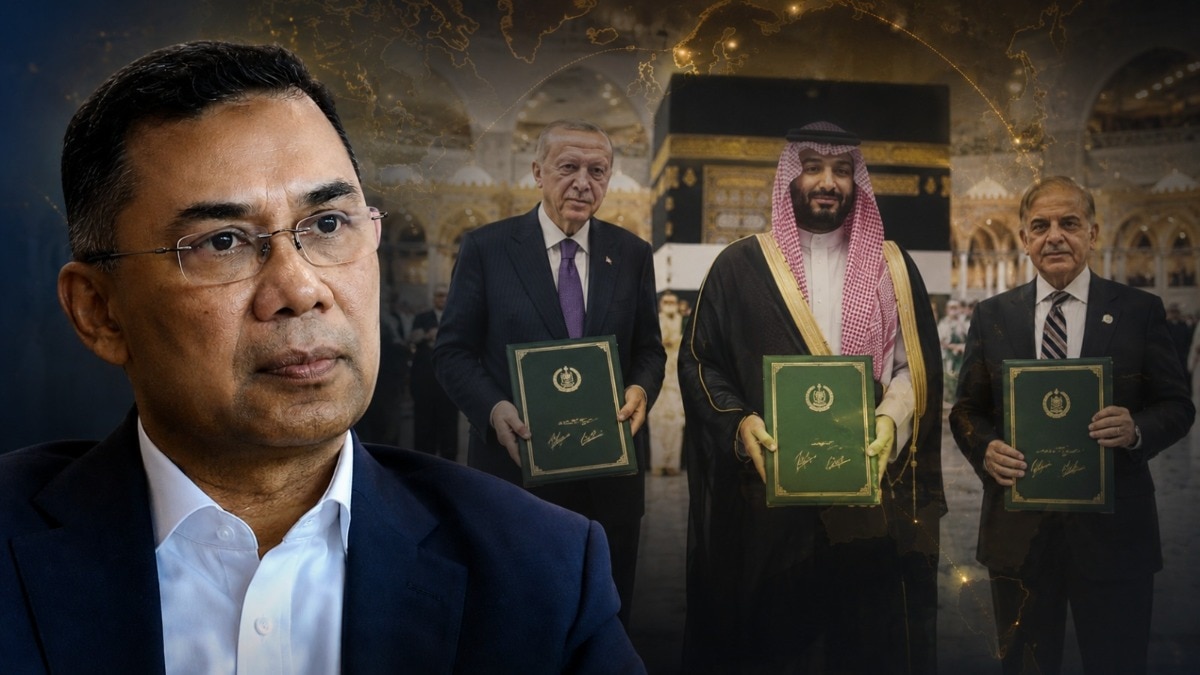
Bangladesh has kept the door open to joining the Saudi Arabia-Pakistan-Turkey Mecca Pact while saying any decision would depend on national interest. But Dhaka's possible entry will hinge on what Riyadh, Ankara and Islamabad offer. And, also on how much strategic freedom Bangladesh might have to give up while it exercises its 'Bangladesh First' policy.Bangladesh PM Tarique Rahman is expected to visit Riyadh weeks after Saudi Arabia signed the Mecca Pact with Pakistan and Turkey. (Images: File)The new Saudi Arabia-Pakistan-Turkey defence bloc, reportedly looking to add more Muslim-majority nations into the fold, is inching towards India's eastern flank, with Bangladesh keeping the door open to joining it. So far, Bangladesh has not decided if it would join the Mecca Pact. But two junior foreign-affairs ministers of the Tarique Rahman government have said Dhaka could consider it if the arrangement serves Bangladesh's national interest.Bangladesh PM Tarique Rahman is also expected to visit Riyadh at Saudi Crown Prince Mohammed bin Salman's invitation, according to reports. The question now is what Bangladesh would want in return for joining the pact being called an Islamic Nato which could complicate its ties with India.Saudi Arabia, Pakistan and Turkey signed the defence agreement in Makkah on August 7. Its central idea is collective deterrence. Like in Nato, an attack on one member would be treated as an attack on all three. It has been compared with Nato's Article 5, though key details like a common command structure, exact obligations and rules for taking in new members have not been made public.So, the debate over what Bangladesh might have to give up and what it could gain comes as Dhaka's BNP government says that it is pursuing a "Bangladesh First" foreign policy, when ties with India remain uneasy despite a concerted bid to reset them, and also as Gulf states rethink security assumptions built around US protection. For Bangladesh, the Mecca Pact could mean new opportunities. It could also mean new risks, according to experts. DHAKA HAS NOT SAID YES TO MECCA PACT YETOn its decision to join the Mecca Pact, Bangladesh, in its messaging, has been cautious for now.However, Bangladesh's openness to the Mecca Pact comes after a rapid deepening of ties with Pakistan, including revived air and sea links, military exchanges and reported intelligence cooperation. Concerns have also grown in India over what some analysts describe as the Islamisation or "Pakistanisation" of Bangladesh and its military. Experts have pointed to Army chief General Waker-Uz-Zaman's overt Islamic messaging, his beard, and new units named after the first four Caliphs. Alongside PM Rahman's expected Riyadh visit, these shifts strengthen indications that Dhaka could be preparing to move closer to the Islamic Nato. Last week, Bangladesh's State Minister for Foreign Affairs, Humayun Kobir, said Dhaka had a "positive approach" towards joining an economic or defence framework involving Saudi Arabia, Pakistan and Turkey. But he added that Bangladesh would decide by looking at its own interests and changing global economic and trade conditions.Another State Minister for Foreign Affairs, Shama Obaed Islam, made Bangladesh's condition clearer. She said Dhaka's position on joining any pact or multilateral body would depend on whether "Bangladesh's interests and the interests of the Bangladeshi people are protected".This means Dhaka is not ruling out an arrangement stretching from Asia's western flank (Turkey), through the Middle East, to South Asia's western edge (Pakistan). If Bangladesh joins, it would push the eastern edge of what is being described as an Islamic Nato further towards India's eastern flank.In this situation, Tarique Rahman's possible Riyadh visit would be watched closely. Saudi Arabia, the custodian of the Holy Mosque, is central to any possible expansion of the grouping.WHAT BANGLADESH CAN OFFER IF IT JOINS MECCA PACTContrary to what many may assume, Bangladesh would not be a token addition or a one-way beneficiary to the Islamic Nato. Riyadh, Ankara and Islamabad would also need to offer Dhaka something substantial in return.Bangladesh's entry would give the Saudi-Pakistan-Turkey grouping a strategic presence close to India's east, a scenario that experts say, would make India uncomfortable.Karachi-based security analyst Ali K Chishti said Bangladesh joining would give the emerging Muslim defence axis "a critical South Asian foothold right on India's eastern flank".That is why New Delhi is likely to watch the issue closely. India's biggest concern would be Pakistan's place in the grouping and the bloc stretching to Bangladesh. A security arrangement that includes Pakistan and a rapidly radicalising Bangladesh is bound to raise questions in New Delhi.Former US diplomat Jon Danilowicz, in a piece in CounterpointBD, wrote that "Indian sources have already expressed concerns about the Mecca Pact" and that Bangladesh joining it "would be interpreted negatively by many in India".India’s Ministry of External Affairs last week said it was "closely follow[ing] developments in West Asia" when asked about Bangladesh's reported interest in the Mecca Defence Pact.But Bangladesh is not only important because of its location. It has one of South Asia's larger militaries and vast experience in UN peacekeeping missions. Former US diplomat Danilowicz wrote that Bangladesh's forces have worked alongside militaries from across the world in global peacekeeping operations. That experience could matter if the pact ever develops joint exercises, common training or shared military planning.In a piece in CounterpointBD, former US diplomat Danilowicz wrote, "Bangladesh's military would be able to draw upon its extensive international experience in global peacekeeping operations, in which it has operated alongside military forces from around the world."Bangladeshi forces might have peacekeeping experience, but that's different from fighting in an alliance war. UN missions are generally based on consent and a mandate. A defence pact could, in theory, ask Bangladesh to consider sending troops to defend another member during a war. That would be a major decision for Dhaka.For the Mecca Pact, Bangladesh would contribute trained personnel, international operational experience and a strategic Bay of Bengal location. For Bangladesh, the question is whether it can get enough in return without losing foreign-policy flexibility, which it is being too assertive about following the departure of Sheikh Hasina.DHAKA'S PRICE OF ENTRY INTO ISLAMIC NATOFormer Bangladeshi diplomat M Shahidul Islam, writing on X, has argued that Dhaka should explore the opportunity, but only after making a hard calculation of its interests."Bangladesh is to make its foreign policy decisions based on its interest, and not to please others," Islam wrote. He said Bangladesh could join the Mecca pact if it gets a clear benefit. The same principle, he argued, should apply to economic groupings such as the Regional Comprehensive Economic Partnership.In another post on X, Shahidul Islam spelt out both sides of the deal. "The cost is fairly clear," he said."Bangladesh may be dragged into conflicts that are not necessarily in line with its own national interest. Benefits are not clear enough," he added.He said Bangladesh's "natural expectation" from Saudi Arabia, the pact's main economic power, should be "more overseas employment, more investment and enhanced energy security."This is Bangladesh's likely price of entry. Dhaka could seek assured recruitment channels for workers, investment in infrastructure and industry, long-term energy arrangements, and support for its economic needs. Turkey could offer it defence technology, training and defence-industrial cooperation. Pakistan could offer military exchanges and political support in Islamic forums.But Bangladesh would need more than broad assurances. It would need clear commitments, funding, timelines and safeguards, Bangladeshi experts have highlighted.Retired Bangladesh military veteran MG Shahidul Haque, taking to X, said, "The Mecca Pact looks good on optics." But he added that Bangladesh would "rigorously evaluate the real contributions, the offers on the table, and the underlying dynamics" before deciding.On the question of joining the Mecca Pact, Bangladesh would also need to ask whether joining could limit its freedom to stay out of an India-Pakistan conflict, an Iran-Saudi confrontation, or any other crisis that does not concern it directly.Altaf Parvez, a Dhaka-based researcher, writing in Prothom Alo, held the pact as part of a wider push for "strategic diversification" after doubts about the old US-led security order in the Middle East. The researcher also warned that competing military groupings could raise pressure on smaller South Asian states like Bangladesh.So, "Bangladesh First" would mean little if Dhaka joined the Islamic Nato just for symbolism. If it moves ahead, it will need a clear bargain, and, most importantly, the freedom not to be pulled into somebody else's war.- EndsPublished By: Sushim MukulPublished On: Aug 25, 2026 08:30 IST
Mecca Pact inches towards India's eastern flank. What's Bangladesh's price of entry?
Full Article
Original Source
Read the full article at Indiatoday →KhanList aggregates and links to publicly available news content. We do not host full articles from third-party sources. Always verify important information with original sources.