
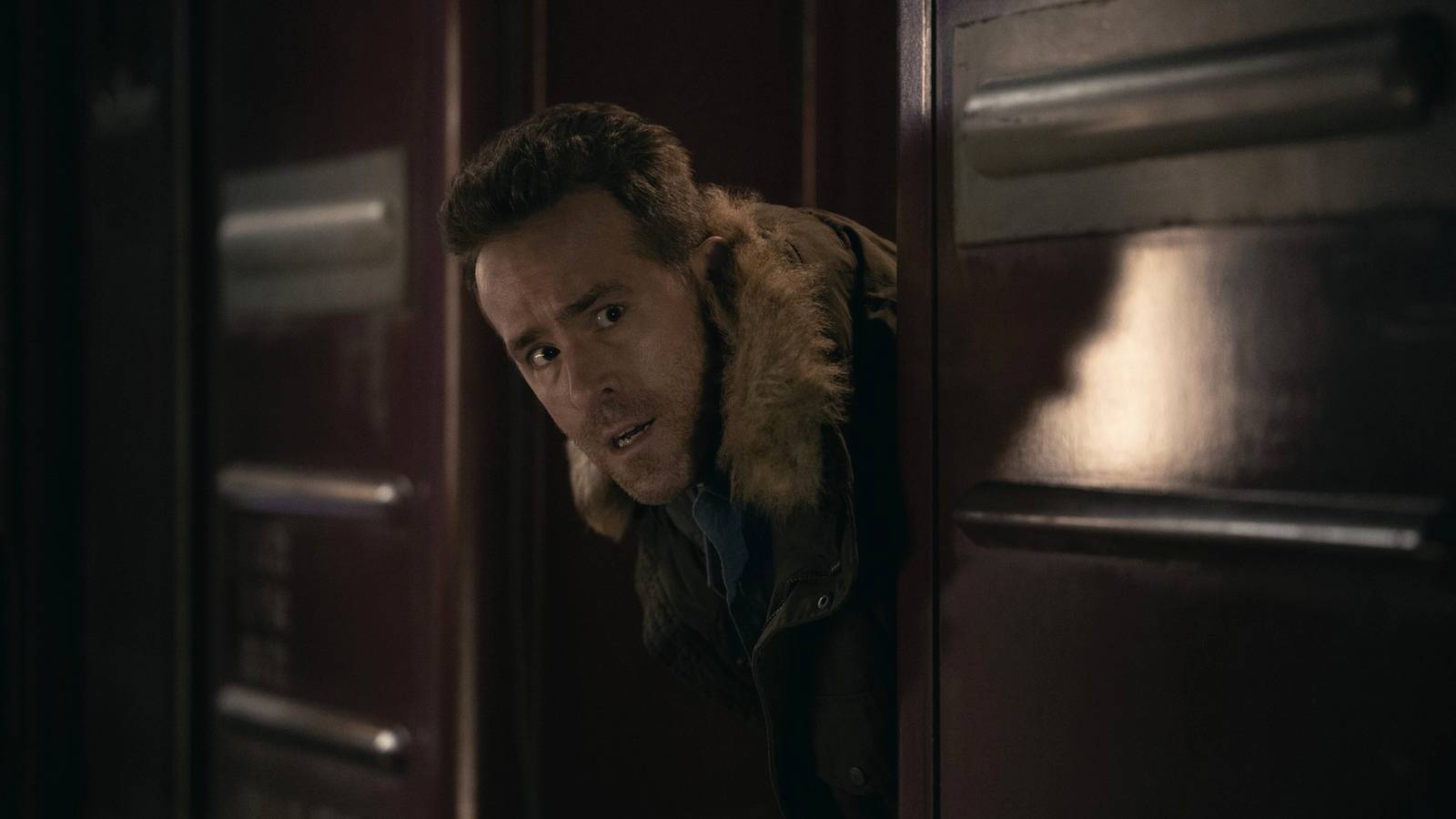
Published Sep 4, 2026, 10:54 AM EDT Alex is the Senior Editor of Reviews & Prestige Content, overseeing ScreenRant's film reviews as one of its Rotten Tomatoes-approved critics. After graduating from Brown University with a B.A. in English, he spent a locked-down year in Scotland completing a Master's in Film Studies from the University of Edinburgh, which he hears is a nice, lively city. He now lives in and works from Milan, Italy, conveniently a short train ride from the Venice Film Festival, which he first covered for SR in 2024. Warning: Major spoilers ahead for Mayday (2026) Mayday's ending is... not at all like Top Gun. The new film from writer-directors Jonathan Goldstein and John Francis Daley stars Ryan Reynolds as Troy "Assassin" Kelly, a US Navy fighter pilot stranded deep in Soviet territory after a mission gone wrong, and Kenneth Branagh as Nikolai Ustinov, the reformed KGB agent and America obsessive who helps him escape. The pair repeatedly beat the odds to make contact with American officials, even getting all the way to Moscow, but Troy learns he doesn't have the "war hero" clout he was hoping for. Nikolai's request for asylum is denied. This sends the pair to their lowest point, but after breaking free from the secretly rogue Soviet official Alexander Volkov, hijacking a mobile nuclear missile launcher, and taking off with a commercial plane (from which Volkov plummets to certain death), Troy and Nick have pretty much patched things up between them. Especially when, after securing permission to land on a nearby US aircraft carrier, Troy essentially strong-arms his government into saving his new friend. The ploy works; the next time we see Nikolai, he's chowing down on a Big Mac and preparing to live his dream of driving cross-country in an RV. Much like Nick's favorite American film, Mayday has a feel-good ending, but don't let that fool you – this is not one of those '80s Cold War movies that concludes with the "good guys" triumphing over their Soviet adversaries. This story ends in a much more skeptical place, and advocates for a different kind of heroism than Maverick represents. How Troy Realizes Turning On His Government Is The Right Thing To Do When Mayday begins, Troy's patriotism is of the blind variety. He's quite confident about who's on the right side of this war, and considers his Soviet counterparts not only backward and wrong, but essentially evil. Over the course of the movie, he learns that he's been too eager to believe that narrative. There are things, he realizes, that his society could learn from this one. American democracy may be preferable to Soviet communism, but a system of government shouldn't be mistaken for the soul of its people. That journey for his character reaches a turning point when Volkov, attempting to convince Troy to lie about the nature of his mission, reveals that the American government is to blame for his father's cancer. Harold Kelly worked in the Navy shipyards, where Troy eventually decided he wanted to become a fighter pilot, and Volkov produces a classified document that proves the Navy knew the asbestos they were using was dangerous to those workers. Because alternatives were more expensive, they hid this knowledge and continued to use it. Troy's faith in his country's leadership had already been dinged by their unwillingness to evacuate him, and again by their refusal to grant Nick asylum. This revelation shattered it. He doesn't betray the United States; indeed, he remains a committed patriot. But his understanding of what it means to serve has changed. As he sums up to Nick: "Right now, the only way to stand up for my country is to stand up to it." When he returns, at a closed-door hearing, he asks that the government not only admit what they've done, but begin to compensate those harmed, and essentially implies that he will leak the document Volkov obtained if they do not. He uses his platform and what he's learned to stand up for the American people, while potentially torching his military career in the process. It's the capstone on a heroic journey for Troy that isn't quite the rah-rah optimism of many of the films Mayday was likely inspired by. What Volkov Really Wanted (And Why It Made Him Mayday's Perfect Villain) The lesson of Troy's arc is clearly something Goldstein and Daley wanted to say with their take on an '80s-style buddy action-comedy, and that's also reflected in their choice of villain. Mayday is set in 1987, when the Cold War is already on the path that will eventually lead to its end, as well as the dissolution of the Soviet Union. For this movie's purposes, the key representative of that path is Mikhail Gorbachev, the Soviet general secretary who was pushing an agenda of political reform, known collectively as perestroika. Alexander Volkov doesn't like Gorbachev's agenda. We meet him in the context of him finally swapping out Konstantin Chernenko's portrait in his office, two years after Gorbachev succeeded him. When he hears of the crashed American spy plane and the surviving pilot still at large, he chooses to get personally involved not out of a sense of duty, but because he sees an opportunity to further his own agenda – fully revealed when he has apprehended Troy and Nick in Moscow. He attempts to convince at least one of the two to confess that Troy's mission was actually to infiltrate the Kremlin and assassinate Gorbachev. He yearns for the days of Russian empire; he believes this would "put an end to this 'glasnost,'" one of the key elements of the reform, which he translates as "openness." What is described in multiple instances as a delicate moment in US-Soviet relations would certainly be ruptured, and the world would have shifted in favor of further division. It's important that the villain of Mayday is not the Soviet Union broadly, but a specific individual who would lie to his country to see it become more authoritarian. Troy, meanwhile, becomes someone who would force his country to tell the truth to see it become more free. Not only does the specificity of Volkov leave room for Troy's appreciation for the Soviet people to grow, but he also serves as the dark mirror of Troy's arc, helping to crystallize the movie's definition of heroism. Mayday Wants Us To Think A Little Harder About Our '80s Nostalgia The past decade or so has seen a wave of '80s nostalgia projects in film and television, whether as original stories set in that decade, like Stranger Things, or revivals of popular properties from the time, like Top Gun: Maverick. On the one hand, Mayday is part of that wave. Part of its appeal as an action-comedy is the way it channels the movies of that era, and through Nikolai's Americana collection, it also gets to reference pop culture of the time in a way that will trigger nostalgia in those who lived through it. On the other hand, this movie is also quite critical of the films and TV shows that look back on the '80s through rose-colored glasses. The film's choice of Top Gun as a reference point, and indeed to center on a Navy fighter pilot at the height of the Cold War, seems quite intentional in this regard. For as thrilling and well-crafted as Top Gun: Maverick is, it also transports the overly simplistic military politics of the original movie directly to the 2020s. The idea that we're meant to cheer for Maverick & Co. conducting an unprovoked airstrike against an unnamed foreign enemy we're not at war with is quite troubling. Mayday suggests that it would also have been troubling then. Goldstein and Daley have gone back to this particular point in time because they believe it has something to say to our current moment. Broadly, it's remarkably pacifist for an action movie – the story arcs toward seemingly oppositional forces coming together, recognizing what they may have to learn from each other, and, in Troy and Nick's case, even becoming friends. That lesson can (unfortunately) be applied to 2026 in a variety of ways. More specifically, though, Troy's line about standing up to his country can be understood as Mayday's thesis. Nikolai represents his own version of that lesson, having become disillusioned with the KGB and the Soviet project more broadly after realizing he could no longer rationalize what he was doing by telling himself he was acting in his country's interest. His daughter Anna essentially teaches that lesson to them both. As a lesbian, her sexual identity is criminalized in the Soviet Union, but she still puts herself in harm's way to advocate for human rights. Meeting her is an important part of how Troy builds the courage to do what he does at the film's end. As fun as their film may be, Daley and Goldstein haven't made escapist entertainment. Mayday encourages us to look past nostalgia rather than wallow in it, and think about the time we're living in as we (re)visit the past – it just does it in a way that isn't so overbearing that it gets in the way of enjoying the story. Release Date September 4, 2026 Runtime 110 minutes Director John Francis Daley, Jonathan Goldstein Writers Jonathan Goldstein, John Francis Daley Producers Ashley Fox, Dana Goldberg, David Ellison, Don Granger, John G. Scotti, Johnny Pariseau, Jonathan Goldstein, Patrick Gooing
Mayday Ending Explained: What Troy's Big Decision Really Means
Full Article
Original Source
Read the full article at Screenrant →KhanList aggregates and links to publicly available news content. We do not host full articles from third-party sources. Always verify important information with original sources.