
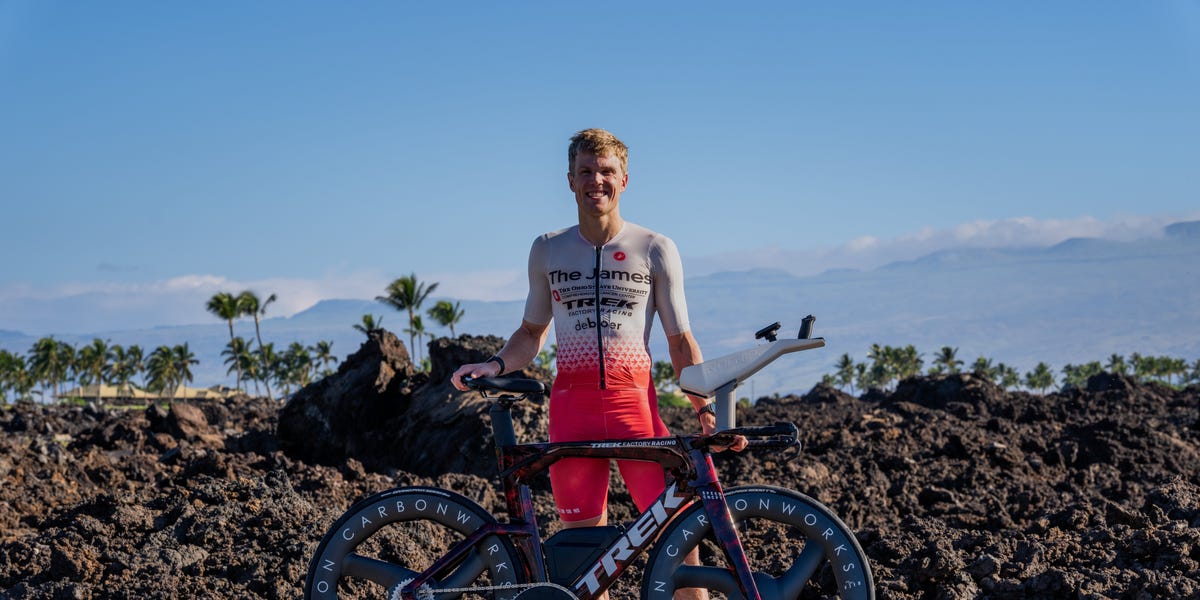
9 min readIn a world where “fitting it all in” is already an extreme sport, pro triathlete and med student Matthew Marquardt, 28, takes it to the next level. Without being high-strung about it.Maybe you’ve seen him on Instagram speed packing a non-precious lunch to take to the hospital (PB&J!), building complicated Lego projects before a world championship race, raising money for cancer research, or you’ve seen him break the tape and set a new course record at Ironman South Africa this year. Or you’ve gotten a peek inside his med student life at the Ohio State University College of Medicine.He plans to become a surgeon specializing in head and neck cancers, and has already published research in the field (here’s one paper in Oral Oncology, if you want to look it up). But before that happens, there’s the Ironman World Championship in Kona this weekend. And Marquardt’s results so far this year are generating a lot of excitement ahead of the big race.If he’s got time to train (about 25 hours a week), you’ve got time to train. He’s clear that time and mental capacity are finite resources, and he’s thoughtful and strategic about how he manages both—without optimizing the joy out.In this interview, we got the surprisingly ordinary extraordinary athlete to reveal how he manages his time, his mind, and his life:Pro triathlete, busy med student—how do you make it all work? It comes down to a few things, and one is hyper-focusing on the main priorities in life, and then making those work. And then if you have time for other things, you allow those when you’re able.For me, my priorities are med school, training, and my close relationships. There’s a very practical side to that—with training, you can’t push something off to the next day. If you miss a workout today, there’s no making it up the next, because the next day you already have something else scheduled.So every day starts with looking at what are the mandatory things I have to get done. When do I need to be in the hospital, what are my scheduled meetings and rotations, what are the workouts that I have, and how am I going to fit those in? Generally, that means doing one workout before I go in and one workout after.It also means being intentional about spending time with people. I think I say only half-jokingly that triathlon and medicine probably have a higher divorce rate than most other activities and careers, mainly because of the time commitment required. I want to make sure I’m intentional about that part of life. I don’t want to look back in 20 years and say, “man, I really missed out.”And the other main things? I’d say the other things are delegation, discipline, consistency, and purpose.I’m very much a proponent of delegating expertise as much as possible. I have a coach. I have a nutritionist, I have a sports psychologist, I have someone that works with me on aerodynamics. At the end of the day, I don’t have enough time to become an expert in all of these fields. I have a really great relationship with my coach, and he writes my workouts for the week. I take a quick look at them and say, “that looks good based on what I think my schedule will be.” I do the workout, send him the results, and I’m pretty much done thinking about it and I’m on to my next thing. It just reduces my mental load, and lets me focus on other things.Last year, there was a wedding in Chicago for my cousin. My girlfriend was a resident and only got one day off per week. We found out that she happened to have the same day off as the wedding. My first thought wasn’t, “oh, it’s too bad that you can’t go.” It was “hey, let’s check flights and see if we can get you there and back the same day.” And sure enough we were able to.I think there are two ways people think about things. You look at an opportunity and can either say, “here are the reasons not to do it,” or “here are the ways I can make it work.” I’m very much one of those people who, when there’s an obstacle in front of me, my mind switches not to “here are all the reasons I can’t get over the obstacle,” but “okay, these are the constraints I have. What are the ways I can get around, over, or under this?”Discipline can seem like a tough word. What does it look like for you? I think a lot of people think about discipline as something that prevents opportunities. But I view discipline as something that gives you freedom. Knowing what the general structure of a day is enables me to not think about those things and focus on free periods to spend time with my girlfriend or do research or whatever.Consistency is important as well. In Ironman, the result is not born from one good workout. It’s from layering workout after workout, day after day. You don’t have to be perfect every day. What’s most important is that you’re doing something that’s hopefully moving you forward every day. And you don’t become a great doctor by just cramming for an exam.Do you study on your bike trainer? I try to study as little as possible when I’m working out, because triathlon is my escape from medicine, and medicine is my escape from triathlon. When I’m doing one thing, I’m recharging for the other thing, and I come back to that next thing with more energy, more focus, and more motivation than I would have had otherwise. I think that type of compartmentalization has really enabled me to do what I do.So it sounds like your success as a triathlete is sort of because of med school, not in spite of it.I very much believe that medical school has helped me be better at the sport largely because of the purpose aspect that it brings. Med school kind of gives me a purpose beyond myself and it’s something that helps me not overthink triathlon. It honestly reduces the stakes a lot. Every race, I tell myself “if you have a good result, that’s great. But you’re still going to become a doctor. And if you don’t have a good result, that’s fine. You’re still going to become a doctor.”How do you keep from getting stressed out about med school? Medicine is a challenging field to be in for a lot of different reasons—trust in healthcare is arguably at its all-time low, and there’s all this misinformation out there. And from a documentation standpoint and a personnel standpoint, and from seeing people go through health consequences, it can wear people down. It’s helpful for me to have a purpose, which is having an impact on the world specifically through being a cancer surgeon. I also leverage my platform as a triathlete to raise awareness about the importance of cancer research and cancer screening.I write the initials of a lot of people who have had cancer on my bike. It shows people that hey, someone else is thinking of me. For others, it’s the closest they can get to their dream. I’ve had multiple people reach out who have a cancer diagnosis and always wanted to do an Ironman, and ask if I can add their initials. It’s really powerful both for me and for them. I also hope to be a role model for how you can do more than you think you can, because that was very much the case for me. I never expected to get where I am now.Triathlon helps with the stress as well. As a medical student, you have pressure to perform every day—everything you do is being watched and evaluated—and you have major exams that can have a big impact on your long-term career. With triathlon, you’re used to the idea of doing stuff that leads up to a big thing. You’re feeling prepared but knowing that things can happen that aren’t exactly what you planned. You focus on what you can control and where it’s most productive to spend your mental energy. Overall, what helps me sleep at night the most, before a big race or before an exam, is knowing that I’ve done everything I can to put myself in the best situation possible to do well—and that doesn’t mean being perfect.Wait, you have time to sleep? I’m very well aware of the importance of getting enough sleep. But there are some days where I can do everything right and still not get enough. And I have two choices: I can either stress about that and think about the impact it’s going to have on me. Or I can say, “I did everything I can to get as much sleep as possible. I’m going to take what I can get and move on.”I think that’s a very good analogy for how I think about life in general. You can think about a lot of “what ifs,” but there are a fair amount of times where you just need to have the confidence that if something happens, you can figure out what to do.There are so many athletes who overthink everything. How do you keep from doing that?I think medical school helps with that a bit because it really constrains the amount of time I have. Optimizing everything to 100 percent is a diminishing returns curve. So I focus on the best things I can do to 90 percent optimize, because that’s going to get me really close to being fully optimized. It’s also going to cut out a significant amount of time. It’s about recognizing that based on my situation, there are certain things I can’t do, so I’m not going to worry about them. You’re always going to be leaving something on the table.What do you do about laundry? I joke that medical school wouldn’t be that hard if you didn’t have to worry about all the other things you have to do as an adult. I think it’s important to focus on places where a little bit of energy can save you a lot of energy in the long term.You can spend an extra two seconds putting your dishes in the dishwasher after using them, or you can let them pile up to the point where it takes longer to put them in the dishwasher. Same with spending 30 seconds to hang up your jacket and put your shoes in the right spot rather than having to spend an hour someday to clean up the mess.I also buy simple foods in bulk and meal prep as much as I can. And I have one of those combo washer/dryers that lets me put my clothes in the machine overnight and the next morning, they’re dry. Time is my most important resource, and whenever there’s a way to me to make life more efficient from a time aspect, I almost always leverage it.Do you work out with other people? Almost never. There are days I would have a better workout if I were working out with someone, but for me, it comes down to the mental load of scheduling things and the extra time it takes if you’re chatty or one of you is waiting for the other to show up. Plus, I’m very much on the line between introvert and extrovert, so it gives me some time to decompress, away from the socializing and human interaction I get otherwise.What do you do for recovery? Recovery really comes down to load management. It starts with the workout itself, in that if your workout is properly designed, and takes into consideration the stresses you have outside of the workout, then you’re already a step ahead in recovery.Let’s say the most training you can take on in a day, given everything you have going on outside of your training, is two hours. If you’re doing three hours of working out, but you can really only absorb two hours of the workout, then you’re putting yourself consistently into a hole that you can’t get out of.I think mindset matters, too. At the end of the day, I’m going to focus on “here are the things I can control, and here are the things I can mitigate.” The other stuff, I’m just going to have to work with because that’s the life I have. Recovery certainly is important. But I think one of the biggest things I’ve learned over the past year is that your mindset and your attitude is probably just as important, if not more important, than any of the physical things that you do.Marty Munson, currently the health director of Men's Health, has been a health editor at properties including Marie Claire, Prevention, Shape and RealAge. She's also certified as a swim and triathlon coach.
Matthew Marquardt Isn’t Just Busier Than You. He’s Weirdly Chill About It
Full Article
Original Source
Read the full article at Menshealth →KhanList aggregates and links to publicly available news content. We do not host full articles from third-party sources. Always verify important information with original sources.