
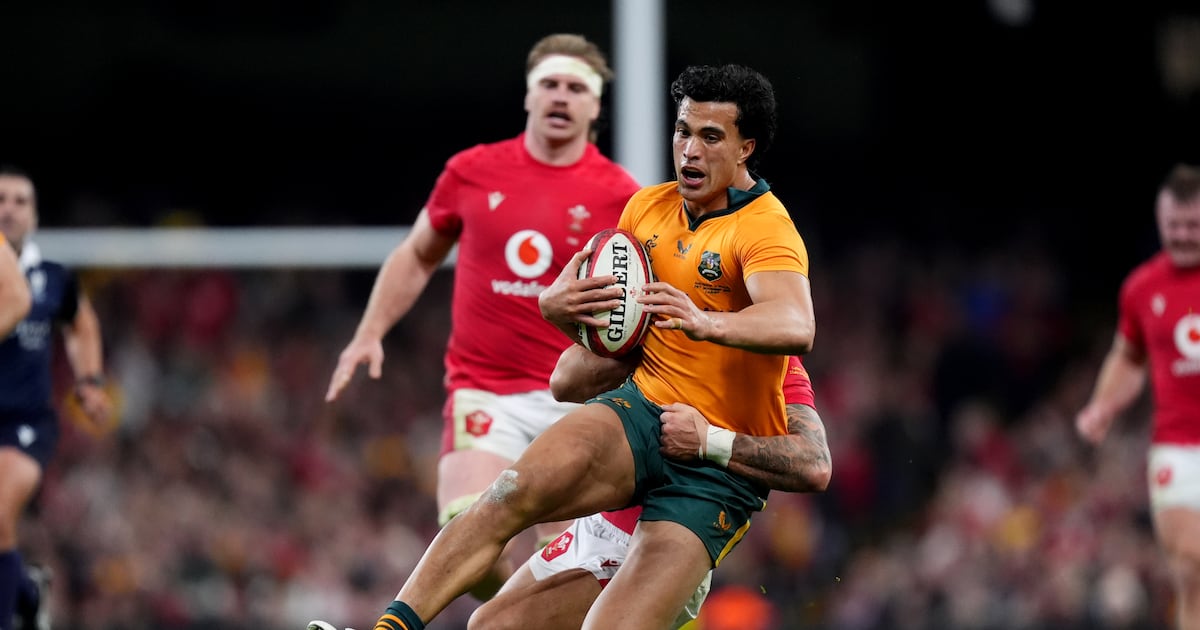
Ireland’s dilemma is that they don’t know which Wallabies team they will face at Twickenham. Will it be the men in gold who triumphed over South Africa and Argentina? Or the timid Wallabies, who meekly submitted to New Zealand, Scotland and England?There is a huge variation between the best that Australia can deliver and their worst.This group is capable of playing with high-octane precision and scoring memorable long-range tries that lift the heart of every rugby lover in Australia. A week later, those same hearts are broken as their team produces a performance with huge defensive frailties.Defence wins Test matches and in their last five games since beating the Springboks, the Wallabies have let in a monumental 179 points, at an average of 35.8 per game. No international team can succeed with those numbers.READ MOREThese defensive failings are even more stark when compared with Ireland’s, who have conceded only 46 points across the whole of November with an average less than half of Australia’s, at 15.3.A counterbalance is that in the last three games between the two nations, the Wallabies defensive system has disrupted Ireland’s attack. In these matches, Australia implemented what is called a slide, or drift, defence. This does not race forward with the same frenetic pace as the Springboks. With origins in Australian Rugby League, the emphasis is on each defender remaining connected with his team-mates on either side, which reduces gaps. In the recent past, this has limited, but not nullified, Ireland’s short passing attack.Wallabies fans have become frustrated recently as their team appears to have developed enough depth and quality across their tight five to support their world-class backrowers.At times the pack has laid down a winning foundation for their attacking backline. On other occasions they have simply gone missing in action.Australia's Carter Gordon during the Nations Championship match at the Principality Stadium, Cardiff. Photograph: David Davies/PA They have electric pace on the flanks and Tom Wright at fullback is a quality player. The inclusion of 37-year-old Kurtley Beale on the bench is a national embarrassment, while Kalani Thomas’s selection at scrumhalf is a major gamble. Carter Gordon continues to show promise in his injury-interrupted development as an international outhalf. But he is yet to master the art of varying his depth, which is limiting the Wallabies’ passing game. In turn, this has contributed to them losing the gainline percentage battle in each of their last six Tests.[ ‘It’s important we back it up this weekend’: Sam Prendergast looks to keep buildingOpens in new window ]The sad irony behind these problems is that next year is the 100th anniversary of the 1927 Waratahs tour of Europe. The team that invented gainline theory.It is a sad fact that the Australians are no longer the masters of the game they invented. Sadly, in my experience, few, if any, of those involved in leading the technical aspects of coaching attack in Australian rugby deeply understand what gainline theory is.The real gut punch for Australians is that the stratospheric rise of Irish rugby is linked to their mastery of gainline theory. When you watched Johnny Sexton run deep into the defensive line before passing, you were watching the genius rugby IQ of the 1927 Waratahs in action.Ireland’s short passing game is the modern evolution of gainline theory and when it is in full flight, it is a joy to behold.[ From the format to ticket prices, what do you think of the Nations Championship?Opens in new window ]A major strategic failure is that the Wallabies’ attack does not deliver the ball into the hands of the freakishly talented Joseph-Aukuso Suaalii more often.Maddeningly, Suaalii’s role has too often been reduced to clearing out rucks. Which is like employing the artistic genius of Michelangelo and asking him to paint the backyard fence.After defeating the world champions, Irish rugby is once again full of early festive season good vibes. While I don’t want to be the rugby Grinch, the margin of victory was the last 2cm of Canan Moodie’s right boot, which scraped the touchline a millisecond before he grounded the ball to score what would have been a match-winning try.Ireland's Mack Hansen tackles South Africa's Canan Moodie into touch before he can score. Photograph: Ben Brady/Inpho So please, follow Moodie’s example and keep both feet on the ground. If Ireland are to continue their domination over Australia, their main challenge will be their ability to recover physically and emotionally from the massive effort they put in to defeat the Springboks. Earlier this year, in the weeks after New Zealand and Australia conquered the South Africans, the toll required to win was so great that both teams could not fully recover in time for the following matches.On New Zealand radio this week, Graham Henry, their former World Cup winning coach, told his nation that after the rigours of a season that included a four Test series against the Boks, the Kiwi players were simply exhausted because they have been asked to play too much elite-level rugby, that “their tanks are empty”.A much misunderstood area of international rugby is how difficult it is for players to emotionally recover from both the lows of defeat and the highs of an enormous win.[ Playing for fifth place is a fair reflection of where Ireland deserve to beOpens in new window ]To have their bodies, minds and emotions reset to the zenith required to win a Test match, six days after the enormous efforts they put in to defeat South Africa, will be hugely challenging for Ireland. Last week I believed it was the Springboks who were vulnerable. This week it’s Ireland’s turn.While all the form points to an emphatic Irish victory, we need to remember that both teams have recently defeated the Springboks. Like Ireland, the Wallabies have displayed that on their day they are capable of delivering a performance that can beat the best in the world.That said, in the Bledisloe Cup they also proved they can leak 50 points.If the Wallabies turn up with a powerful mindset to tackle Ireland into the Twickenham turf for 80 minutes, then they could disrupt Andy Farrell’s men. If they do, then this match may be a repeat of last week, with the outcome once again determined by a matter of centimetres.
Matt Williams: I don’t want to be the rugby Grinch, but Ireland need to keep their feet on the ground
Full Article
Original Source
Read the full article at Irishtimes →KhanList aggregates and links to publicly available news content. We do not host full articles from third-party sources. Always verify important information with original sources.