
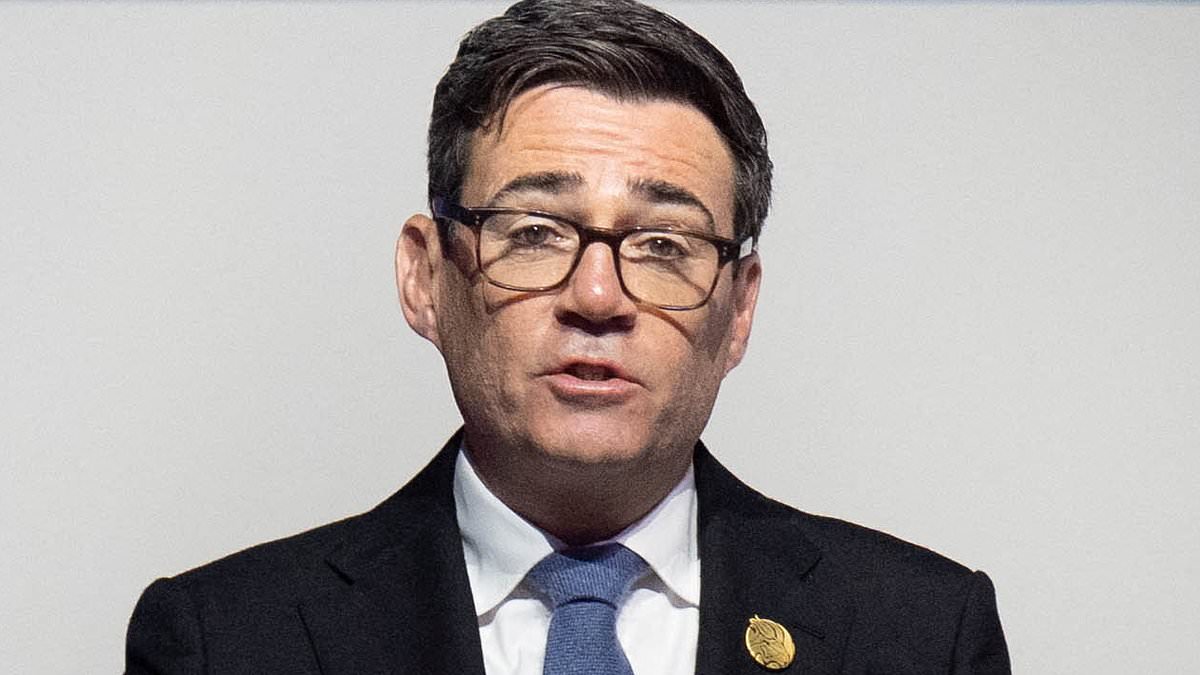
Andy Burnham went to the Turkish seaside resort of Antalya for a global climate summit.But if he’d hoped to fix up meetings with Donald Trump, Mark Carney, Friedrich Merz, Emmanuel Macron, Giorgia Meloni or even Japan’s Sanae Takaichi, he would have been disappointed. Burnham is the only G7 leader who thought it necessary to attend.There was no sign, either, of Xi Jinping, Vladimir Putin or Narendra Modi.As he twiddled his thumbs in Turkey, sipping sustainable soy lattes with his Energy Secretary Miatta Fahnbulleh and the 255 British officials who have made the trip with them, Mr Burnham might have noticed something else.COP31, the annual jamboree of the climatocracy officially known as ‘the 31st Conference of the Parties to the United Nations Framework on Climate Change’, has finally managed to unite both sides of the climate debate.Yes, the sceptics and the alarmists are in agreement at last: COP meetings are a waste of time. Andy Burnham delivered his speech at the 31st Conference of the Parties to the United Nations Framework on Climate Change in Turkey on ThursdayThose who insist the climate is in ‘crisis’ also complain ever more loudly that 31 meetings, attended by a record 93,000 people this year, have had zero effect on slowing the relentless rise of carbon dioxide in the atmosphere – up from 0.032 per cent to 0.042 per cent in 60 years.They grumble that the meetings now seem to happen in coal-burning or forest-felling countries and feature swarms of corporate lobbyists striking lucrative fossil-fuel deals in the corridors.Meanwhile, people who think the climate is not in crisis complain that 31 meetings attracting dozens of private jets (a record 93 this year) appear to have done nothing to change the weather, with storms, droughts and floods still showing no sign of getting either worse or better than they always were.They complain the meetings always seem to attract armies of taxpayer-funded bureaucrats and environmental campaigners more concerned with green-washing deals and hobnobbing with ‘sustainability’ tycoons than saving the planet.Nothing of diplomatic significance is ever agreed at these meetings. Even the Paris summit of 2015 – widely considered the most revolutionary of all the COPs – confined itself to suggesting governments make non-binding promises to reduce emissions, few of which they kept.So it is worth asking why these pow-wows persist. And why our PM thinks it made sense for him to be there, even briefly. Activists took part in a protest on the second day of the climate change conference in TurkeyWe may never discover the answer to the second question but the answer to the first is that the COP meetings are an entirely self-sufficient enterprise in their own right, now largely cast adrift from any real-world issue.The purpose of each meeting is to prepare for the next meeting. The process, you might say, is the product.Bureaucrats can devote entire careers to writing obscure papers for such events. Airlines can make millions flying delegates back and forth. And hotel chains can trouser massive windfalls from supplying them with room service and limo rides. The whole thing could be done on Zoom, of course, but that would spoil the fun.The truth is that vested interests now keep the COP process afloat. Suppose we wake up tomorrow and scientists tell us that – sorry! – they now think the climate is less sensitive to carbon dioxide than they thought, or that they now think we can have a warmer world without more storms, droughts and floods.Ask yourself if such good news would be welcome in Antalya this week. Of course not. The politicians would hate losing climate change as a convenient excuse for their failed policies. The officials, campaigners, capitalists and commentators attending the COP all have a massive stake in stressing the cloud in every silver lining. It is true that the looming El Nino – a climate pattern that involves weaker than normal trade winds in the Pacific pushing warm water back East towards the West coast of the Americas – has put a spring in the step of the climatecrats this year as droughts and floods begin to worsen on both sides of the Pacific Ocean.Although one modelling study has suggested that El Ninos might be getting 10 per cent stronger as a result of man-made global warming, they were happening long before the warming began and the strongest one was in 1877.Whatever the truth, it represents a golden opportunity to ramp up the alarm about bad weather.Politically, too, the American midterm elections have emboldened the scaremongers, as they glimpse the end of the reign of the climate villain-in-chief, Donald Trump.That prophet of doom, former Secretary of State John Kerry (why the long face?), arrived in Turkey along with 19 Democrat congressmen and declared that the elections are a referendum on Trump’s climate policies.The only problem with this argument is that, in the weeks running up to the Congressional elections, greens were complaining that the Democratic party’s leaders, donors and strategists were frantically telling candidates not to mention climate at all, lest it put voters off. They called this tactic ‘climate hushing’.The candidates did indeed hush themselves. As the energy commentator Michael Shellenberger reports, the share of House and Senate Democrats’ Press releases that mentioned climate change has plummeted from 28 per cent in 2021 to just 2 per cent in 2026. Hardly a hot topic.All over the world people are alarmed about the high cost of energy and the threat to reliable energy supplies presented by the wars in Ukraine and Iran. By contrast, the possible future effect of emissions on the weather has dropped far down the list of voters’ concerns. When asked to pay yet more taxes and bungs to the crony capitalists of renewable energy and electric cars, they baulk.Three decades ago, when the COP summits got under way, it was reasonable to hope that decarbonisation might prove to be easy and cheap as well as urgent. Now we know better.Bjorn Lomborg, president of the Copenhagen Consensus, a project set up to identify the greatest challenges facing the world and how to solve them, has launched a new website – netzerocostbenefit.com – based on the temperature models and economic models used by the Intergovernmental Panel on Climate Change.You can enter the name of your country and find out how much benefit you can expect to get from the climate policies being pursued by your government and at what cost.In Britain’s case, if we reach net zero by 2050, the world will be 0.00376C less warm in 2100. That is to say, at a cost of £695billion we can make our great-grandchildren’s lives cooler by under four thousandths of a degree Celsius – less in summer in the daytime, more in winter at night.Even if the whole world were to achieve net zero emissions by 2050 – of which there is less chance than snow falling in London in July – the world would be just 1.38 degrees less warm than it would otherwise be in 2100, 74 years from now. The benefit of achieving this would be worth $24trillion, if you believe the models, but the cost would be $255trillion. I don’t know about you, but in my own life I don’t generally spend £10 for £1 worth of goods.At least you won’t have to worry that they might actually do something at COP31. They will no doubt pull the usual dramatic all-nighter on the last day, November 20, but – if history is any guide – we can expect few, if any, breakthroughs.Viscount Ridley is a writer and businessman.
MATT RIDLEY: If Britain reaches its Net Zero target, the world will be 0.00376C less warm by 2100. Is that REALLY worth £695bn?
Full Article
Original Source
Read the full article at Dailymail →KhanList aggregates and links to publicly available news content. We do not host full articles from third-party sources. Always verify important information with original sources.