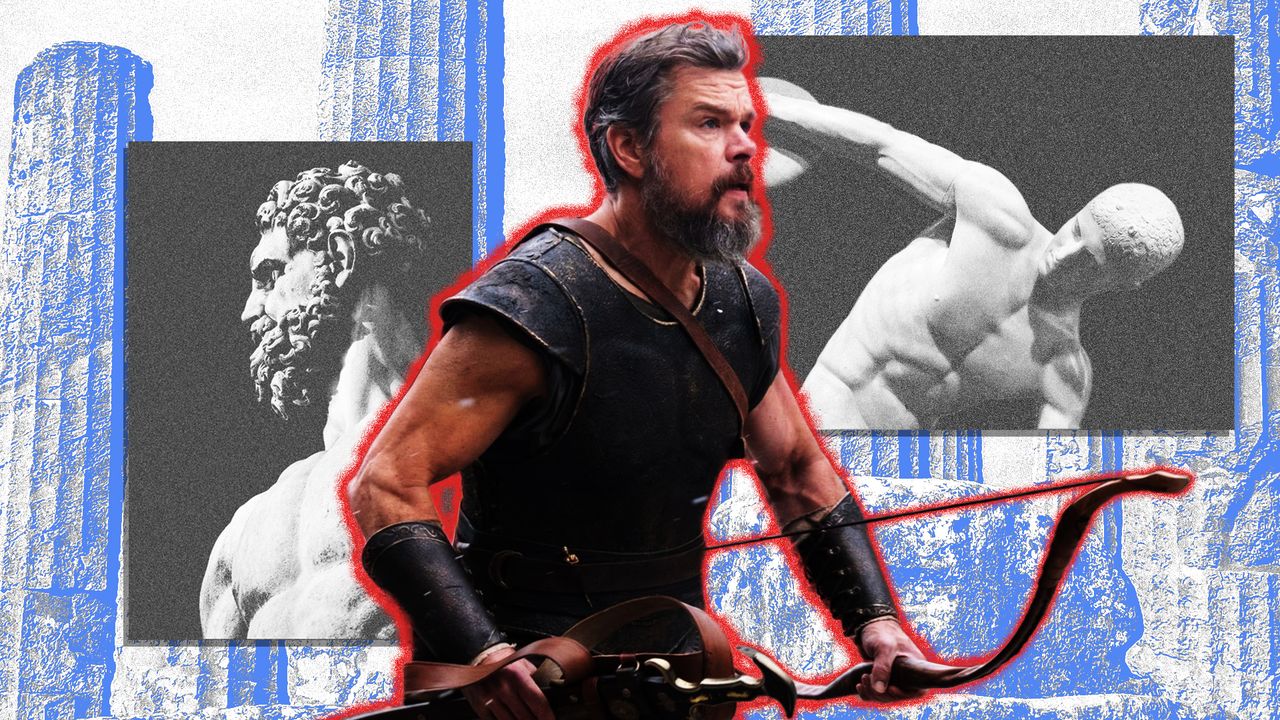
Preparing to put your shirtless torso on display in front of millions of people around the world is one thing. Baring it all on a sky-scraping IMAX screen is quite another—and in a Christopher Nolan film, no less. (No CGI abs for you!) Yet, in The Odyssey you’ll find Matt Damon, chiseled as ever at the age of 55, towering over audiences as the battle-hardened hero Odysseus, looking every bit the part.Perhaps even more impressive is how that statuesque physique came to be. Obviously, for an Academy Award-winning actor like Damon, physical transformations are just part of the job description. But this time was different. Working with personal trainer and physical therapist Gabe Stump, DPT, the actor had just five months to get into mythological shape. And he did it all in a bare-bones apartment gym, with a rudimentary workout plan that even a mere mortal like you could follow without needing to quit your day job or pray to the gods.A Hollywood hero sets sailMatt Damon isn’t the kind of actor who lets himself go between films. But he doesn’t walk around looking like Odysseus, either. Leading up to The Odyssey, it had been a minute since the actor needed to impress with a shirtless scene. “I started working with him right after Air came out, where he’s playing the Nike executive [Sonny Vaccaro] who’s kind of chubby,” recalls Stump. Films like Netflix’s The Rip and Apple TV’s Instigators followed, neither of which called for much skin. “The last three years, we were really just doing general fitness,” Stump says. “We were thinking more about longevity, and just keeping him functional and healthy.”The way Stump puts it, Damon’s body at the start of training for The Odyssey was “workable.” He had a solid foundation of muscle that the actor has managed to hold onto pretty consistently since his early Bourne days, but not exactly the kind of definition you’d expect of an epic hero. Basically, to get to where he needed to be, Damon would have to lose around 15 pounds of fat while hanging onto as much muscle as possible.“For The Odyssey, we had a very specific goal and look that we were trying to achieve, and it was decided between Nolan and Matt, and I guess whoever the advisers are that decide what they want the movie to look like, historically,” recalls Stump. “They basically came back and said, ‘We see Odysseus as someone who's obviously a warrior and very strong, but he’s gone through this 20-year odyssey, and through that time he’s gotten more and more lean.’”Forging Bronze Age muscle with ironIn order to melt as much fat off Damon’s physique as possible without chipping away at the actor’s existing muscle, his trainer devised a weekly workout plan consisting of four strength training days—two upper body and two lower body—and one cardiometabolic day in the middle of the week. “The strength days were really important, not because we wanted to put on more size, but because that’s what maintains the size you have and tells your body to prioritize body fat as fuel,” Stump says. “Your body is very stubborn in terms of what it wants to hold on to; if you’re not using the muscle, your body will consume that tissue instead of fat.”The strength sessions, which took place in a modest gym in the basement of Damon’s apartment building, were kept simple due to the sheer scarcity of equipment on hand in the spartan space. “You’d be shocked at how crappy it is,” Stump recently told Vogue. Each workout consisted of between six and eight exercises and lasted just 45 to 60 minutes. The pair trained upper body on Mondays and Thursdays and lower body on Tuesdays and Fridays, which allowed for at least 72 hours of recovery between body parts.On the upper-body days, they’d hit a mix of push and pull exercises, covering chest, back, shoulders, biceps, and triceps in each session. They also alternated between horizontal and vertical movements from one workout to the next, allowing them to work the muscles along different planes of motion. “We’d do a flat dumbbell bench press, and then the next upper-body day we'd do it at an incline,” Stump recalls. “Or if we did a chest-supported row one day, we’d do pull-ups the next time.”Sessions would begin with a main lift, like a bench press or row, followed by accessory work, such as cable flies or landmine presses, to isolate the smaller (albeit highly photogenic) muscles that would end up getting the most screen time in the film. Stump had Damon doing three or four sets per exercise across the board, with 8 to 10 reps for the main lifts and 12 to 15 for the subsequent accessory work. “The general idea was to do higher volume,” Stump says. “Lots of sets, versus really intense strength work.”Lower-body days followed the same formula. “We had a trap bar, so our big leg lift was the trap bar deadlift,” Stump says. “That's where we would go the heaviest.” But in the absence of basic leg-day equipment, like, say, a squat rack, the duo had to get creative. “We had a regular barbell, but no rack,” Stump says, “so we did landmine [squat] variations, and different kinds of hip thrusts.”The cardiometabolic day was less structured, concedes Stump, who notes that Damon isn’t particularly fond of cardio. (“He hates doing cardio. But who doesn't, right?”) Instead, these sessions served as a miscellaneous catch-all for any kind of beneficial non-strength work. Some weeks that meant intervals on the Versaclimber or a HIIT circuit consisting of medicine ball slams, kettlebell swings, and jump rope, while other weeks the pair would simply focus on mobility or steady-state cardio. “Let’s say we’d had a couple of hard workouts during the week and we needed something that was lower intensity,” Stump says. “So I’d just say, ‘Alright, throw on the weight vest, put your headphones in, and walk uphill for 45 minutes. It doesn’t have to be super fast; just get a good sweat going and then come home.’”“The power of a sacrifice is in the cost to the person making it”At the end of the day, regardless of how hard or how often he worked out, Damon’s ability to drop 15 pounds of fat would come down to his diet. “I told him at the outset that this is a diet and nutrition goal,” Stump says. “Anytime you’re talking about losing body fat, that’s a calories-in thing. You're not going to control that by exercising more.”Fortunately, this came as no surprise to Damon, who knows his way around a Hollywood transformation. “My big thing was just making sure he’s getting enough protein to support the muscle mass that he has, but the truth is that he didn't really need that much help with his diet, and I think that’s because he’s done this so many times before,” says Stump, who notes that staying away from alcohol, gluten, and processed sugar went a long way in helping Damon cut his caloric intake while training for the role.According to Stump, it was ultimately Damon’s commitment to the process—both in the gym and in his diet—that allowed the actor to achieve blockbuster results in such a short time. “In terms of his training, I would say the most impressive thing about him is his consistency,” Stump says. “He's really a guy that will show up, day in and day out, and put in the work. And I think that's probably what comes through the most in terms of how he looks in the movie.”A version of this story originally appeared in British GQ.
Matt Damon’s ‘Odyssey’ Workout Is ‘Very Doable,’ According to His Trainer
Full Article
Original Source
Read the full article at Gq →KhanList aggregates and links to publicly available news content. We do not host full articles from third-party sources. Always verify important information with original sources.