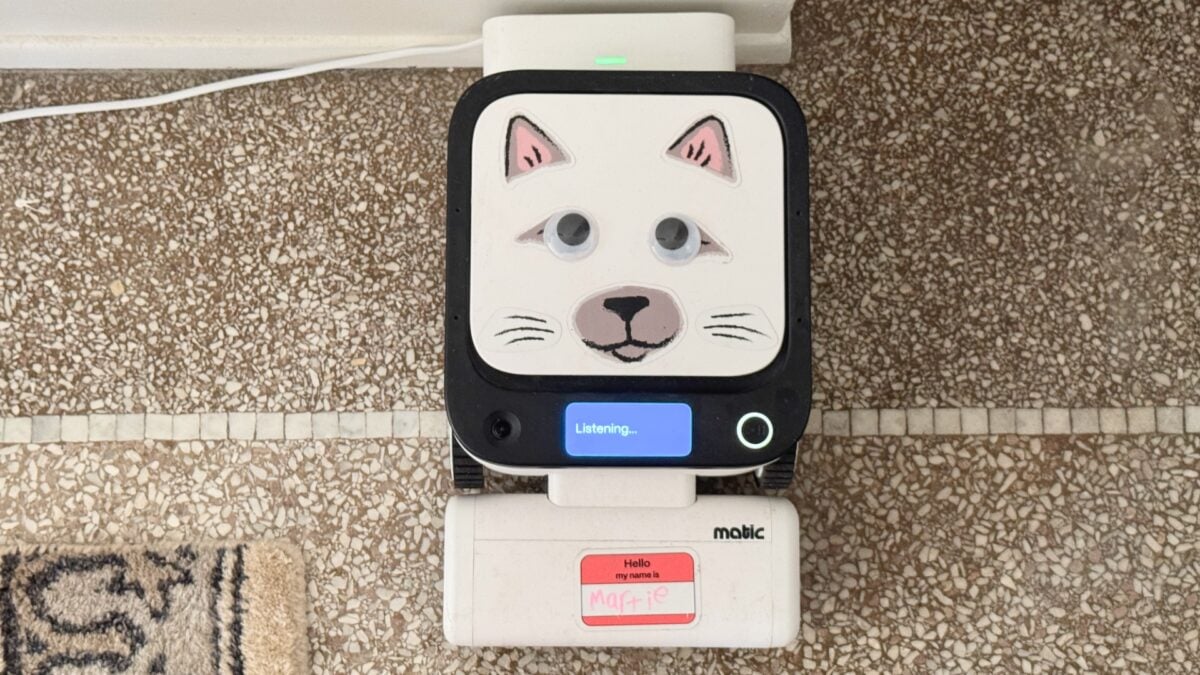
I haven’t been particularly quiet about how much I like the unusually boxy, upright Matic robot vacuum since reviewing it last year. Even if it can’t get under my couch, it’s so smartly designed and so effective everywhere else that it has become the yardstick by which I judge all other floor-cleaning automatons. Now, after many months of steadily ticking smaller feature checkboxes, Matic has rolled out a big update that brings voice and gesture control. Together, the new input methods are called “Matic Cues.” Starting today, Aug. 13, owners with the new firmware will be able to use the wake phrase “Hey Matic” and issue natural language commands to the robot, which are then processed in cloud servers by Google Gemini. These can be as simple as “start cleaning” to initiate a whole-home cleaning job or as complex as “vacuum the dining room rug and then mop the hard flooring in the bedroom.” You can also ask the robot to follow you or say something like “clean this” while pointing at a spot on the floor to have it do a quick spot clean. I’ve been testing the features out for a few days. When you say its wake phrase, it will turn to face you as its screen lights up with a blue background and the word “Listening…” The only feature that I thought still needed work was having the robot follow me—it was easy for it to lose track of me if I rounded a corner or walked by a chair. (It had a tendency to shift focus to the chair legs instead of my human ones.) © Screenshots by Wes Davis / Gizmodo Everything else worked well, though. In one test, I dumped some cornmeal on the ground in my kitchen and some scraps of paper on my living room rug before pointing to each spot to ask it to clean them. (I quickly realized that the Matic was just spot cleaning, not recognizing the mess I pointed at and cleaning that.) It responded by either backing up to get a better look at me or telling me, using text on its display, to step back for the same reason if it didn’t have room to reverse, then cleaning up the spot I’d pointed out. The Matic also successfully carried out complex requests—the example from the above paragraph was one I used the morning before I started writing this story. It was nice to be able to quickly ask the robot to vacuum in one room and mop in the other as a single job. Matic’s app doesn’t let you set cleaning preferences on a per-room basis, making the voice command the first time that’s been part of the robot’s feature set. © Wes Davis / Gizmodo I asked Matic co-founder Mehul Nariyawala in an interview this week if users will be able to do that in the app. He responded that the company hasn’t before now because it doesn’t want to overcomplicate the app. “The answer is yes, we absolutely want to do this, but from here onwards, we want to approach everything voice-first.” (Other robot vacuums I’ve reviewed, like the Eufy Omni E28 and the Narwal Freo Z10 Turbo, let you set per-room cleaning preferences in their associated apps, but I wouldn’t call any of their implementations graceful.) Overall, it’s a nice update that Matic owners may appreciate, especially since it lets others in the home operate it without having to deal with an app. In my apartment, it responded quickly to my commands, almost immediately starting the job I’d asked for, most of the time. That said, it’s the first Matic feature I’m aware of that requires an internet connection. That’s a bummer, because one of my favorite things about the Matic is that it’s otherwise fully controllable via Bluetooth alone, so I don’t have to worry about it being bricked by an internet outage or the company going under. The future of the Matic robot vacuum Nariyawala says the company hopes to distill the Matic’s AI model enough that its voice features work sans internet, at least within the 4GB RAM constraint of the robot’s onboard Nvidia Jetson Orin chip. It wouldn’t quite be as capable as with a connection to the company’s cloud-based models, but he says customers who prefer a local-only model will still “get 80% of the benefit.” The company also plans to upgrade the Matic robot so that it can identify furniture and other objects it encounters in homes. Nariyawala says Matic’s goal is to make it so you can ask the device to, for instance, clean around toys—he showed me a video demo of its vision model identifying things like balls and stuffed animals as the robot cruises around—or near things like a fridge or a couch. I also watched a demo of the Matic tidying up by using its cleaning head to gently push a shoe so it’s sitting next to others already in a row. Nariyawala says the goal is for the Matic to eventually go on scouting runs, cleaning up messes as it finds them. Nice ideas, although I’d hold the applause until such features are actually finalized and released and we get to see how well, or poorly, they work. © Wes Davis / Gizmodo As for the more immediate future, Nariyawala says that within a month, the company plans to expand its new voice-first approach even to setting up the robot: “Instead of pressing start mapping, we just want them to say, ‘Hey Matic, start mapping.’ So from the get-go, it’s around voice … maybe nine months from now, there’s just a simple chat window or a voice button in your app, and you just tell it what to do.” Nariyawala says this voice-first approach could even include creating schedules and such, adding that you would “never have to go around and tap on those manual buttons.” Responding to an emailed follow-up question, Nariyawala said the company won’t go voice-only—the app will continue to have a menu interface. Which is good! The idea of getting rid of graphical user interfaces comes up a lot in tech—you know, a Star Trek-like future where the computer is just this ambient thing that you talk to but don’t interact with otherwise. That idea is the basis of so many AI devices, yet gadgets like the Rabbit R1 or the Friend AI pendant have failed to find much of an audience. Even in Trek, digital interfaces are everywhere. Piloting spacecraft or managing systems is still handled by human beings (or aliens, or androids, or whatever) at consoles. Going all-in on voice may sound appealing, but as a person with way too much smart home crap in his life and smart speakers to control them, I would often rather press a button in an app. After all, I’m a garbage public speaker. I trip over my words or hesitate, then robots or smart speakers stop listening prematurely and do whatever they think I asked for, and then I just get frustrated. I’m used to this and fine with it, but not everyone is! The next Matic will have to wait I talked with Nariyawala last year, before my review of the Matic. During that conversation, he said the company hoped to release a follow-up model to the Matic in 2027, something I asked him about during our most recent interview. It sounds like that probably isn’t happening—he now says the company’s aim is to “maximize this hardware” before working to create a new Matic robot vacuum. © Wes Davis / Gizmodo When I asked if the new U.S. robotics ban affected the company’s decision-making, he told me it hasn’t. The FCC now requires that companies source at least 65% of their robotics parts from U.S. manufacturers. Matic has reached out to the FCC to request an exemption, and Nariyawala says he believes the company will get one, adding that the agency has “been very cooperative” in these discussions. What’s been more impactful is the ongoing components shortage. “Memory prices literally have gone from $12 for 4GB last year to about $120 now,” Nariyawala said. “So just the memory crunch, the CPU crunch.” He called this a “good constraint” that’s forcing Matic to get as much out of its robot’s 4GB of RAM as possible. Component price hikes have affected the Matic’s affordability. When I reviewed it, the robot vacuum already cost $1,095. It has since risen to $1,245—which the company blamed on import tariffs that “raised the cost of components”—and is scheduled to increase again, to $1,495, on September 9, 2026.
Matic’s Robot Vacuum Will See (and Hear) You Now
Full Article
Original Source
Read the full article at Gizmodo →KhanList aggregates and links to publicly available news content. We do not host full articles from third-party sources. Always verify important information with original sources.