
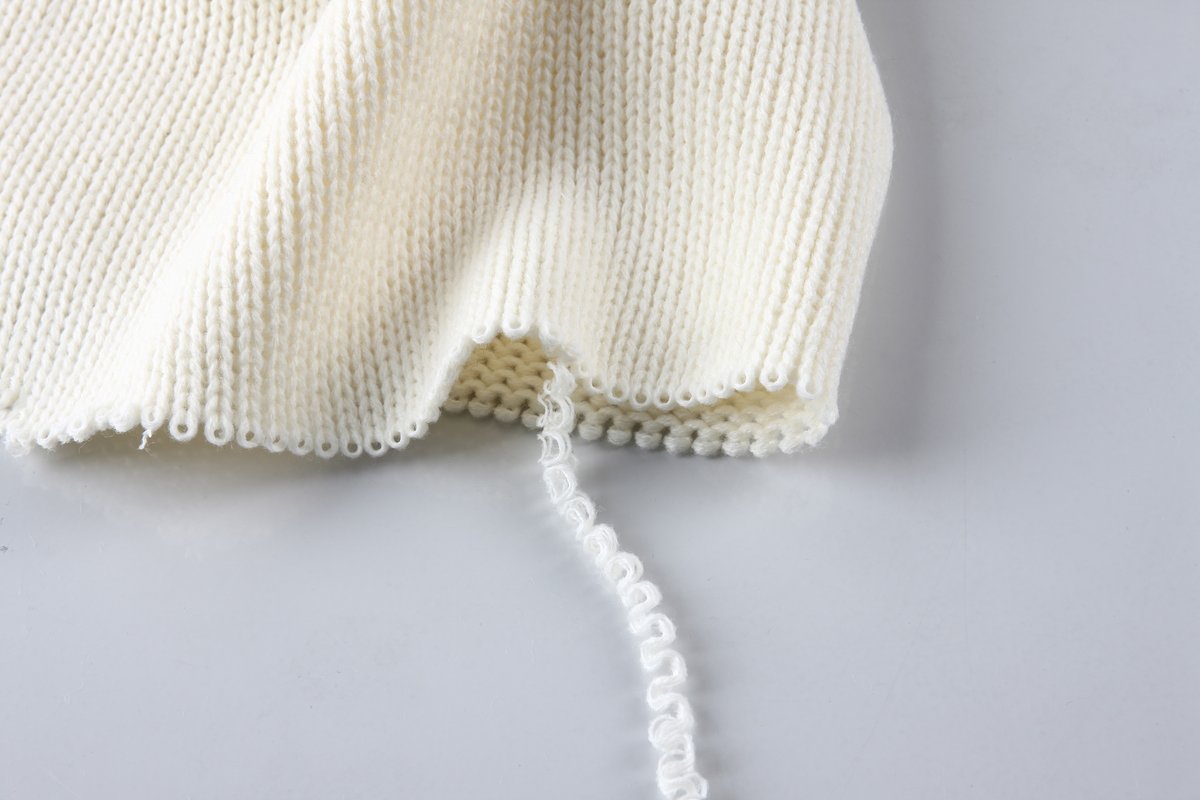
October 8, 20262 min read Add Us On GoogleAdd SciAmWith a little help from knot theory, scientists have invented a “robust knit” to fight laddering glamstock/Imazins/Getty ImagesDespite its tranquil reputation, knitting is anything but boring. One stitch slip-up can cause a defect that spreads across the entire fabric. But does it have to be that way? In a recent paper in Physical Review X, a team of researchers mathematically investigated knitting to invent a new, more resilient stitch.Knitting is a special form of fabrication in which the two ends of the yarn remain outside the fabric. In knitting, loops from the middle of an entangled yarn are slipped through one another so the yarn holds its position but isn’t knotted together. The knitting process is portable and easy, but the structure also means a tug on one loose end can quickly unravel the whole project. It’s also vulnerable to other quickly spreading errors.Daisuke S. Shimamoto, a physicist at Ritsumeikan University in Japan, and his colleagues wrapped a three-dimensional model of a single jersey knit stitch—a simple beginner’s stitch—around a doughnut shape called a torus, which preserves the pattern without including any edges at the top or bottom. It basically converts the knit pattern into one giant knot that can be analyzed with knot theory. The scientists projected multiple knit rows on the torus to reveal how defects from one row of stitches spread until the entire fabric unravels. The process is called defect propagation, and the researchers say it’s one of the defining characteristics of knittable fabrics.On supporting science journalismIf you're enjoying this article, consider supporting our award-winning journalism by subscribing. By purchasing a subscription you are helping to ensure the future of impactful stories about the discoveries and ideas shaping our world today.Amanda Montañez; Source: “Topological Defect Propagation to Classify Knitted Fabrics,” by Daisuke S. Shimamoto et al., in Physical Review X, Vol. 16; July 14, 2026 (reference)Researchers have mathematically described stitch defects in the past, says applied mathematician Alexander Omelchenko of Constructor University in Germany, but only as static objects. This study shows how defects move dynamically across a textile. “It’s a very original approach,” says Omelchenko, who wasn’t involved in this study but originated the topological analysis method used.One common type of defect propagation is “laddering,” in which a single missed loop slips down a column of stitches, unraveling the whole column along the way. “If one unit cell is disentangled, the cell just below that cell is disentangled, and it is repeated, and it propagates endlessly,” Shimamoto says.After his topological analysis of the jersey knit, Shimamoto used moves from basic knot theory to design a knittable stitch in which defect propagation can still happen but not endlessly. This “robust knit” is a complex stitch with sweeping loops that cross over through two stitches rather than one, and it reduces propagated defects row by row until they stop. Defects expand only when there is more than one slipped stitch in a row.Amanda Montañez; Source: “Topological Defect Propagation to Classify Knitted Fabrics,” by Daisuke S. Shimamoto et al., in Physical Review X, Vol. 16; July 14, 2026 (reference)Omelchenko appreciates the study authors’ ability to translate math to real life but notes that fully evaluating the possibilities of new stitches by using torus diagrams would be impractically expensive to compute. Shimamoto hopes his work with the robust knit, as a proof of concept, can one day inspire stronger fabric design for manufacturing.Besides a fascination with fabric, the two researchers have another thing in common: both consulted their mothers’ knitting advice for their papers, and Shimamoto even gave his mother an author credit as a thank you for teaching him how to knit. According to Omelchenko, “It sometimes was a little bit more useful to talk with her rather than textile researchers.”Subscribe to Support Independent JournalismGreat science journalism requires human expertise, time, effort and creativity. And it costs money. That’s why I and the journalists here at Scientific American hope you’ll join our community.When you subscribe, you are supporting staff and freelance journalists who are passionate about telling science stories that are true, important and compelling. Our editors and reporters are often experts in their fields, which means they understand the nuances of big discoveries and can untangle the breakthroughs from the hype. With a subscription, you are also supporting rigorous fact-checking to ensure the words we publish are precise and accurate. And you’re supporting original illustrations, graphics and photos that bring you closer to an advanced laboratory, an ice sheet in Antarctica or a space mission in orbit. You’re helping us craft other types of high-quality journalism as well: Our newsletters are carefully written, edited and curated by staffers you have or will come to know and love. Our Science Quickly podcast is based on original reporting, collaboration with editors and scientists and exacting production.Subscriptions keep this engine running so we can continue to deliver thoughtful, rigorous and independent science journalism to you. In an era of viral misinformation, this work is crucial. If you value what we do, I hope you’ll consider joining us as a subscriber
Mathematicians invented a knitting stitch that stops mistakes from spreading
Full Article
Original Source
Read the full article at Scientificamerican →KhanList aggregates and links to publicly available news content. We do not host full articles from third-party sources. Always verify important information with original sources.