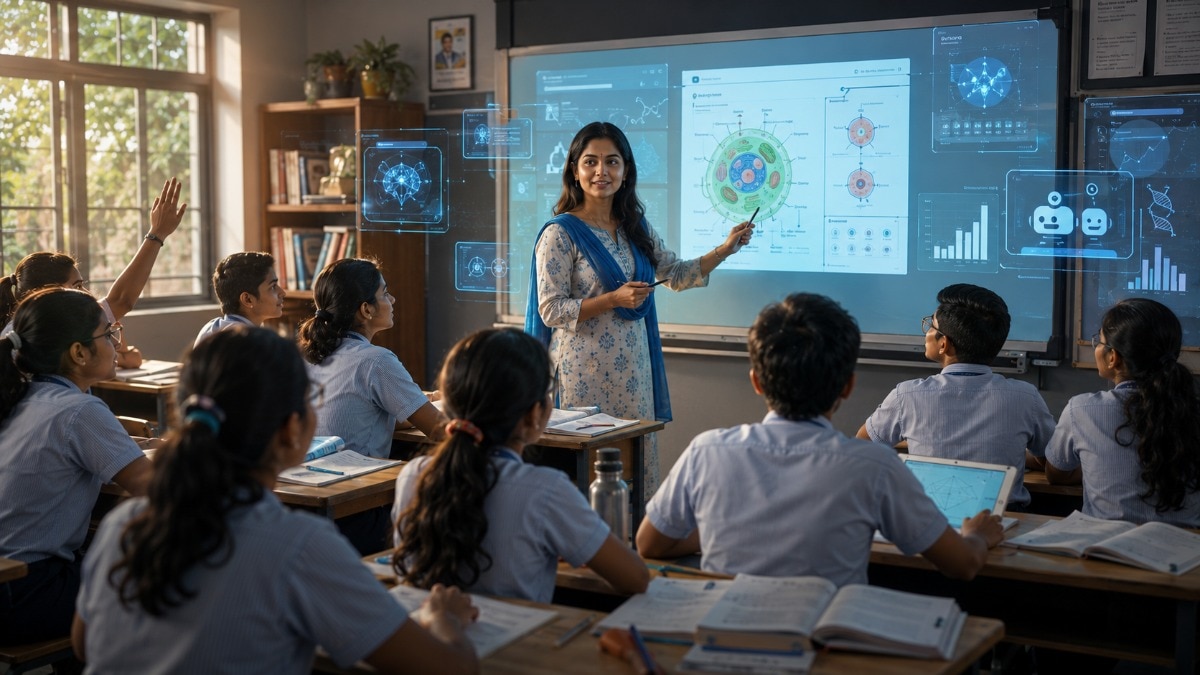
The piece argues that mastery learning can help Indian schools address unfinished learning through flexible support and assessment. It says AI can make that approach workable at scale by identifying gaps early and guiding teachers.The piece argues that mastery learning can help Indian schools address unfinished learning through flexible support and assessment. (AI-generated image)Every year, millions of children move to the next grade carrying unfinished learning with them. A student who has not fully understood fractions is expected to learn algebra. Someone who struggles to read fluently is asked to comprehend longer passages the following year. The curriculum moves ahead, but not every learner does.For a long time, this has been accepted as part of the education system. Teachers do what they can, students work hard, and examinations measure outcomes at fixed points. Yet the gaps remain.The conversation around school education is changing. With the National Education Policy (NEP) 2020 placing greater emphasis on competencies rather than memorisation, schools are beginning to ask a different question. Instead of asking whether a chapter has been completed, they are asking whether students have truly understood it. That shift brings Mastery Learning back into focus.LOOKING AT DIFFERENT SPEEDSThe idea behind Mastery Learning is not new. Benjamin Bloom introduced the concept more than five decades ago, but its central message is even more relevant today. Children do not learn at the same pace. Some understand a concept after one explanation. Others need more examples, more practice or simply more time. That difference should not be treated as a weakness, it is simply how learning works.Traditional classrooms rarely have the flexibility to account for this. Everyone follows the same timetable, writes the same tests and moves to the next lesson together. Whether a student is ready or not often becomes secondary to completing the syllabus. Mastery Learning turns that thinking around. Its philosophy is simple: learning is fixed, while time and support are flexible. Instead of expecting every child to learn within the same timeframe, it expects every child to achieve mastery before progressing further. Teachers assess students before introducing a new topic to understand whether the student has the required knowledge, making sure that foundational gaps are identified and addressed early on.WHY THIS MATTERSThe direction of school education in India is changing. The NEP and the National Curriculum Framework have both made it clear that education must move beyond marks and memorisation towards Competency-Based Learning (CBL), conceptual understanding, critical thinking and problem-solving.That sounds straightforward, but it demands a different way of teaching. A child cannot demonstrate competency without first building strong fundamentals. When those basics are weak, everything that follows becomes harder.Mastery Learning helps in this shift by making sure that students advance after they showcase their understanding, application or analysis of a concept, depending on the learning outcome expected. For example, if a child in Grade 2 has missed learning a concept, it can become a problem in higher grades. Mastery Learning averts this by identifying the gaps early on.Instead of depending on only end-term summative assessment of learning, it encourages a formative assessment for learning. These are not designed to rank students but to provide regular diagnostic feedback, helping teachers understand where learners are struggling and enabling timely intervention before misconceptions become permanent.MAKING IT A REALITY IN AI ERAAsk any teacher what makes personalised learning difficult, and the answer is usually the same - ‘time’.In a class of forty or fifty students, every learner is at a different stage. One needs extra practice. Another has already mastered the topic. A third may have missed school altogether.Keeping track of all of that manually is close to impossible. This is where AI technology can support education, not by replacing teachers, but by making Mastery Learning more practical at scale.By constantly identifying concept-level learning gaps, initiating learning pathways, and giving real-time insights to educators, AI can make individual learning a practical method across educational institutions, thereby enabling Mastery Learning at scale.AI – generated diagnostic assessments, at each concept or learning outcome level, can recognise existing gaps before new ideas are implemented. When learning pathways are made flexible, it can become personalised by giving targeted methods to students who need extra support.AI enables students to get personalised help through various teaching methods. If they are ready to move faster, they are challenged with deeper learning opportunities. The objective is not to slow the class down, but to prevent small learning gaps.Technology, therefore, becomes an enabler and not the centrepiece. Its real value lies in giving teachers the visibility and time needed to personalise learning for every student.MEASURING SUCCESSEducation is often, unfortunately, rewarded for speed. Finish the chapter. Finish the textbook. Finish the examination. Mastery Learning asks a different question: Did the student truly learn?That is a more demanding benchmark, but it is also a more meaningful one. As schools adopt competency-based learning, the focus moves beyond completing curriculum to make sure that students understand concepts genuinely. By diagnosing incapabilities early on, constant guidance, collaborative learning methods and timely human intervention, educational institutions can close this gap and assist teachers to focus on teaching and mentoring – which are essential requirements.When every child is given the opportunity to understand before moving ahead, better academic outcomes are only one part of the result. Students gain confidence, curiosity and the belief that they can learn. With the combination of Mastery Learning and AI technology, India can build collaborative and adaptive classrooms and foster a new generation of poised, talented and future-ready learners.- EndsPublished On: Jul 29, 2026 20:03 IST
Mastery learning in the AI era: Reimagining India's classrooms
Full Article
Original Source
Read the full article at Indiatoday →KhanList aggregates and links to publicly available news content. We do not host full articles from third-party sources. Always verify important information with original sources.