
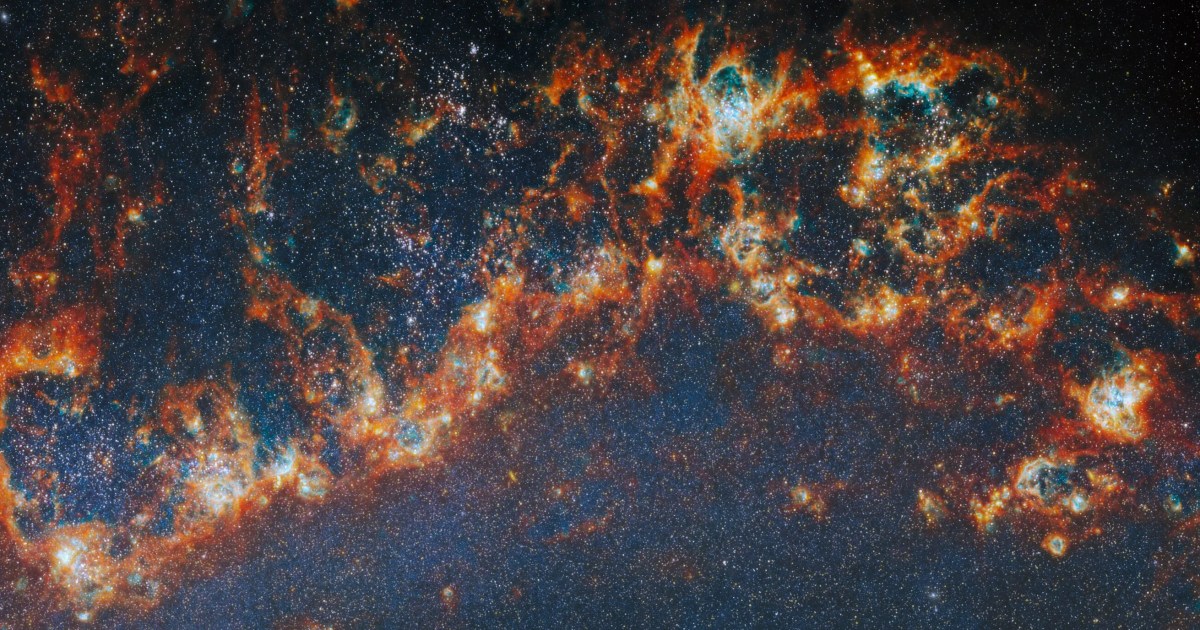
JWST and Hubble observe nearly 9,000 star clusters and learn which reach maturity first. | Published: September 22, 2026 One of the Whirlpool Galaxy’s spiral arms resolves into dozens of stellar nurseries that one day will produce massive open star clusters. Each of the nascent clusters spans up to 100 light-years. This JWST infrared image, combined with Hubble observations at optical wavelengths, shows that more massive clusters emerge from their birth clouds more quickly. Credit: ESA/Webb, NASA & CSA, A. Pedrini, A. Adamo (Stockholm University), and the FEAST JWST team One of the Whirlpool Galaxy’s spiral arms resolves into dozens of stellar nurseries that one day will produce massive open star clusters. Each of the nascent clusters spans up to 100 light-years. This JWST infrared image, combined with Hubble observations at optical wavelengths, shows that more massive clusters emerge from their birth clouds more quickly. Credit: ESA/Webb, NASA & CSA, A. Pedrini, A. Adamo (Stockholm University), and the FEAST JWST team Astronomers understand the basics of star formation. It starts in giant molecular clouds when an event — perhaps a nearby supernova or a collision with another cloud — triggers a high-density region to collapse under the force of gravity. The region fragments into individual pockets that eventually contract into stars within a cluster. The more massive stars emit copious amounts of high-energy ultraviolet radiation and fierce stellar winds, and they eventually explode as supernovae. These forces — collectively known as stellar feedback — disperse the cluster’s remaining gas well before much of it can be incorporated into new suns. Yet how long this process takes and how it depends on a cluster’s intrinsic properties have remained open questions. And computer simulations struggle to replicate what astronomers see. A massive survey Researchers have now turned the powerful eye of the James Webb Space Telescope (JWST) on thousands of clusters in four nearby galaxies to answer these questions. They find that the most massive clusters emerge from their natal clouds and unleash a torrent of ultraviolet light in about 5 million years, while less massive ones take between 7 million and 8 million years. Heavyweight clusters thus have a much bigger and earlier impact on their surroundings and how their host galaxies evolve. Despite JWST’s unique abilities, scientists also needed to use archival images from the Hubble Space Telescope. JWST’s infrared vision penetrates the gas and dust surrounding the youngest clusters, allowing researchers to view those still totally cloaked in their formative material and those starting to emerge from their nurseries. Hubble, which records visible light, targets mature clusters clear of gas and dust. By studying the spectral fingerprints of the clusters, the astronomers estimated the mass and age of each. The team focused on four galaxies — the Whirlpool Galaxy (M51), the Southern Pinwheel Galaxy (M83), the Phantom Galaxy (M74), and NGC 4449 — each of which provides a unique perspective. Although the Milky Way might seem a more promising target, Earth and most of our galaxy’s young clusters reside in its disk, hindering clear views. The chosen four are close enough to study in exquisite detail but far enough away that a multitude of clusters appear in every image. The prominent spiral arms of the Whirlpool are chock-full of stellar nurseries and the star clusters they give birth to. It lies about 27 million light-years from Earth in the constellation Canes Venatici. The Southern Pinwheel boasts an unusually high rate of star formation and has witnessed six supernovae in the past 105 years. It resides 15 million light-years away in Hydra and is one of the closest and brightest barred spirals. The Phantom is a spiral galaxy located 32 million light-years from Earth. It appears face-on to us and thus allows astronomers to study its entire disk. An intense burst of star formation and totally different structure set the dwarf irregular galaxy NGC 4449 apart from the others. It lies 12 million light-years away in Canes Venatici. All told, the team studied 8,897 clusters. The survey comes as part of Feedback in Emerging extrAgalactic Star clusTers (FEAST), a JWST program designed to investigate stellar feedback and the emergence of clusters in nearby galaxies. FEAST principal investigator Angela Adamo of Stockholm University and the Oskar Klein Centre in Sweden and her team reported their results in the May 6 issue of Nature Astronomy. Planet perspective Despite the focus on stars, the new observations also affect theories of planet formation. Planets form in the disks of gas and dust surrounding newborn stars. Intense ultraviolet radiation from nearby suns erodes these disks, and the faster this happens, the smaller any resulting planets will be. This makes it less likely that gas giant worlds, which appear to be crucial in forging planetary systems like ours, will form in the most massive clusters. Contributing Editor Richard Talcott wrote about JWST’s observations of protostar EC 53 and the formation of silicate crystals in the August issue.
Massive star clusters drive galaxy evolution
Full Article
Original Source
Read the full article at Astronomy →KhanList aggregates and links to publicly available news content. We do not host full articles from third-party sources. Always verify important information with original sources.