
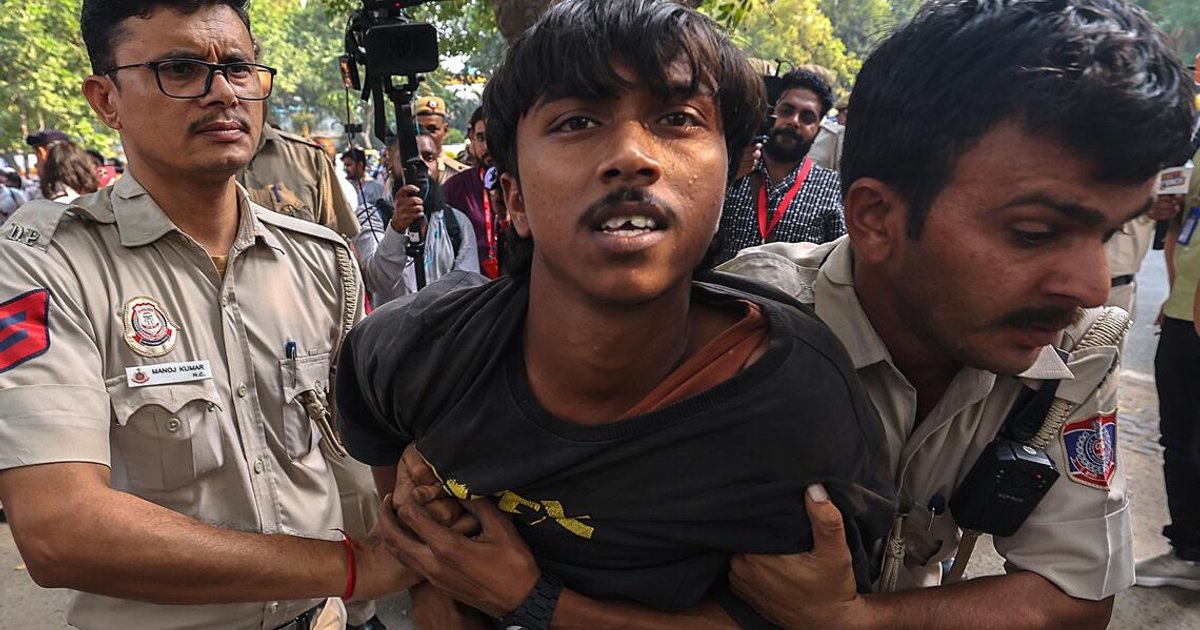
NEW DELHI – When Indian police closed in on young protesters in New Delhi in October, Simran locked hands with a friend. They made a quick pact: if they were getting hauled away, they were going together.Soon, half a dozen officers wrenched their fingers apart.Simran, a 25-year-old doctoral student who asked to be identified only by her first name due to fears of retribution, recalled being dragged across the asphalt toward a waiting police bus.She watched her friend disappear into another.Simran was brought to a makeshift detention centre in a sports complex some 20km outside New Delhi, where she reunited with her friend.They saw security officers seize phones and physically intimidate protesters at the site, with one pulling Simran’s hair while she sat quietly.She recalled that female officers also made sexually threatening remarks to women protesters, telling them that “girls like you come to the protests to get raped.”“I feel angry – I feel rage – because of all this,” Simran said.It was her third detention in October alone.The Delhi Police did not respond to repeated phone calls, messages, and in-person requests for comment.In affidavits filed with the court, police defended their actions as necessary to maintain order and prevent violence.India’s Ministry of Home Affairs, which oversees the capital’s police force, also did not reply to an emailed request for comment.Simran is one of thousands of young Indians who have repeatedly hit the streets in recent months to protest perceived unfairness in national exams and elections, posing one of the biggest challenges yet to Prime Minister Narendra Modi.After protesters affiliated with the Cockroach Janta Party pressured him into ousting his education minister in July, Modi has used mass detentions to try and stop the latest wave of protests before they get a chance to gain momentum. Many of those young demonstrators will again hit the streets on Nov 1, with opposition groups expecting one million participants at a large ground in centralDelhi traditionally used for official ceremonies, religious festivals and protests.Police have granted permission for the gathering provided that nobody marches anywhere and it wraps up at 5pm. While allowing the stationary protest on Nov 1, Modi’s administration has more broadly tightened controls on demonstrators.On Oct 10, his administration undertook mass detentions to prevent the Cockroach group from gathering at a location closer to Parliament – sharpening a debate over the space for dissent in the world’s largest democracy. More than 7,000 people were detained across Delhi that day, according to police sources cited by the Press Trust of India, about 100 times more than the July protests that forced Modi into a rare retreat.Police established at least 35 detention facilities across the capital region, including sports complexes, community centres and banquet halls, according to the volunteer-run Protest Support Initiative. The clampdown has spilled on to the internet, where government censorship has spiked sharply.Indian authorities have ordered more than 1,500 online take-downs in 2026 – six times the volume seen in 2025, according to tracking data from the digital rights group SFLC.IN.The government insists the orders are legal tools essential for combating misinformation and preserving public order. Across Delhi and beyond, young demonstrators described being phoned or visited by police before planned rallies, intercepted on their way to protests and – in some cases – confined to their homes.Other detainees told Bloomberg they were loaded onto buses and taken to holding centres as far as 50km outside Delhi. A day before the Oct 10 protest, the government warned Delhi Police of potential public-order risks from the Cockroach Janta Party demonstrations and asked authorities nationwide to consider preventive action, according to a letter signed by the Home Secretary seen by Bloomberg.The directive, sent to all states and territories, called for coordination with Delhi Police and said the group lacked permission to mobilise in the capital and posed a potential law-and-order threat.While Modi has not directly addressed the allegations of police brutality or the dispute over voter rolls, he has accused the opposition of fomenting unrest.In recent public remarks, Modi targeted Congress leader Rahul Gandhi and his allies, accusing them of attempting to derail India’s development by inciting street disruptions and manufacturing political controversy.Demonstrators push against a police barricade during a protest demanding the resignation of India's Chief Election Commissioner Gyanesh Kumar, in New Delhi, on Oct 3. PHOTO: REUTERSIndia’s sweeping detentions have attracted criticism from experts in the United Nations Human Rights Office, who in October called on the government to immediately release anyone arbitrarily detained and “to ensure that the right to peaceful assembly is fully respected and fulfilled.”India has rejected the criticism, saying the concerns are “unwarranted.” “Our law enforcement authorities act strictly in accordance with the law, and our courts remain available to all for the redressal of any grievances,” the Ministry of External Affairs said in a statement earlier this month.The main legal tool used by police is Section 163 of India’s revamped criminal code, which has evolved from a British colonial statute in the 1800s invoked frequently to suppress freedom fighters and thwart nationalist movements.The provision allows officials to issue sweeping, unannounced bans on assembly and movement whenever they deem public order to be at risk.Its frequent use over the years to stop protests in Delhi has been challenged at the Supreme Court, which ruled in 2018 that it can’t be used in perpetuity to stifle dissent.But since fresh orders can be issued at any time – one study found that 6,100 orders were issued in 2021 alone – they are nearly impossible to challenge.By the time the court holds a hearing on a given order, the protest date will have already passed and new decrees can be issued to stop fresh demonstrations.“If freedom of speech is absolute unless you create public disorder, how do you ban a peaceful protest?” said Colin Gonsalves, senior advocate practising in the Supreme Court of India.“Is it some magic mantra that you say Section 163 and everybody’s right to protest disappears, dissolves into the air? Obviously not.”After the Oct 10 protests, the Supreme Court held an unusual Sunday hearing, directing authorities to guarantee legal safeguards against detentions, keep internet access undisturbed, and ease widespread public transit curbs across the capital.Lawyers for the Cockroach protesters have sought to challenge police actions in India’s top court on two main grounds: Some people were detained in areas where no prohibitory orders were in force, and officers used excessive and disproportionate force against demonstrators who posed no immediate threat.According to affidavits submitted to the court, demonstrators were grabbed, struck, and dragged across roads into police buses without being told why they were being detained or where they were being taken.Cockroach Janta Party supporters holding the country's national flags protest, demanding India's Chief Election Commissioner Gyanesh Kumar's resignation over alleged voter roll irregularities. PHOTO: AFPTestimonies from female demonstrators submitted with the petitions allege they were subjected to physical groping, verbal abuse and inappropriate handling by male personnel during crowd dispersal and inside transport vehicles – violating statutory rules requiring female officers to detain women.Prashant Bhushan, a prominent Supreme Court lawyer known for pursuing anti-corruption and civil-liberties cases, alleged that officers seized phones to prevent detainees from recording beatings.He argued that detention buses should be equipped with CCTV cameras, just as police stations are required to have surveillance systems.“The manner of detentions was totally illegal,” Bhushan said. “They thought that by behaving in this brutal manner, they can scare these youngsters not to come back.”The latest protests revolve around allegations that the Election Commission of India purged voter rolls in a way that helped Modi’s ruling Bharatiya Janata Party.Both the government and the Election Commission, an independent body, have rejected the accusations, saying the exercise is needed to ensure the accuracy of electoral rolls.While the detentions have deterred some students, the voter-roll protests have since broadened from student circles and opposition parties to include the powerful farmer groups that forced Modi to roll back controversial farm laws in 2021. Harsh Solanki, a 20-year-old Hindu College student from neighbouring Uttar Pradesh state, said he was detained for about three hours on Oct 10. He said he should have the right to decide for himself whether to demonstrate. “The government is trying to suppress us and oppress us,” Solanki said. “I’ll go to the protest if I want to.”In one of the most aggressive moves of the latest crackdown, police boarded a commercial airliner to detain three leaders of the Cockroach Janta Party, which formed earlier in 2026, before they could deplane.Two of them, Saurav Das and Ashutosh Ranka, were later arrested during another protest and held in a Delhi jail for more than a week.Recalling his time in a high-security ward in October, Das said the pair were in isolation but treated respectfully by jail staff.“It was a detox from social media, and a detox from people as well,” Das said in an interview. “I had my peace and solitude inside jail.”Guards initially allowed them newspapers before swapping them for works of fiction.“Reading kept me busy. And a lot of thinking,” Das said. “We will rethink and re-strategise,” he added. “We are not giving up on this issue.”On the streets of the capital, the government earlier in October removed the designation of Jantar Mantar – a traditional area near the Parliament and government offices – as a designated site for demonstrations, replacing it with three spots further away from the centre of the capital. The historic site has seen 616 demonstrations since 2016, nearly four times that of any other location near Parliament, according to conflict monitor ACLED.For student organisers already dodging police crackdowns and internet take-downs, the move left them with virtually nowhere left to gather.For Simran, the repeated detentions have given her a mordant familiarity with Delhi’s holding cells.She jokes that she prefers the Kapashera facility on the city’s south-western border with Gurugram because the children’s section is breezy and the canteen offers all-you-can-eat meals for 80 rupees (S$1.08). “After a good thrashing, we go eat,” she said.On the front lines, students like Simran have adapted to the cycle of detentions. She now arrives prepared: running shoes, water, a protein bar, and exam prep.“Detention is designed to waste our time,” Simran said. “I try to make the most of my wasted time.” BLOOMBERG
Mass detentions stoke anger among young protesters in India
Full Article
Original Source
Read the full article at Straitstimes →KhanList aggregates and links to publicly available news content. We do not host full articles from third-party sources. Always verify important information with original sources.