
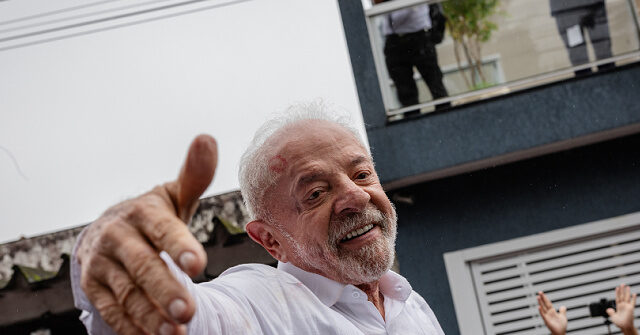
Socialist President Luiz Inácio Lula da Silva, 80, was elected president of Brazil for a fourth term in Sunday’s runoff election, narrowly defeating conservative Sen. Flávio Bolsonaro in a tightly contested race in which both sides alleged irregularities and the Supreme Court intervened to extend voting. At press time, with 99.76 percent remaining, Lula is in the lead with 51.75 percent, or about 64.066 million, of the votes. Sen. Bolsonaro has accumulated 48.25 percent of the vote, or about 59.725 million votes, creating a gap that authorities have deemed too large to overcome with the remaining vote. Lula’s return to power in Brazil in 2022 was historic, as the radical Marxist founder of the Workers’ Party (PT) is a convicted felon who was sentenced to upwards of 20 years in prison in 2019 on charges of misusing public funds during his first two terms as president. He was allowed to run for president once more through the grace of the nation’s top court, the Supreme Federal Tribunal (STF), which in 2021 overturned his conviction on a technicality, not revealing any new exonerating information regarding his case. Lula’s opponent, Sen. Bolsonaro, is the son of Lula’s 2022 presidential rival, former President Jair Bolsonaro. He announced his intention to run for president in December after the same STF convicted the elder Bolsonaro of “crimes against democracy” for questioning the integrity of the 2022 election and allegedly attempting to poison Lula, allegations Bolsonaro has aggressively denied. The elder Bolsonaro is currently on house arrest, as a result of various health problems, and banned from running for any public office until he is 105 years old. This time, Lula’s win is historic again as he defeated Sen. Bolsonaro after losing the first round of the election, the first time in decades a candidate has obtained the achievement. In Brazil, a first round of presidential voting includes all candidates and requires a candidate to receive 50 percent or more support to secure a presidential victory. If no candidate surpasses the 50-percent threshold, the top two candidates move on to a runoff election without the rest of the candidates in which the person with the largest absolute number of votes wins. Sen. Bolsonaro won the first round of voting with 47.12 percent support — somewhat of a surprise as the total represented a larger amount of support than polling anticipated, but nonetheless insufficient to avoid a runoff election. Lula, vying for his fourth term in office, received about 45 percent of the vote in that race. Most major polls prior to Sunday’s vote also showed the senator with a slight lead, though many were within the margin of error. The election on Sunday was affected — marred, critics alleged — by a decision by the country’s top court, the Supreme Federal Tribunal (STF), to allow for the extension of voting times after Lula’s campaign reportedly complained of a bus shortage for transport. The cities in which the Lula campaign reportedly complained that transport issues had prevented voters from reaching the polls — Salvador, Lauro de Freitas, and Feira de Santana — are all in Bahía, part of the northeast, which has long been a PT stronghold. STF Justice Cristiano Zanin issued an unprecedented, single-justice ruling late in the voting time to extend voting by two hours, closing polls at 7 p.m. local time, rather than 5 p.m. as previously anticipated. The ruling was notably a success for Lula after he attempted a similar move in 2022, when he ran against Sen. Bolsonaro’s father, then-President Jair Bolsonaro, but another STF justice, Alexandre de Moraes, rejected the move. Zanin’s decision was controversial not just because of its unprecedented nature and the fact that no other STF justice participated in the ruling, but because he ruled that only polling stations that had not closed at the previously agreed-upon time could remain open. Once polling stations are closed, to preserve integrity, poll workers cannot easily reopen that process, so those that refused to close at the appropriate time — presumably, those advocated for by the Lula campaign — obtained an extra two hours to collect votes. In addition to the STF decision, local authorities reportedly ordered the arrest of Pablo Souza, the Secretary of Transport of Salvador, over the alleged bus incident. Follow Frances Martel on Facebook and Twitter.
Marxist Lula Beats Bolsonaro in Brazil Presidential Election After Unprecedented Voting Time Extension
Full Article
Original Source
Read the full article at Breitbart →KhanList aggregates and links to publicly available news content. We do not host full articles from third-party sources. Always verify important information with original sources.