
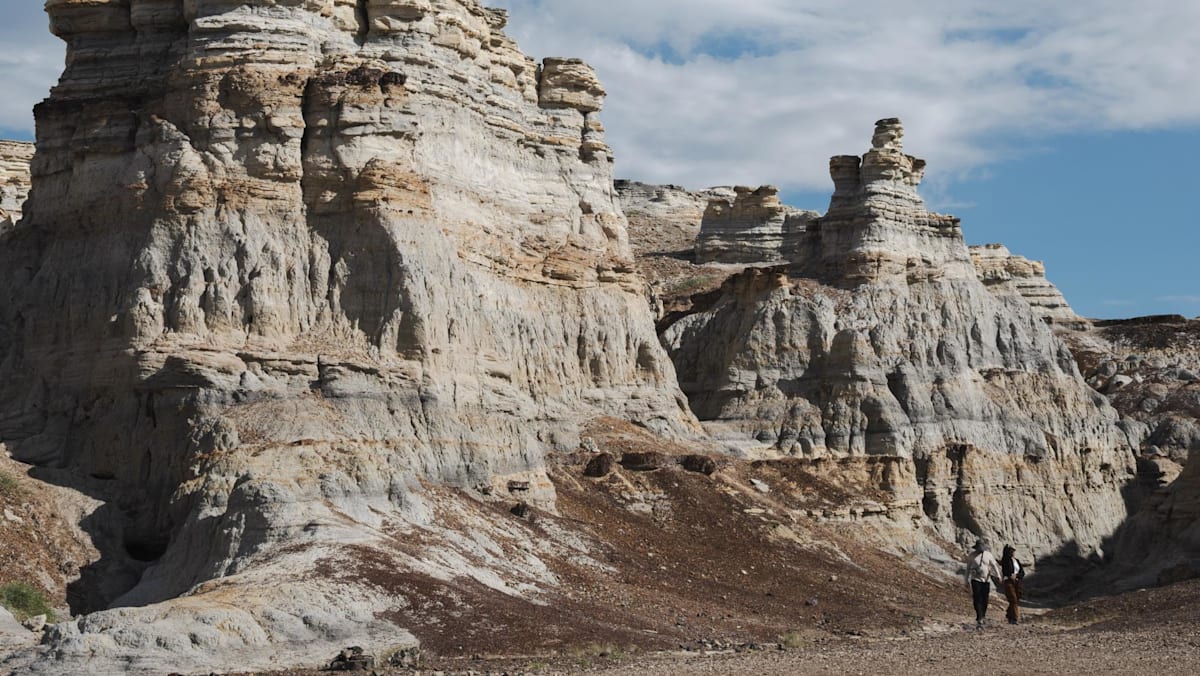
I am sitting in the back of a four-wheel drive (4WD), the camping equipment rattling in the boot as the car lurches over a track that barely seems to exist.Over the next four days, I am set to cover roughly 970km on-road and another 230km off-road, and there is no graceful way to describe some of the latter.About eight hours into the road trip, through the windscreen and the window beside me, I can see little beyond a thick cloud of dust and I begin to wonder about the driver's confidence in navigating through what is almost zero visibility, when we come to a staggering halt.It takes a few seconds for the dust to settle before the view emerges. What I see is an 80m cliff dropping beneath us, with the vast white expanse of the Tuzbair salt flats stretching towards the horizon. From the chalk-white escarpments to the salt-crusted basin below, the Tuzbair salt flat looks like a lunar landscape. (Photo: Avantika Chaturvedi) “We're here!" says Arailym, our 25-year-old Kazakh guide, as though we have simply pulled up outside a hotel. WILD CAMPING UNDER THE STARSIn fact, it kind of is: This is the first campsite of our expedition through Mangystau with Red Maya Travel, in the far west of Kazakhstan. I had met the Red Maya team in Aktau, the Caspian Sea port city that serves as the gateway to Mangystau. Travellers can connect to Aktau via international hubs such as Istanbul or Dubai, or fly into Almaty or Astana and take a domestic connection.By sundown, the drivers have doubled up as chefs, preparing chicken pasta in a makeshift galley at the back of one of the three 4WDs in our convoy, while we lie on carpets watching the Milky Way spread across the sky.Wedged between the Caspian Sea and the Ustyurt Plateau, a vast, arid tableland stretching across parts of Kazakhstan, Uzbekistan and Turkmenistan, much of Mangystau lay beneath the now extinct Tethys Sea hundreds of millions of years ago. As a scuba diver who has travelled far and wide to descend underwater, there is something absurdly pleasing about arriving in the world's largest landlocked country, only to find myself standing on a former seabed. A makeshift dining area between the chalk cliffs of Mangystau are amongst the simple pleasures of travelling through this remote landscape. (Photo: Avantika Chaturvedi) Marine life once thrived here and the region's rocks still contain fossils and traces of prehistoric sea creatures, including shells, ammonites and shark teeth. The Tethys deposited layers of sediment that geological upheaval eventually exposed as chalk, limestone and clay formations now sculpted by wind and water over unfathomable stretches of time.JURASSIC ROCK AND UNDERGROUND MOSQUESWe are reminded of this at Torysh the next morning, where hundreds, if not thousands, of enormous stone spheres appear almost out of the blue, scattered across a stretch of desert only a few tens of kilometres wide. Scattered across the steppe, the enormous stone spheres of Torysh are geological curiosities shaped by processes unfolding over millions of years, offering a glimpse into Mangystau’s ancient past. (Photo: Avantika Chaturvedi) Some are almost perfectly round, others cracked open, and some as large as a tractor. “These are concretions,” explains Arailym. “They are geological formations that formed within ancient sediments and were later exposed as erosion stripped away the surrounding rock.” The further we travel through Mangystau, the harder it becomes to separate the spectacular from the historical. At Kokala, the earth changes palette completely and the desert is suddenly streaked with colour. Layers of Jurassic clay appear in shades of white, crimson, purple and greenish grey, weathered into ridges, columns, gullies and miniature canyons dating back around 200 million years, when dinosaurs walked this land. The further you wander into Kokala’s sculpted ravines, the more the landscape seems to fold in on itself, revealing another layer of its ancient geological history. (Photo: Avantika Chaturvedi) But the story of Mangystau did not end with the retreat of the sea. Over the centuries, people learnt to navigate, inhabit and make meaning from this unforgiving landscape. The ancient Silk Road once crossed the region, connecting Central Asia with the Volga Valley, the Caucasus, Persia and, ultimately, the wider world. Sherkala, a solitary, yurt-shaped 308m mountain, is a reminder of this history, with local legends telling of Kazakh soldiers who held its summit against Turkmen forces after creating a passage through the rock to bring food and water to their position. Rising alone from the Mangystau steppe, Sherkala, a 332-meter-high chalk and limestone mountain in Mangystau Kazakhstan, resembles a giant yurt. Its name translates to “Lion’s Fortress”. (Photo: Avantika Chaturvedi) The underground mosques of Mangystau, five of which have been recently inscribed on the UNESCO World Heritage list, are perhaps the most profound expression of that relationship. Tracing the early spread of Islam through the region, these places of worship were carved directly into its soft limestone and chalk, where the boundary between architecture and geology almost disappears.The landmarks are dramatic, but it is the enormous distances between them that make Mangystau feel so remote. Double-humped Bactrian camels are the only companions on the road through the expansive steppe of Mangystau, where nomadic pastoral traditions remain closely tied to the rhythms of the arid landscape. (Photo: Avantika Chaturvedi) We spend hours driving through open country, passing the occasional herd of double-humped camels or wild horses, or stopping at an oasis for water. For four days, there is almost no phone signal, yet the changing colours and rock formations outside the window are enough to break the monotony of the road. Kyzylkup appears in layers of red and white sediment, stacked so neatly that the landscape has acquired the nickname Tiramisu Canyon. With its alternating bands of cream, rust and dusty pink, Kyzylkup has earned its nickname Tiramisu Canyon. (Photo: Avantika Chaturvedi) Nearby, Bokty Mountain – whose profile features on Kazakhstan's 1,000-tenge banknote – seems to have been christened by the same particularly hungry geologist. Meaning “pie” in Kazakh, a reference to the bands of contrasting white, ochre, red and grey rock across its slopes, Bokty is an isolated mass rising about 165m from the otherwise flat surroundings.MANGYSTAU: PAST, PRESENT AND FUTUREEventually, the desert gathers itself into Mangystau’s most famous features: the white cliffs and limestone formations of Bozzhyra, rising in enormous, sculptural shapes. The Fangs, two massive shards of limestone, have become the region’s signature image, while the Dragon Crest stretches across the plateau like the serrated back of some enormous fossilised creature. The landscape beyond is a succession of ridges, towers and sheer walls stretching towards an almost impossibly distant horizon – and somewhere among them, our camp for the final night. Against the deep blue sky, Bozzhyra’s distinctive rock spires, known as the Fangs, stand above a chalk-white slope shaped by millions of years of geological change. (Photo: Avantika Chaturvedi) From the ancient Tethys Sea to the people who learnt to navigate its exposed seabed, from Silk Road travellers and pilgrims to the communities that have lived here for generations, Mangystau has continually taken on new chapters. Now, increasing numbers of travellers from around the world are arriving to experience a part of the world that has long been remote and difficult to reach. International attention is growing too, including through Jackie Chan's Armour Of God franchise, whose latest instalment was filmed here and is due for release in 2027. New tourism infrastructure is also planned around Bozzhyra and elsewhere in the region. These plans have inevitably prompted opposition from locals concerned about how development could affect the ecosystem, especially in a region whose appeal rests partly on the integrity of its fragile desert environment. At the undulating white chalk formations of Akespe, erosion has carved the exposed terrain into an intricate landscape of ridges and hollows. (Photo: Avantika Chaturvedi) Having travelled through Mangystau by 4WD, sleeping in tents and yurts, eating dinners cooked at the back of a car and adjusting our plans to the whims of the weather, I also came to feel that how one experiences this landscape matters as much as seeing it. The time spent with local guides and drivers, learning how they navigate the terrain and understand their relationship with it, made Mangystau feel less like a collection of spectacular geological sites and more like a place shaped by generations of living alongside its extremes. Far from the nearest city lights, Mangystau offers a now rare kind of darkness, in which the Milky Way becomes impossible to ignore. (Photo: Avantika Chaturvedi) A quick drive to Bozzhyra, a few photographs and a night in a luxury hotel might make the region more accessible, but it cannot offer the same kind of encounter. Travel at this pace demands patience, resourcefulness and a willingness to relinquish control; it leaves you not simply with images of a place, but with a deeper sense of your own smallness within it. As destinations like Mangystau enter their latest chapter attracting more and more visitors, concerns about ecological damage and overtourism obviously exist, alongside concerns of the gradual reduction of a complex landscape to a handful of photogenic stops. Development need not be incompatible with conservation, but it should not erase the conditions that allow travellers to engage with Mangystau on its own terms.
Martian landscapes, underground mosques and wild desert camping in Kazakhstan's remote west
Full Article
Original Source
Read the full article at Cnalifestyle →KhanList aggregates and links to publicly available news content. We do not host full articles from third-party sources. Always verify important information with original sources.