
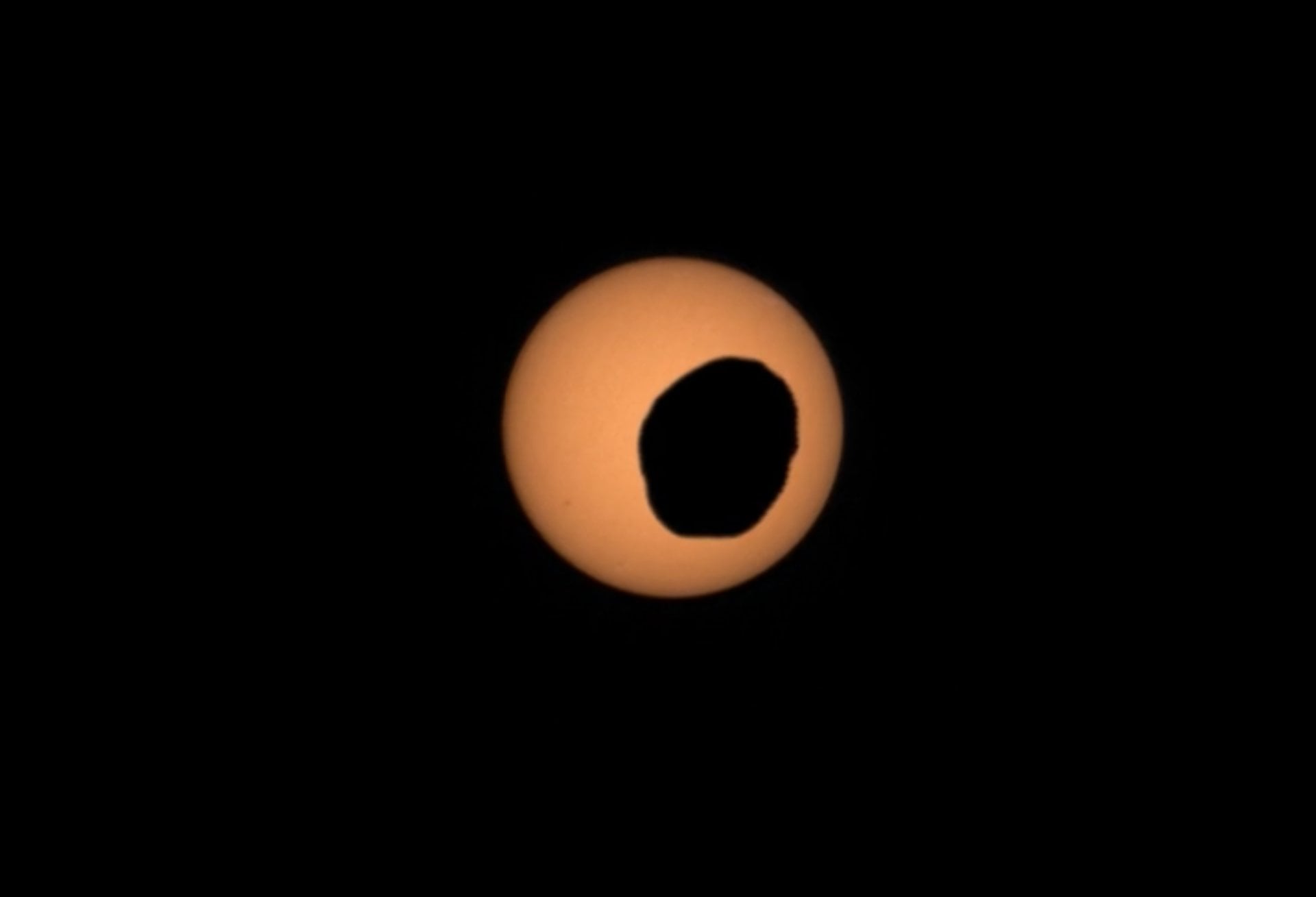
What’s so special about spotting Phobos crossing in front of the Sun? Sure. It’s just another image of Phobos, crossing the disk of the Sun, as seen from the surface of Mars. Like so much of the modern space era, these images, once amazing, are now almost routine. But there’s some real science behind tasking the Mars rovers to conduct a little ‘Martian astronomy.’ Opportunity was the first rover to directly spy a Mars moon transiting the Sun, way back in 2004. Viking 1 also caught the shadow of Phobos skimming its Chryse Planitia landing site in 1977. Both Curiosity and Perseverance have since made the effort to ‘look up’ and monitor the celestial scene on occasion. The latest image was captured courtesy of Percy’s main Mastcam-Z camera, and was taken on Mars Sol 1948 for the mission earlier this month on August 12th, 2026. A real-time view, of this month's Phobos solar transit. Credit: NASA/JPL-Caltech/ASU/MSS/SSI Do you say eclipse, occultation or transit? Certainly, Phobos’s irregular potato-shape silhouette lends itself to more of a misshapen annular eclipse of the Sun. Orbiting Mars at just under 6,000 kilometers above the planet’s surface, speedy Phobos takes just 7 hours and 39 minutes to orbit the Red Planet, faster than the planet rotates. It covers just a quarter of the apparent disk of the Sun at its maximum, and you would see it moving in real time, taking under a minute to cross the Sun’s disk. I know what you’re thinking… is it safe for Percy to stare at the Sun? “Mastcam-Z used solar filters, much like eclipse glasses, to take the images,” Mark Lemmon (Space Science Institute) told Universe Today. “The filter change was done before aiming at the Sun; the other order would not have resulted in damage, but that is a simple precaution. None of the instruments on the remote sensing mast can be damaged by the Sun when they are aimed that way and not in use.” The rovers witness other strange sights, including dusty blue sunsets, and transits of the lesser of the two Martian moons, Deimos. The rovers have even been tasked to try and spot interstellar comet 3I/ATLAS on its close 29 million kilometer pass near Mars on October 3rd, 2025, and the close 140,000 kilometer pass of Comet C/2013 A1 Siding Spring past Mars on October 19th, 2014. Percy follows Comet 3I/ATLAS on October 4th, 2025. Credit: NASA/JPL-Caltech/ASU/MSSS. And just recently, Perseverance caught a bizarre occultation of the Earth by Phobos. Mars is the only place in the solar system that you could stand on solid ground, and witness an asteroid-shaped body crossing in front of the Sun. The start of a Deimos solar transit in 2024. Credit: NASA/JPL-Caltech/ASU/MSSS. You’ll note that Percy also caught a few sunspots on the solar disk. These sorts of observations come in handy when Mars is near solar conjunction on the farside of the Sun versus the Earth. Percy noted a massive sunspot region in early May 2024, which later rotated into view for Earthbound observers and sparked an historic solar storm and auroral show about a week later. Sunspots on the solar farside seen by Perseverance in 2024. Credit: NASA/JPL-Caltech/ASU/MSSS. The Science Behind the Image Catching sight of Phobos crossing the Sun also allows researchers the chance to help and refine the positional orbits of the two Martian moons. “We image the transits because they give precise measurements, better than 100-meter accuracy, of the location of Phobos at a specific instant,” says Lemmon. “This constrains the Phobos orbit much better than can be done with the biggest telescope on Earth, since the rover is so much closer. The Sun makes for a great target as a reference for Phobos' position. Better knowledge of the orbit is nice for planning: the first time transit imaging was done from Mars, Deimos was 40-kilometers off course using Viking-era ephemerides, but this problem is at the kilometer level now. However, the major purpose is to use the orbital evolution as a probe of the Martian (and Phobos') interior. Tides raised by Phobos on Mars cause the orbit to change; the changes probe the flexibility of the Martian mantle. This is why we keep doing it, we want a long time baseline of these high-quality measurements. From the Spirit and Opportunity measurements, to Curiosity and now Perseverance, we are in the third decade of this experiment. In addition, orbiter teams have been working on this with images of Phobos' shadow and occasional images of Phobos with stars from orbit.” This will prove handy when we want to approach, land on and explore the two moons. And that’s coming right up, as the joint JAXA/NASA Mars Moons Explorer (MMX) is launching on a H3-24L rocket from the Tanegashima Space Center in Japan this year on October 19th. The mission will approach Phobos in 2027, and return samples to Earth starting sometime in 2031. Finally, watch for more Mars-based astronomy, currently underway. “We are in the middle of a nighttime Phobos imaging campaign that will be 5-6 nights in the end,” says Lemmon. “Three are done, with image data on the ground for two. These were designed to complement the solar images by observing Phobos near background stars in different parts of its orbit. These are intended to add to the above measurements, since a complete description of an orbit at a moment in time requires 6 parameters, and the transit only measures two at high precision (of course, it measure the one that is by far most important compared to how well known it is, which is how far along the orbital path Phobos is). For this, we use short exposures to see where Phobos is and long exposures to measure the star trails for a position reference.” Phobos, imaged at night by Perseverance on August 28th, 2026. Credit: NASA/JPL-Caltech/ASU. Phobos was discovered by American astronomer Asaph Hall using the U.S. Naval Observatory’s new 26” refractor (the largest in the world at the time) during a favorable Mars opposition in 1877. Modern astrophotographers have managed to tease out the elusive moons from the glare of Mars near opposition season. Currently high in the pre-dawn sky in the astronomical constellation Gemini, Mars is once again approaching opposition on February 19th, 2027. An astrophotographer image of Mars (over-exposed) Phobos and Deimos (annotated). Credit: Shahrin Ahmad. Certainly, it’s handy to have observers stationed on Mars offering a unique and separate vantage point in the inner solar system versus our Earthbound perspective. Perhaps one day, we’ll have a dedicated observatory based on Mars, to bear witness to the wonders of the Martian sky.
Martian Astronomy: Percy Sees a ‘Phobos Eclipse’ From Mars
Full Article
Original Source
Read the full article at Universetoday →KhanList aggregates and links to publicly available news content. We do not host full articles from third-party sources. Always verify important information with original sources.