
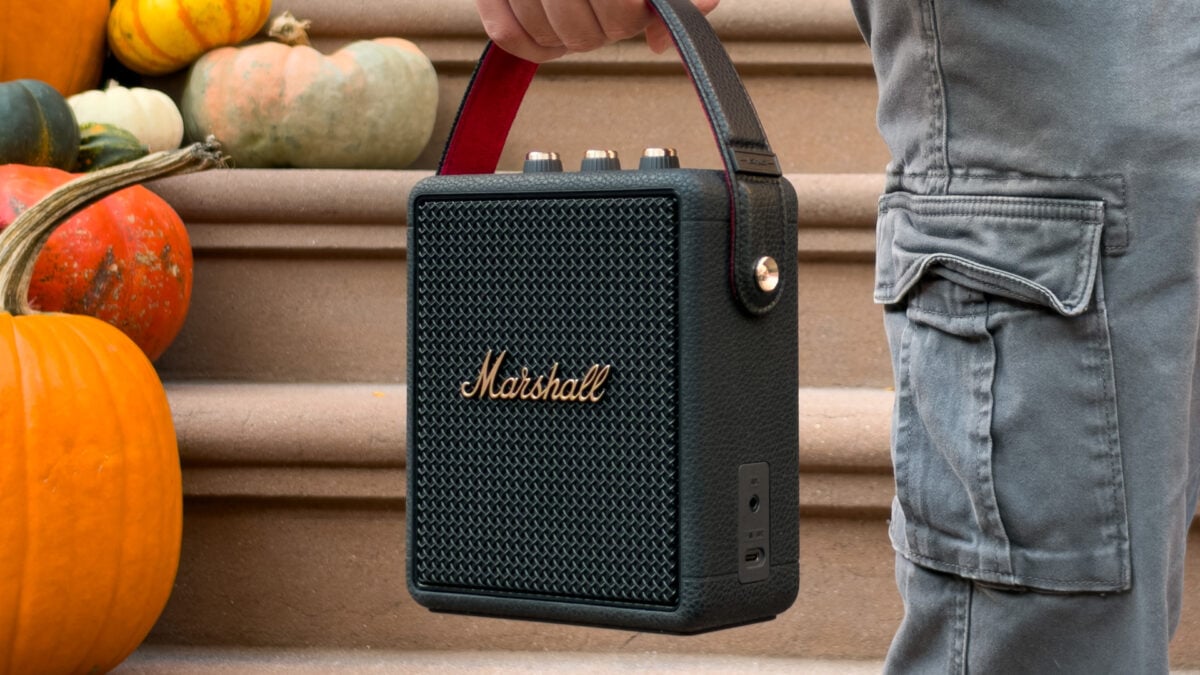
When I was growing up, names like Marshall and Fender were synonymous with music gear and music gear only. As it turns out… I am old. Fender now makes portable speakers and wireless headphones that are surprisingly good, and Marshall predates Fender’s foray into that realm with its own slew of similar products, which started in 2012. Slapping a Marshall logo on something may reek of gimmick, but like previous entries into that category, Marshall’s new Stockwell III portable speaker shows exactly why its pivot to personal audio has turned out to be a lot more than just an exercise in branding. Marshall Stockwell III The Marshall Stockwell III is a small speaker with truly room-filling sound. Sound is big Battery life is great Portable and premium-feeling Software feels a bit laggy sometimes No stereo pairing Like the velvet strap but a bit boring to look at A powerful little black box On the outside, the $250 Stockwell III may have all the sex appeal of a carton of cigarettes or a dish sponge, but the sound is anything but pedestrian. © Raymond Wong / Gizmodo This little speaker packs a lot of power. Inside, there’s a single three-inch woofer and two 1.75-inch drivers powered by 65W Class D amplifiers and 31W Class D amplifiers, respectively. What really makes this driver setup sing, though, is Marshall’s True Stereophonic 360-degree sound, a digital signal processing technology that projects sound on all sides of the speaker and is meant to fill rooms instead of just blasting audio in one direction. I realize that sounds like a lot of marketing mumbo jumbo, but my ears tell me otherwise. I’m really impressed with how the Stockwell III fills up my space and how it manages to sound as though there are multiple speaker channels even though it’s coming from one speaker. My usual test tracks like Steely Dan’s “Any Major Dude Will Tell You” and Daft Punk’s “Da Funk” both had a ton of room to breathe, separating instruments across the frequency range well. © Raymond Wong / Gizmodo The low end is a particular highlight here. I found the Stockwell III’s bass to be punchy and full without being overwhelming or competing too much with the rest of the frequency range. In “Da Funk,” I was able to make out a heavy dose of low end in both the kick drum and the driving bass, all while the Stockwell III was able to convey synths and sample pops of melody in the background. The soundstage of the Stockwell III is much larger than you’d expect for a speaker of this size, so if you’re looking for something with power and dimension but you don’t want to take up too much space, it’s like a particularly good value. If the soundstage isn’t doing it for you, Marshall also allows you to go into its companion app and tinker with the “width” even further—up to three levels above the default or three levels below. © Raymond Wong / Gizmodo According to Marshall, increasing the soundstage bar makes the resulting audio “airy and detailed,” while reducing it makes it “tight and punchy.” There’s definitely a discernible difference in moving the toggle in either direction. Sliding the toggle all the way up gives tracks a more ambient quality, as though there’s a slight reverb from a room, while sliding it the other way gives a tighter, straightforward feel—closer to something you’d hear in a studio. While this isn’t something I can see myself using a ton, I really like the option of being able to select the level, especially because it’s not something I’ve seen in other wireless speakers. And everyone is different—this is definitely a win for anyone who’s picky or specific about the sound profile they like or dislike. Solid features with some slight lag Speaking of software, there are quite a few other things you can take advantage of in the Marshall app, including a five-band EQ that you can manually adjust or pick from presets—I’m a particular fan of the mid boost preset, but I like the default Marshall tuning as well. Another useful feature is “placement compensation,” which adjusts the sound based on where your speaker is located in a room. This isn’t anywhere near as complex as technologies like Sonos’ Trueplay, which uses your phone’s microphones to tune speakers to the acoustics of your specific room, but you can at least choose whether your speaker is close to a wall, a corner, or whether it’s in the center of a table, and then the app will optimize playback accordingly. © Raymond Wong / Gizmodo I actually did a lot of testing with the Stockwell III next to a wall, so I toggled placement compensation on and didn’t notice a humongous difference, though I did get the feeling it wasn’t bouncing as much noise off the wall in the back. If Auracast is something you care about, you can also join an Auracast broadcast, which allows compatible speakers to play audio simultaneously. And there are practical features like power-off timers, the ability to adjust the brightness of LED indicators, and a battery preservation mode. Though you can pair Marshall speakers to play simultaneously, there’s no stereo pairing for left/right channels like the kind you’d get with Sonos’ Play or the CMF Speaker M. I have no qualms with any of the Marshall app’s included features, though I do find using the app to be a little bit laggy at times. Sometimes when I’m cold-opening it (not pulling it up as it runs in the background), it takes a little while to find the Stockwell III. Not enough to qualify the delay as a bug, but just enough to make me a little impatient. It’s a small complaint, to be clear, but something Marshall could improve on. © Raymond Wong / Gizmodo As is the case with software, I can find little to complain about with the hardware. Marshall sticks to its amp-coded look with the Stockwell III, with the iconic Marshall signature on the front and knobs that look like a classic Marshall amp. I love how the knobs feel and the inclusion of the LED lights on top that show you the volume or whether you’ve tweaked bass or treble. The “M” button is a nice touch, too, which is just a programmable action button that you can customize in the app. Customized actions include the ability to play Spotify or even toggle between EQ settings. Like some other features, I don’t think I’d use it all that much, but it’s nice to have. Speaking of nice-to-haves, there’s a spot for a 3.5mm jack, and you can also play lossless audio via USB-C. © Raymond Wong / Gizmodo I’ll be honest, I’m not a huge fan of the look, but I don’t find it offensive, either. I really like the nice velvet touch on the strap and the metal accents that make it feel like a real Marshall amp, but the shape definitely feels like some kind of rugged battery or a C4 in an old Xbox shooter. Nothing about that is a dealbreaker, but it definitely stands in stark contrast to colorful speakers like the CMF Speaker M, for example, which makes ample use of bright-ass colors. On top of everything, battery life is great, too. Marshall says that its Stockwell III gets 40 hours on a single charge, and after one hour of playing music at 50% volume, the speaker dropped to 98% from 100%, so that estimate seems legit. A difficult proposition to beat I’m hard-pressed to find many reasons not to buy the Stockwell III. While the look isn’t my favorite, that’s pretty subjective, and it’s far from offensive. The sound is genuinely room-filling and fantastic, and there are plenty of features in the companion Marshall app. For its size and weight, this speaker punches above its weight class and feels like an overall better value than more expensive speakers like Bose’s SoundLink Plus, which costs $270. While I would like to see more refinement in the app speed and maybe the option to create stereo pairs down the line, this speaker has more than enough for most people, especially if sound and battery life are your top priorities.
Marshall Stockwell III Review: Big Sound in a Small Package
Full Article
Original Source
Read the full article at Gizmodo →KhanList aggregates and links to publicly available news content. We do not host full articles from third-party sources. Always verify important information with original sources.