
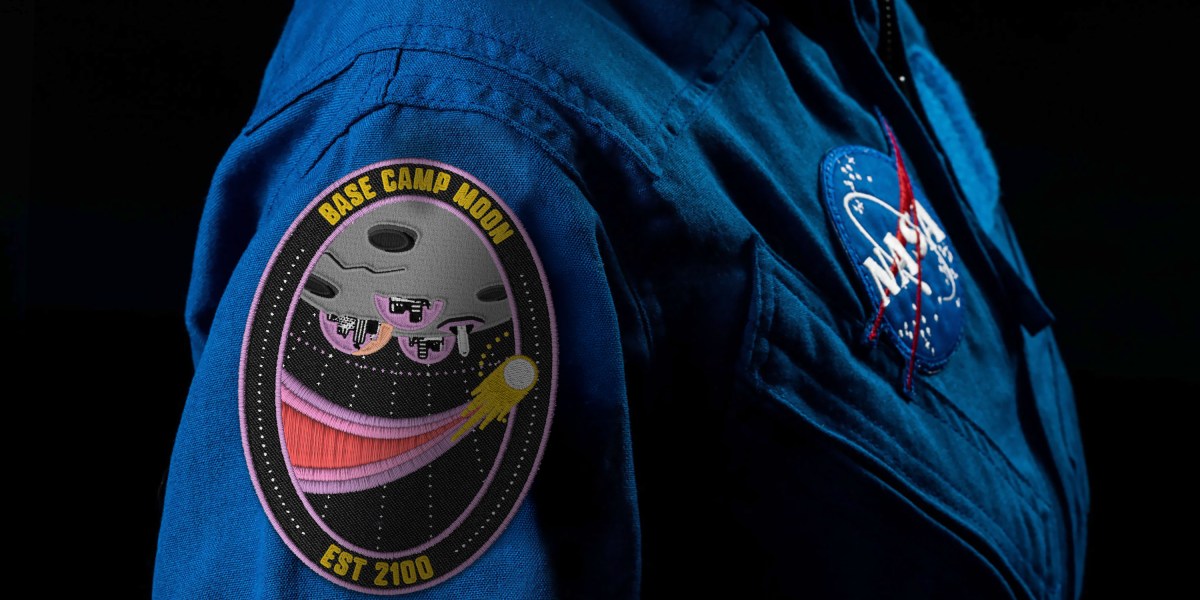
Welcome to the second space race. You can be forgiven for experiencing déjà vu. Last time, it was the Soviet Union and the United States vying to be the first to plant some flags. Now it’s a sprint to the lunar surface between America and China—alongside a host of varyingly friendly and rival nations—plus a cornucopia of private spaceflight companies. And this time it looks like they’re getting ready to set up camp. There will be, the contenders say, bases on the moon, permanently inhabited castles under the stars. The notion of a moon base, fanciful as it might sound, isn’t new. But this year, under the leadership of Administrator Jared Isaacman, NASA has been flooding the zone with bold announcements. If all goes according to plan—a plan that will likely cost tens of billions of dollars to start—there will be drones, robotic landers, communication satellites, and a nuclear power plant; there will be plant terrariums and moonquake sensors; there will be mechanized scouts exploring craters for water. Initial astronaut missions to the lunar surface, which the US is currently planning to start in 2028, will be focused on exploration and technological experimentation. But the idea is that we will—some time in the 2030s—get to a point where there will be habitation quarters for long-term stays, surrounded by a network of scientific research stations, resource mining and processing plants, and landing pads for spaceships. “It’s going to be an expanse,” says Carlos García-Galán, NASA’s moon base program manager—one that will add up to “hundreds of square miles.” The effort is undoubtedly being fueled by nationalistic competition. China has near-identical plans to build its own base on the moon. And being first matters, because the “victor” gets to define the terms. What is the moon, exactly? Is it a militarized outpost? Is it a manufacturing hub? Is it a wilderness to be studied and preserved? But there are also other reasons to go. Earth’s companion contains primeval rocks that hold clues to the formation of the entire solar system. The lunar surface, with virtually no atmosphere in the way, is an ideal place to put telescopes that could examine the most ancient epochs of the cosmos. The far side of the moon would be “a fantastic place to explore the further universe,” says Josef Aschbacher, the European Space Agency’s director general. And it’s way more energy efficient to launch rockets from the low-gravity lunar surface than it is from Earth, meaning sending astronauts—or robotic spacecraft—farther into the solar system will become much less difficult. “The moon is critical. It will be a stepping stone for going further—that means to Mars and beyond,” says Aschbacher. SELMAN DESIGN But if these bold visions are to become reality, there’s a daunting amount of work to be done. A sprawling moon base must be safe for its astronaut inhabitants—protected from falling asteroids, endless cosmic radiation, razor-sharp lunar dust, and torturous temperature swings. It also must be somewhat self-sustaining, so that it can weather changing political fortunes and not cost ruinous amounts of money to maintain. For that, we’ll need to find a way to use the moon’s resources to keep the base operating—and ideally generating revenue. And we’ll need autonomous robots that can build, maintain, and expand the base even when their human masters aren’t present. “It’s almost like starting civilization from scratch,” says Simon Middleburgh, co-director of the Nuclear Futures Institute at Bangor University in Wales. Assuming we can overcome these starting challenges, decades from now—let’s say, by the year 2100—our initial moon bases could grow from barely visible structures into luminous cities, perhaps not too dissimilar from those dreamed up by authors and screenwriters the world over. “It’s like science fiction today that we really want to turn into a reality,” says García-Galán. Will anyone succeed? The moon is a tremendously hostile place to set up camp. In general, daytime temperatures can reach more than 250 °F; at night, they can plummet to less than –200 °F. Exposed to the vacuum of space, the surface is constantly showered in carcinogenic radiation and frequently hit by meteoroids. And its volcanic dust is sticky and corrosive, a destroyer of equipment and choker of lungs. Sadly, the lunar south pole—the area NASA is targeting—is even harsher. NASA wants to build a base there because its permanently shadowed craters are thought to harbor caches of water ice, which would be more precious than gold. Purify it, and you can water crops and hydrate astronauts; split it into oxygen and hydrogen, and you have breathable air and rocket propellant. But the temperature in those craters can be lower than –410 °F, making them some of the coldest places in the known universe. On the surface outside those pits, astronauts would be bathed in the scorching sun for 14 days before experiencing an equally long frigid night. But there is only so much money we can spend on safety. “What it comes down to is acceptable risk of death,” Philip Metzger, a spaceflight engineering researcher at the Florida Space Institute, said while pondering some of the dangers. “What can we reasonably survive without breaking the bank?” Temperature is one of the easiest problems to handle. Materials science has come a long way, and there are myriad metals, ceramics, plastics, compounds, and alloys that can resist wild temperature swings. Radiators keep things cool; heaters keep batteries from dying prematurely. Astronauts survive just fine too, with their fancy spacesuits—but that technology has proved itself only during brief excursions. It’s not yet clear how long this equipment could operate under such tempestuous conditions. The temperature in the moon’s south pole craters can be lower than –410 °F, making them some of the coldest places in the known universe. Outside those pits, astronauts would be bathed in the scorching sun for 14 days before experiencing an equally long frigid night. Space radiation, which can wreak havoc on electronics and trigger a cancerous division of cells, is far more pernicious. And as Stuart George, a physicist at NASA’s Johnson Space Center in Houston, explains, it comes in two unpleasant forms. The first is galactic cosmic rays, which rain down on the moon almost constantly. “They’re made by supernovas and neutron star mergers—all these kinds of things,” says George. And because the atomic nuclei, protons, and electrons that make them up are moving at significant fractions of the speed of light, these cosmic rays have oodles of kinetic energy, meaning they can punch through thin shielding (say, a metal wall) with ease. “They also have this habit where the heavier ions are fragmenting in that shielding and making secondary particles,” says George. That means if your shield is too thin, the astronauts behind it will be blasted with a surprisingly large dose of radiation. Then you have the sun. It may sustain life on Earth, but without our planet’s thick atmosphere and magnetic bubble to get in its way, moonwalkers will occasionally be blasted by one of its paroxysms: a solar flare (a burst of diverse types of radiation) or a coronal mass ejection (volleys of magnetized plasma). “During Apollo, they knew that if a large solar flare occurred while the crew was on the moon, there would be no way to keep them alive,” says Metzger. The crew could have developed acute radiation sickness and perished in a matter of days. The way to survive a powerful solar flare or coronal mass ejection is straightforward: “Get back inside a habitat where there’s more shielding,” says George—preferably a dedicated, highly shielded “storm shelter,” essentially a thick-walled bunker. The issue is that astronauts might be outside the base, driving a rover many miles away. Coronal mass ejections take hours to days to reach the vicinity of the Earth-moon system, but solar flares can do so in under an hour. And scientists can’t yet model the sun well enough to give much advance notice. “All of the capability to forecast solar storms is kind of like where weather forecasting [was] … in the ’50s and ’60s,” says George. As for those punchy galactic cosmic rays, the only way to avoid them would be to put a lot of stuff—lunar rocks, possibly—between the astronauts and the sky. “Build habitat modules underground,” says Chris Dreyer, director of engineering at the Center for Space Resources at the Colorado School of Mines. One option: Burrow living quarters into lava tubes, the naturally hollowed-out volcanic tunnels created by molten rock eons ago. At this point, NASA hasn’t mentioned any plans to make its moon base subterranean, but it may need to if it wants to end up with a small lunar city. Radiation limits the time astronauts can spend on the lunar surface over their entire life—it can total around two years max, experts estimate, before the health risk becomes too high. Unfortunately, that’s not all space will throw at them. When the Artemis II astronauts swung around the far side of the moon earlier this year, they saw curious flashes light up the silvery land below. These were the explosive deaths of small meteoroids punching into the lunar surface. Earth is naturally protected from smaller space rocks, up to around 50 feet in diameter: They burn up inconsequentially in the atmosphere. “You don’t have that option on the moon,” says Philip Lubin, a physicist and planetary defense researcher at the University of California, Santa Barbara. Since smaller rocks plunge toward planets and moons far more frequently than larger ones do, this means the moon is often peppered by what are effectively tiny space bullets. They could easily puncture a spacesuit or the engine of a moon rover. How do you protect astronauts from the onslaught? “The simplest answer is burial,” says Nicholas Schmerr, a planetary seismologist at the University of Maryland—conveniently, the same way you’d deal with radiation exposure. Pile up moon rocks onto your base walls or put habitable structures in lava tubes. Inconveniently, there’s always a chance that a bigger asteroid will come along. Even buried habitation modules would have trouble surviving an assault from a 50-footer—about the length of a semi-trailer. That doesn’t mean a moon base would be helpless against bigger asteroids. Planetary defense has come a long way in just a few decades. NASA’s DART mission demonstrated that it could deflect an asteroid by ramming into the rock with an uncrewed spacecraft, and cutting-edge experiments at clandestine labs around the US suggest that a nuclear bomb could swat away or entirely vaporize errant space rocks. An array of both ground-based and space-based telescopes specifically designed to spy killers—such as the ATLAS quartet of largely automated telescopes, and the soon-to-be-launched NEO Surveyor infrared telescope—are also aiming to find 90% of the near-Earth asteroids potentially capable of wiping out entire cities (those 460 feet across) in the coming years. All these protections apply to the moon. But asteroids 50 feet across are so stealthy that even NASA’s best telescopes would struggle to see them years or even months in advance. Odds are that they would first be seen not long before they were due to hit the lunar surface. Then what? It’s not unreasonable to imagine several turret-like launch sites on the moon that, owing to the lower gravity and airless environment, could rapidly fire projectiles toward an incoming asteroid. Hit it hard enough and it would break into fragments. Just make sure you shoot when it is as far away as possible: “If you were to break something up into a thousand pieces, then you have a thousand impacts on the moon,” says Lubin. “That might be worse than letting it hit one place.” Having your base destroyed by an asteroid would be awful. But a moon base is far more likely to be imperiled by dust—which, unlike asteroids, is everywhere, all the time. Volcanic lunar rocks, when broken down, turn into sharp, electrostatically charged, adhesive, acrid, abrasive particles. While on the moon, Apollo astronauts who inhaled some of this dust occasionally suffered from a strange “lunar hay fever,” which irritated their eyes and agitated their lungs. That same dust ate through all kinds of gear with disturbing ease. “It rips up seals, gears, motors, spacesuits, habitats—everything else it comes into contact with,” says Justin Cyrus, the CEO of Lunar Outpost, a spaceflight technology company that is providing NASA with one of the Artemis program’s moon rovers. NASA has already developed a defense against these dark shards: the electrodynamic dust shield, or EDS. The lightweight electrodes that make up this shield—which can be layered on machinery, walls, and perhaps even spacesuits—use opposing currents to blast away the electrically charged dust. The EDS worked wonders when tested in labs on Earth, and it also demonstrated its anti-dust magic when sent to the lunar surface in 2025 as part of a NASA-sponsored robotic mission. Amy Fritz, a dust-mitigation researcher at Johnson Space Center, says that the EDS will likely be widely featured all over a lunar habitat. But other dust-fighting instruments are being developed too—including a lint-roller-type object inspired by gecko skin and a sci-fi-esque blaster that uses ionized nitrogen gas. Its first spray will neutralize the charge of the dust to remove its stickiness; then a second burst will clear it off the surface. Irritatingly, the busier a base gets, the dustier things will become. As it expands to the size of a small city, rocket ships will need to deliver cargo and crew to the lunar surface on a frequent cadence. Each takeoff and landing will launch a salvo of dust in every direction, inundating the base’s infrastructure. “You have to worry about essentially being sandblasted every time,” says Fritz. Metzger calculates that even with landing pads more than 3,000 feet away from a base, just 10 to 20 liftoffs or landings would be sufficient to severely damage things like protective coatings on exterior walls and communications equipment. After a while, he says, “everything breaks.” Even if the moon base of the future is buried partly below ground, barricaded against micrometeorites and space radiation, and well equipped with dust-repelling technologies, it’s still a risky gig for any astronaut. Skipping around in a preternaturally agile way at one-sixth of Earth’s gravity will be entertaining. But “microgravity is not good for the human body,” says Dreyer. Muscle wastage, cardiovascular troubles, respiratory problems, and immune deficiencies can arise. Radiation, too, may always afflict lunar residents. And there’s also evidence that disease-causing microbes could stealthily sneak aboard spacecraft, even after stringent sterilization procedures. Those microbes may behave differently than they do on Earth; microgravity experiments (both real and simulated) have suggested that some become more aggressive and more likely to cause disease. “We call them the invisible crew,” says Lisa Carnell, the director of NASA’s Biological and Physical Sciences Division. The lunar south pole, which is thought to contain a sizable amount of water, is an attractive target for lunar exploration and, eventually, settlement. This map shows the topography of the region. The South Pole–Aitken basin (blue) is an immense crater studded with smaller craters. The vertical distance from the lowest-lying regions to the surrounding peaks can exceed 15 kilometers, almost twice the height of Mount Everest.NASA/GSFC/MIT Hoping to find a better way to protect astronauts, Carnell spearheaded an experiment called AVATAR (A Virtual Astronaut Tissue Analog Response), which launched aboard the Artemis II mission. It used thumb-drive-size chips, containing cells taken from the heart, lungs, or other parts of the body, that could be switched on to act like miniature organs. Scientists have previously used this organ-on-a-chip technology for purposes like testing out new pharmaceuticals in a highly controlled setting. For Artemis II, Carnell’s crew sent up chips containing bone marrow samples taken from the mission’s four astronauts. Bone marrow makes red and white blood cells, as well as platelets—the sort of stuff that affects almost the entire human body. So seeing how space radiation and microgravity affect it would give Carnell and her team vital insight into how astronauts’ biology might change on the moon. The advantage of organ chips is that you can make them for any astronaut and then send them into space ahead of time to see how that person’s organs will react to spaceflight. Researchers envision that data from such chips will be able to clue medics in to the specific preventive treatments or pharmaceuticals that will help moonbound astronauts on their journey. What is NASA likely to send up sooner rather than later? “Brain organoids,” says Carnell. Yes, she adds—that sounds super weird. But it would be good to know how a real brain might respond to being on the moon for several months before people start living there. Okay. Your vast moon base and its inhabitants are protected—as much as is possible—from the treacherous lunar environment. But astronauts’ time is extremely valuable, and humans are fragile creatures. You can’t make them do all the heavy lifting, which means that whether you’re trying to make a tiny lunar outpost or a small city, you’re going to need a lot of robots. “The buildup of the moon base, in the first years, will pretty much 99% be robotic,” says NASA’s García-Galán. Autonomy will be there right from the start. NASA’s new version of the moon buggy, its Lunar Terrain Vehicle, can be driven by the astronauts riding in it but can also be piloted remotely from Earth (or from elsewhere on the moon). There are visions, too, of adding modular robotic arms, towing vehicles, and cargo movers—all still in the preliminary stages of planning. Over the next few decades, though, we’ll likely want an army of robots to do our bidding: excavators to dig up lunar rocks that could be turned into concrete and bricks, plus other robots to flatten surfaces, dig trenches, create building foundations, pave landing pads, and build up dust-deflecting berms to keep the base from being sandblasted by launches and landings. Even solar panels and wiring can potentially be made from moon rocks—something that the spaceflight company Blue Origin demonstrated in labs on Earth in 2023 using a geologic simulant designed to match the composition of lunar regolith. Powering this robot army will require considerable energy. Two-week-long nights make solar power an impractical solution. Aside from a cornucopia of high-capacity, extreme-temperature-resistant batteries, nuclear power is probably the only viable option. A small, car-size nuclear reactor, filled with an almost literal handful of uranium, could power a small village for a decade without needing to be refueled. And although nobody’s yet tested a nuclear reactor on the moon, few doubt that NASA and the US Department of Energy can conjure up a working design—one that perhaps wouldn’t be too different from those aboard nuclear submarines. A moon base in 2100 would probably feature multiple small, autonomously or remotely operated nuclear reactors, which—conveniently—the base-expanding robots could simply plug themselves into to recharge. But the biggest lunar question mark might be water, which planners want to support the astronauts—and to make fuel to launch things from the lunar surface. A process known as electrolysis, which uses electricity to snap apart molecular bonds, can be used to split water into oxygen and hydrogen, both of which could be used to make rocket fuel. Getting them this way could be far less expensive than sending either all the way from Earth. And as an added bonus, it would provide a source of breathable oxygen. Orbital data has revealed that there is some amount of water preserved in patches on the lunar south pole, but little is known about how much there actually is, what form it takes, or how easy it will be to extract. Will there be solid sheets of ice here and there, ready for us to excavate? Or will there be scattered ice crystals intermingled among the rocky grains, requiring some more inventive form of extraction? A lot of the moon’s water is thought to be hiding in deep, dark craters on the south pole, where the environment is so extreme that robots may freeze up, tumble over, or lose contact with the base. “To me, that is the biggest hurdle,” says Paul van Susante, principal investigator of the Planetary Surface Technology Development Lab at Michigan Technological University. Van Susante’s lab has been putting various construction robots through their paces in moon-like vacuum chambers filled with moon-like rocks. His team was part of NASA’s recent Break the Ice challenge, which invited engineers to build robots to test different ways to excavate such rocks. Some teams used an electric jackhammer and a scoop, while others used scrapers to peel off layers of the ground. The teams simulated the moon’s weak gravity using a crane to lift and offset the weight of the robots. Progress in this regard is speeding along. “I won’t say that’s solved, but we’ve got a lot of the puzzle pieces,” says van Susante. Mining the water will be just one part of an extensive operation. “When you extract it, it’s not going to be clean. It needs to be purified,” says Jessica Atkin, a space botanist at Texas A&M. The technology to do this already exists and works fine on terra firma. But things in space never go the way you expect. “There’s a water purification system on the International Space Station (ISS), and it is known for getting contaminated with microbes,” she says. SELMAN DESIGN But if you purify the water sufficiently—something that can handily be achieved on Earth but may falter in microgravity, where fluids flow in stranger ways—then your moon base can hit its stride. With an effective water recycling system, an increasingly populous base will never go thirsty—and, just maybe, you’ll have a lunar greenhouse. Several edible plants have been successfully grown aboard the ISS, including lettuce, mustard greens, tomatoes, and peppers. Lunar dust unfortunately makes for a terrible garden: It’s filled with far too much aluminum—and it forms a resistant layer when watered. But Atkin has shown that with the help of fertilizing fungi, chickpeas can grow in soil much like the volcanic stuff found on the moon. Moon base inhabitants of 2100 would be supported largely by prepacked meals sent from Earth. But in time, they would start growing some of their own produce—probably with a good deal of automation for lighting, watering, and maintenance of humidity and other environmental conditions. Aside from chickpeas, there might also be plenty of lunar tomatoes. They’d be desirable not least because they’ve been bioengineered to produce higher levels of compounds called anthocyanins that, according to some studies, might help humans mitigate the cellular damage caused by space radiation. A garden on the moon would do more than just provide food, as recent experiences on the ISS suggest. Carnell says that NASA recently caught the astronauts aboard the space station doing something sneaky. All plants up there are supposed to be confined to their growth chambers. But “we learned that the crew were pirating our leftover soil and bringing their seeds and planting their own little gardens, if you will, and hiding them in their own cabins,” she says. Conversations were had in the summer of 2026, after which NASA decided to let astronauts grow their own mini-gardens anywhere they wanted. “Some of the astronauts said they thrived better,” says Carnell. Nature, and gardening, has a hugely beneficial psychological effect on those kept in confined quarters hanging above Earth. That will be even truer for those living in lava tunnels under the lunar surface. “That human element is so important,” she says. Nobody is deluded into thinking there isn’t a mountain of technological challenges in the way. Mars may be a hellhole, as the writer Shannon Stirone put it in 2021 in The Atlantic, but the moon isn’t too far behind. It’s an almost comically menacing place to be. Much about it stands in the way of building a safe, self-sustaining, robotically managed base. NASA wants to put the first nuclear reactor on the moon by 2030. China, partnering with Russia, wants to place its own nuclear power plant up there around 2035. Beyond the first basic habitation module, it will take decades of experimentation and iteration on the lunar surface to get to a working moon base spanning hundreds of square miles. But few doubt that with enough time and tinkering, humanity can prevail. “It’s not an unsolvable problem,” says the University of Maryland’s Schmerr. The chief obstacle, especially in the initial stages of building, may be one of political will. NASA is currently bringing every resource to bear on the project—something that the agency hopes could culminate in a small lunar city by the century’s end. But will that commitment continue over multiple US administrations? Will the international community also throw its weight behind the NASA-led effort? NASA has “a very ambitious plan,” says Yuqi Qian, a lunar geologist at the University of Hong Kong. “We need to keep an eye on it.” In fact, he says, “the current plan looks over-ambitious.” The agency, for example, wants to put the first nuclear reactor on the moon by 2030. (China, partnering with Russia, wants to place its own nuclear power plant up there around 2035.) “These sorts of projects—although very exciting, and potentially transformative for humankind—are the first ones to be delayed or scrapped,” says Middleburgh of the Nuclear Futures Institute. NASA’s direction tends to change when a new administration comes into power—sometimes dramatically so. But several experts outside of NASA agree that, at least for now, there is definite momentum and political will behind the moon base. “NASA has very clearly expressed where they want to go, what their priorities [are], what their ambition is, and how they want to do it,” says ESA’s Aschbacher. “It was quite impressive to see.” Even if the political will behind the US-led endeavor is maintained over the coming decades, expanding anywhere beyond an initial, compact moon base will require more than government funding. “There has to be a lunar economy for this to be self-sustaining,” says Dreyer, the space resources expert. Perhaps that will come from the production of rocket fuel, or from the mining of valuable materials on the moon that can replace similar, polluting activities on Earth. But it’s not at all clear how valuable, or not, a lunar economy will be. Even Isaacman, NASA’s chief, doesn’t think the moon will be a major moneymaker. “I don’t know of anything on the moon right now that’s going to be easier and more affordable to mine, manufacture, and then bring back to Earth than what we could make here on Earth,” he remarked back in February. (Instead, he suspects, mining metals from asteroids will be the path to prosperity.) What if, instead, a moon base earns the right to exist because it’s a place for novel scientific research? Aschbacher imagines it will be like humanity’s outposts in Antarctica. Down there, in what truly feels like another world, scientist-explorers work in a land of gleaming and endless ice to learn more about our planet’s climate, its deep past, and its resilient life-forms. “We understand planet Earth by looking into those remote places,” he says. The moon offers a similar opportunity. What discoveries await astronauts in those primordial lava tubes? What will lunar astronomers see in the night sky—with effectively no atmosphere or light pollution in the way—that those on Earth can’t? As in all spaceflight programs, technologies developed up there will no doubt be tweaked to be used back on Earth. And a base on the moon will make exploring the rest of the solar system easier. Technologically, physiologically, and psychologically, the moon “is a proving ground for the technologies we need for Mars,” says NASA’s García-Galán. If we play the US-China race forward, perhaps the lunar south pole of 2100 will feature several sprawling bases operated by multiple geopolitical rivals. Perhaps it’ll be an off-world powder keg of militarized territorial ambitions and jingoism. But maybe it could instead become an international cathedral to science—and the ultimate adventure destination. “Even if countries on planet Earth have difficulty talking to each other,” says Aschbacher, they might behave differently when it comes to the moon. “I’m pretty sure they will get together and see what we can do together, and see what problems we can solve.” After all, he says, up there, far from home, “you’re so dependent on each other.” Robin George Andrews is an award-winning science journalist and doctor of volcanoes based in London. He regularly writes about the Earth, space, and planetary sciences and is the author of two critically acclaimed books: Super Volcanoes (2021) and How to Kill an Asteroid (2024).
Mars may be a hellhole, but the moon is not far behind
Full Article
Original Source
Read the full article at Technologyreview →KhanList aggregates and links to publicly available news content. We do not host full articles from third-party sources. Always verify important information with original sources.