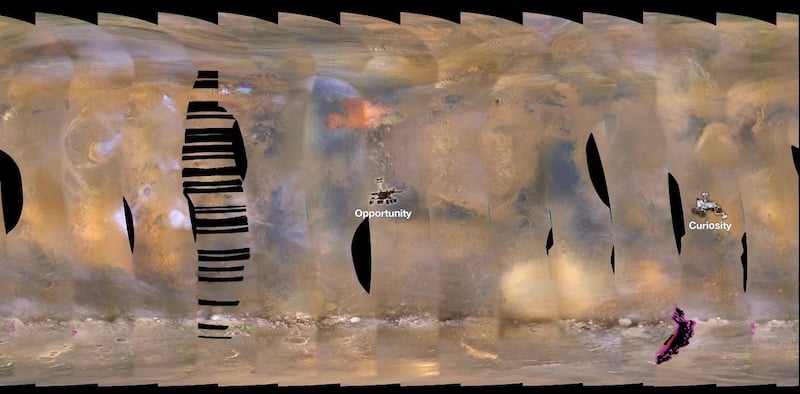
There's something quietly thrilling about scientists stumbling onto a discovery they weren't even looking for. That's exactly what happened to a team studying space weather at Mars, who set out to answer one question and ended up uncovering something else entirely, a possible link between solar storms and Martian weather that nobody had thought to check before. The team, from Lancaster University, the University of Leicester, and Spain's Instituto de Astrofisica de Andalucia, wanted to know whether solar energetic particle events, bursts of high energy charged particles flung out by solar flares and coronal mass ejections, could heat the lower atmosphere of Mars, the layer where its weather happens. This matters more at Mars than at Earth, because Mars has a thin atmosphere and no strong global magnetic field to shield it, leaving it far more exposed to whatever the Sun throws its way. A solar flare and coronal mass ejection erupt from the Sun's surface, captured in extreme ultraviolet light by NASA's Solar Dynamics Observatory (Credit : NASA/GSFC/Solar Dynamics Observatory) They examined five of these solar particle events. Four showed nothing much at all, no clear heating signal in the data. But the fifth, from June 2018, was different, and it happened to coincide with a colossal global dust storm sweeping across the planet, the very same storm that plunged NASA's solar powered Opportunity rover into darkness and silence for good. During that one overlapping event, the team found genuine heating in the Martian lower atmosphere, and crucially, it didn't look like something a dust storm alone could produce. Dust storms do heat the atmosphere on their own, by absorbing sunlight, but the pattern here didn't match that explanation. Something else appeared to be going on, as though the solar particles and the dust storm were compounding each other's effects rather than acting independently. The researchers are cautious about what this means. One overlapping event isn't proof of anything, and they're the first to say so but it raises a genuinely interesting possibility. That is that Mars' atmosphere might respond to combinations of events in ways that studying solar activity or dust storms in isolation would never reveal. One of the last images NASA's Opportunity rover sent from Mars, as a global dust storm plunged its surroundings into darkness in June 2018 (Credit : NASA/JPL Caltech/Cornell/ASU) What I like about this result is that it wasn't actually the plan. The team wasn't hunting for dust storms when they started, instead they only noticed one because the heating turned up in a single case and not the other four, and had to go looking for why. If future observations confirm the pattern they have stumbled upon then it could mean our models of Martian weather need to account for the Sun and the dust working together, not as two separate stories, but as one. Source : NAM 2026 - First study hints solar storms may alter the weather during Martian dust storms
Mars' Double Storm Problem
Full Article
Original Source
Read the full article at Universetoday →KhanList aggregates and links to publicly available news content. We do not host full articles from third-party sources. Always verify important information with original sources.