
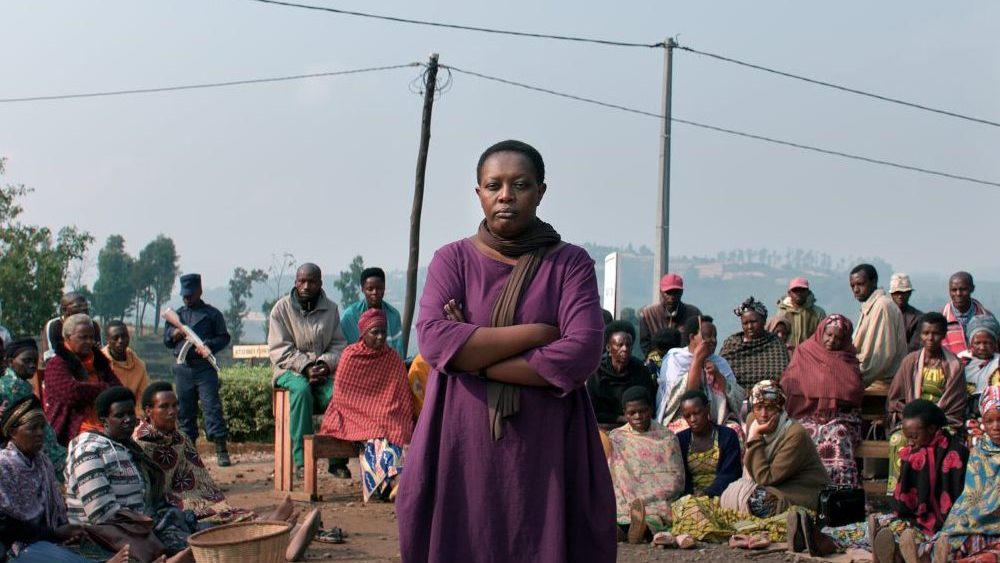
Around this time one year ago, Hédi Zardi, head of the Marrakech Film Festival’s Atlas Programs, was approached by a young filmmaker with an urgent request. The director, who had a feature film in development at the industry event, was just putting the finishing touches on a short film. “She just asked, ‘Hedi, I would love to meet Venice,’” Zardi recalls. As luck would have it, a key member of the Venice Film Festival programming team was also in attendance. Zardi connected the duo, who hit it off over a leisurely coffee. That ability to make an “easy connection” in Marrakech is by design, Zardi notes, with the industry team carefully curating its program to facilitate meetings of both the formal and informal variety. “Everything is possible,” Zardi insists, with a wave-of-the-hand nonchalance that undersells the work he and his team do to achieve the best possible outcome for every film entrusted into their hands. It’s a philosophy he describes as “curat[ing] each moment” and attempting — through a combination of one-on-one meetings, casual lunches and other events — to “build connections to see what happens.” For Shaden Safieddine Tazi — the young Moroccan Lebanese director who came to Zardi with her urgent appeal — that approach resulted in a trip to Venice, where her short “A Few Moments of Happiness” was selected for the festival’s Horizons section, winning the award for best short film. It’s been just eight years since the Marrakech Film Festival introduced its industry program, Atlas Workshops, which was conceived as a springboard for filmmakers from Africa and the Arab world. (It’s now one of several sections joined under the Atlas Programs banner.) This year’s event runs Nov. 22 – 26. Through a combination of mentorship programs, workshops and both one-on-one meetings and pitching sessions with industry professionals from around the world, the platform — which was founded by festival artistic director Rémi Bonhomme — was designed to boost directors who often face a dearth of exposure on the wider festival and industry circuit. Eight years later, the event’s track record speaks for itself: Since its first edition, 42 projects that have passed through the Atlas Workshops have been selected by Cannes, Venice or Berlin. Nearly half the films in this year’s main competition in Marrakech are alumni of the program, including Marie-Clémentine Dusabejambo’s Cannes Caméra d’Or winner “Ben’Imana” (pictured above) and Rafiki Fariala’s Un Certain Regard prizewinner “Congo Boy,” while the top prize at last year’s festival, the Étoile d’Or, went to Erige Sehiri’s migrant drama “Promised Sky,” a former Atlas participant. That progression is indicative of a broader strategy crafted by Bonhomme and Zardi, who joined Atlas Workshops in 2023, to “offer support at the different stages of a film, from the development to the distribution,” Zardi says. That begins not only with the difficult selection process — this year saw 30 feature films in development, production or post-production chosen from 410 submissions — but with an insistence on keeping the event at what Zardi describes as a “human size.” Rafiki Fariala’s Un Certain Regard prizewinner “Congo Boy” Courtesy of Marrakech Film Festival “This boutique size allows people to mingle more easily than is possible in bigger markets or bigger industry events, where people need to be more efficient. Here, they allow themselves to spend time,” he explains. “This quality time for work and networking is crucial. The idea of being too big might affect the quality of the event and what people are coming here to look for.” Festival programmers, he notes, have found Atlas’ selection of pix-in-post to be fertile ground for the coming year’s lineup, while the pared-down program means they “could also have time to meet projects in development to see what is coming up in two or three years.” Similarly, the distributors and sales agents who typically make up the event’s 200-strong contingent of industry guests can “discover the upcoming films without any pressure [and] allow themselves to be more curious.” Partly that owes to the event’s curation, which is as rigorous with its guest list as its lineup. “We have to say no to a lot of people,” Zardi admits. “We limit the access. It creates more excitement. It creates some buzz. And it’s good for the projects,” he adds. “This is a really safe environment that we have to protect, because it’s the size that allows people to discover something that is not expected.” Thirty projects made the cut for this year’s Atlas Workshops, with 11 of those currently in production or post-production and 14 in development. In addition, five projects have been selected for Atlas Close-Ups, a section devoted to emerging voices in Moroccan cinema. The event boasts a loaded lineup, with new features from Palestinian filmmaker Laila Abbas (“Thank You for Banking With Us!”), Sudan’s Amjad Abu Alala (“You Will Die at Twenty”), Morocco’s Meryem Benm’Barek (“Behind the Palm Trees”) and Moroccan French filmmakers Sofia Alaoui (“Animalia”) and Yasmine Benkiran (“Queens”) among the selection. Five first-time directors will also present their debut features, including Lebanon’s Jessy Moussallem, whose short film “Faux Bijoux” premiered at Sundance, and Rwandan director Samuel Ishimwe, who won a Silver Bear in Berlin for his short film “Imfura.” “Promised Sky” won the top prize at the 2025 Marrakech Film Festival. Courtesy of Maneki Films/Henia Production “All these films are bringing me a different kind of cinema,” Zardi says, pointing to the evolution of filmmaking in the region. “We are not only [seeing] classic, dramatic films from countries of the South that reflect something expected from international audiences. These directors now have a different professional dynamic to try new things and to surprise us,” he continues. “I like the idea that, from this region, they are trying genre films; they relate national or regional history through intimate stories. It’s not an expected, classic storytelling, which used to be the case.” That so many Arab and African filmmakers, such as Dusabejambo and Venice prizewinner Abu Alala, are enjoying breakout success on the festival circuit doesn’t come as a surprise to Zardi, an industry veteran who co-founded the Paris-based sales and production company Luxbox a decade ago. “There is a variety, and the market is reacting to this,” he says. “If the region was offering the same thing each year, as a buyer, you can be bored. They want to [come to Marrakech] because they are aware that there are new things to discover.” Last year, the Marrakech team launched Atlas Distribution Meetings, which brings more than 60 key players in sales and distribution to the Moroccan event. From a practical perspective, this allows them — through both the festival selection and the industry program — to sample a wide variety of new and established talents from Africa and the Middle East. It also fosters a rare opportunity “to encourage dialogue between the sales agents and the distributors from our region,” Zardi says, while also putting them in the same room with their European counterparts. “Distributors from MENA or Africa might not be key priorities for sales agents during the big markets, because they are facing other challenges. So the idea is to allow them to have this [opportunity] to meet with the distributors of our region,” he says. “And the fact that distributors from the Arab world and Africa can also meet European distributors because they are doing the same job — not in the same reality, but it’s very inspiring for them to share these ecosystems.” Last year, Marrakech rebranded its industry event, which is now organized under the Atlas Programs banner. That includes the flagship Altas Workshops section; Atlas Station, which provides 10 Moroccan directors or producers with support aimed at strengthening their skills and opening up their projects to international audiences; Atlas Distribution, which encourages the presentation of Moroccan, Arab and African films to new audiences in the region; and Atlas Press, which seeks to strengthen the culture of film criticism in Morocco. The event’s evolution, says Zardi, points to a commitment “to avoid having a single template that is called the Atlas Workshops that will repeat each year.” “After each Atlas Workshops, we coordinate, we do an evaluation, we see what works, what doesn’t work,” he says. “My idea is to never stop reshaping the editorial offer that we are bringing to the region…and to remain constantly aware of the changes.” The Marrakech Film Festival runs Nov. 20-28.
Marrakech’s Atlas Workshops Takes Victory Lap as Industry Event Celebrates Cannes, Venice Triumphs
Full Article
Original Source
Read the full article at Variety →KhanList aggregates and links to publicly available news content. We do not host full articles from third-party sources. Always verify important information with original sources.