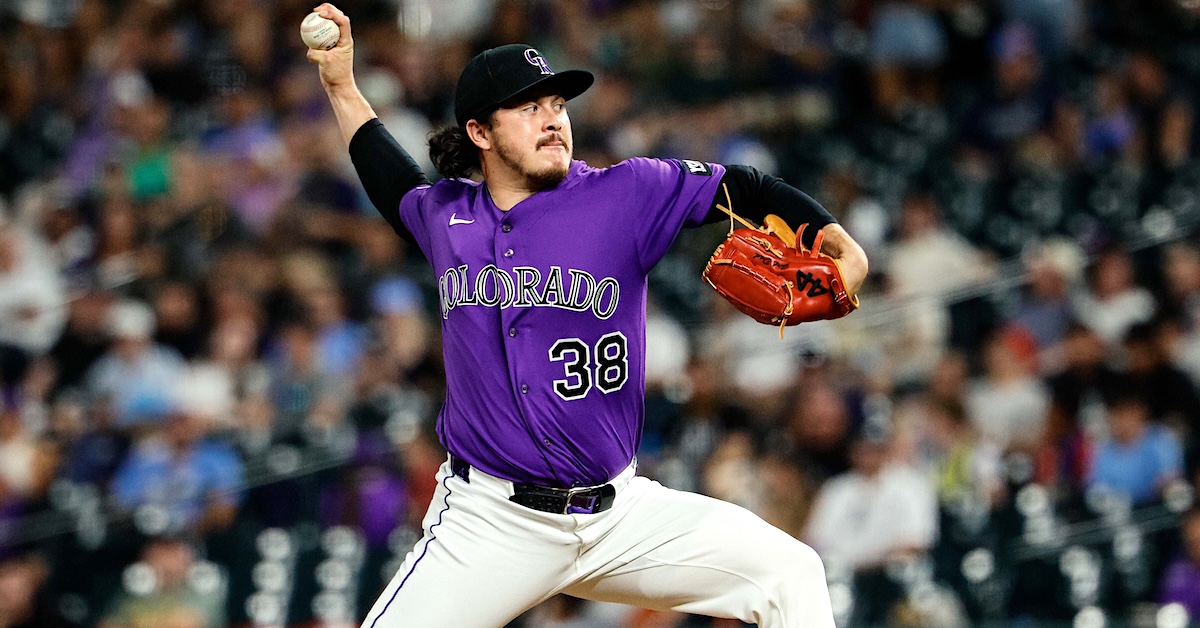
Isaiah J. Downing-Imagn Images In this trade deadline season where everyone’s within reach of a playoff spot, the Marlins were one of several teams that attempted to chart a middle path. Sure, we’ll sell off some of our best players — including, in Liam Hicks and Lake Bachar, some guys with plenty of team control left — but we’ll add in other trades and try to backfill those roles. Miami’s big major league add was 26-year-old reliever Victor Vodnik, late of the Colorado Rockies. That sounds like damning with faint praise, and it is: Vodnik has a 5.25 ERA in 36 innings this season, and at the time of the trade, he was fifth among Rockies relievers in gmLI, which is the average leverage index when he enters the game. In other words, the Rockies don’t think Vodnik is a high-leverage reliever, or at least they hadn’t been using him that way. Vodnik cost the Marlins third baseman Connor Norby, who was the less successful half of the Trevor Rogers trade, and pitching prospect Aiden May. Vodnik has been a fixture in the Rockies bullpen for the past three years. He’s been reasonably durable, with one IL stint in each of the past three seasons, none of which lasted more than 40 days. Since the start of 2024, Vodnik has averaged 55 appearances and 60 innings per 162 team games, with an ERA- of 87. That’s worth a full-time spot in any bullpen, but you understand why Vodnik got traded to the Marlins for Norby, instead of to the Cubs for Moisés Ballesteros. Especially when you look at Vodnik’s strikeout and walk numbers. He doesn’t do the former, and he does way too much of the latter. Out of the 163 relievers with at least 100 innings over the past three seasons, Vodnik is 139th in strikeout rate, 147th in walk rate, and 157th in K-BB%. There are effective relievers with a rock-bottom K-BB%, but they — Ryan Yarbrough, Wandy Peralta, Tim Hill — tend to be crafty lefty types. This is Vodnik. You Aren't a FanGraphs Member It looks like you aren't yet a FanGraphs Member (or aren't logged in). We aren't mad, just disappointed. We get it. You want to read this article. But before we let you get back to it, we'd like to point out a few of the good reasons why you should become a Member. 1. Ad Free viewing! We won't bug you with this ad, or any other. 2. Unlimited articles! Non-Members only get to read 10 free articles a month. Members never get cut off. 3. Dark mode and Classic mode! 4. Custom player page dashboards! Choose the player cards you want, in the order you want them. 5. One-click data exports! Export our projections and leaderboards for your personal projects. 6. Remove the photos on the home page! (Honestly, this doesn't sound so great to us, but some people wanted it, and we like to give our Members what they want.) 7. Even more Steamer projections! We have handedness, percentile, and context neutral projections available for Members only. 8. Get FanGraphs Walk-Off, a customized year end review! Find out exactly how you used FanGraphs this year, and how that compares to other Members. Don't be a victim of FOMO. 9. A weekly mailbag column, exclusively for Members. 10. Help support FanGraphs and our entire staff! Our Members provide us with critical resources to improve the site and deliver new features! We hope you'll consider a Membership today, for yourself or as a gift! And we realize this has been an awfully long sales pitch, so we've also removed all the other ads in this article. We didn't want to overdo it. We can debate his craftiness, but Vodnik is a hard-throwing righty. How does he get away with not missing bats while simultaneously running a double-digit walk rate? Like this, mostly: Technically, Vodnik throws a sinker. Or at least, according to Statcast, 3% of his pitches this year have been sinkers. He’s also got a changeup, which he uses more against lefties than righties, which is what you’d expect. But mostly, Vodnik throws fastball-slider, and both of those pitches dip like they’re ducking under a low bridge. Typically, you want a four-seamer to have both backspin-induced rise and arm-side run. Vodnik’s four-seamer dips and cuts, at least relative to expectation. His slider has barely any glove-side movement, but it dives toward the ground by 4.5 inches more than comparable pitches. Combine that with a teeter-totter delivery that allows Vodnik, who’s only an even 6-foot, to get above-average extension, and what you get is a ton of groundballs. He allows 2.24 grounders for every fly ball, which is the 10th-highest ratio among qualified relievers this season. It also explains how a pitcher with strikeout and walk numbers from the 1950s is running a better-than-average FIP. In his career, Vodnik has faced 371 batters at Coors Field and allowed only six home runs. To put that in context: 84 pitchers have faced at least 300 batters at Coors Field in their careers. Of those, Vodnik has the fourth-lowest home run-to-batters faced ratio. That explains why Vodnik was valuable to the Rockies, but now he’s moving to Coors Field’s atmospheric opposite. In the long run, Vodnik will probably find loanDepot Park more hospitable, but the MLBPA shouldn’t let the Rockies trade a player directly from Denver to Miami without giving him a decompression chamber or something. Once Vodnik acclimates to Miami’s thick, humid atmosphere — the air in South Florida probably feels like the breathing liquid from The Abyss — he’ll find that he’s gone from the no. 1 offensive park and no. 6 home run park, according to Statcast, to the no. 15 park for offense and no. 25 for home runs. On one hand, the ability to induce grounders becomes less important in that environment. You’d want him to miss more bats. On the other, this is the team of Sandy Alcantara, Janson Junk, Tyler Phillips, and Calvin Faucher. Marlins pitchers aren’t scared of using their defense. And it didn’t cost the Marlins much to get Vodnik. Norby is a former top-50 pick of the Orioles; as profitable as the first two rounds have been for the Orioles the past decade, especially for infielders, Norby isn’t one of their success stories. The former East Carolina Pirate has gotten a little over a season’s worth of major league work (198 games and 764 plate appearances) across two teams and three seasons. In that time, he’s batted .234/.302/.383 with a 29.3% strikeout rate. At 5-foot-10, 180 pounds, Norby isn’t exactly an imposing masher. But at the same time, he’s slid inexorably down the defensive spectrum over the past three years. He got into 65 games for the Marlins this year by the time of the trade; he played first base or DH in 56 of them. At 26, Norby probably is what he is unless the Rockies put him on the Mickey Moniak diet. But he is cheap (he won’t reach arbitration until after next season at the earliest), optionable, and capable of standing either at the plate or at an infield corner without inspiring secondhand embarrassment in onlookers. Norby isn’t a needle-mover for a contender, but he’s quite handy as a depth player for a team that’s wrapping up Year Eight of a rebuild. May’s value also comes as depth. College baseball fans will remember May as the ace of the Oregon State Beavers in 2024. He went 7-1 with a 3.05 ERA in 14 starts in his draft year, but he’s progressing slowly through the minors because of injury and a sinker-slider combo that’s not as effective against pro hitters as it was amateurs. In June, our prospect guys ranked 53 Marlins minor leaguers; May only made the Other Prospects of Note category. Suffice it to say, I think the Marlins got the best player in this deal. Vodnik is relatively young, throws hard, gets a ton of grounders, and is under team control through 2029. A smart team can do something with that.
Marlins Cap Off Deadline Day by Ordering Vodnik on the Rockies
Full Article
Original Source
Read the full article at Blogs →KhanList aggregates and links to publicly available news content. We do not host full articles from third-party sources. Always verify important information with original sources.