
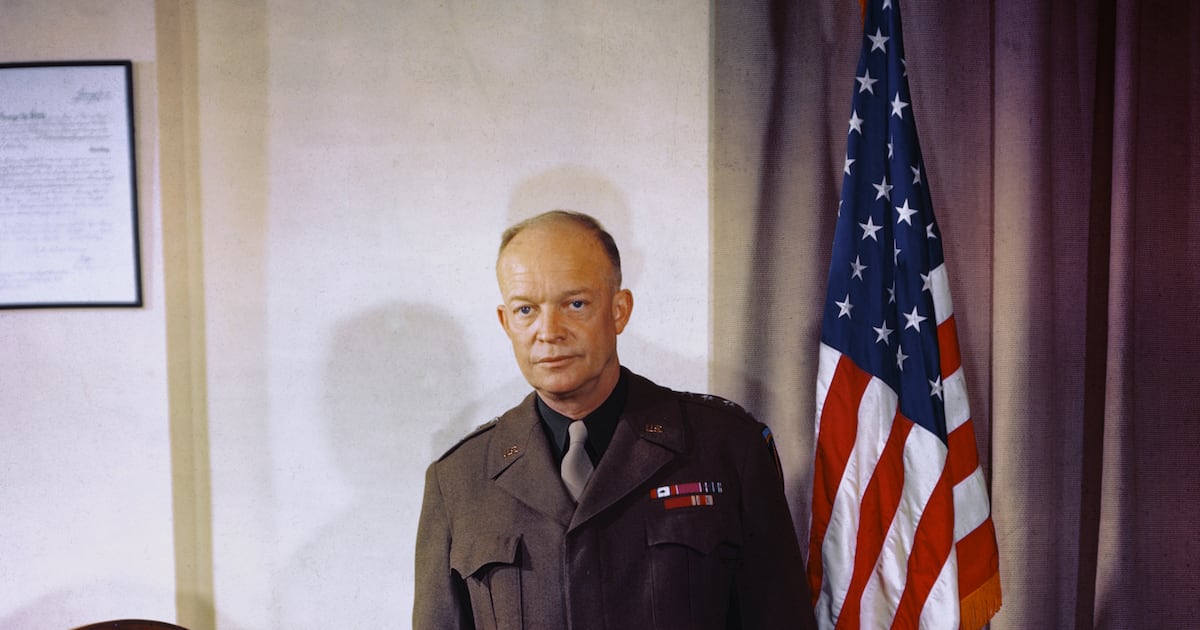
The set-up is this: a US secretary of defence gets it into his head that a globe once owned by former president Dwight D Eisenhower and kept in the Pentagon should be brought to his own personal office and put on display there. The globe is an important historical artefact, one used frequently by Eisenhower as an army general during the second World War. Rather than consulting the curators and military historians who are charged with the custodianship of such artefacts, the defence secretary dispatches a few members of his personal staff to take the globe and put it in his office. As they are carrying it, the globe falls to the floor, and is bashed against its own supporting structure. A large hole is smashed into the bottom of it, leaving Antarctica in pieces on the floor.The scenario feels naggingly familiar. Is it a scene from Stanley Kubrick’s Dr Strangelove, or perhaps a moment from In the Loop, Armando Iannucci’s Iraq invasion satire? No: neither. It is, in fact, a moment from the oeuvre of whatever greatly inferior (if admittedly more prolific) satirist is responsible for the black farce of current global politics.The incident happened earlier this year, according to a detailed report in the Washington Post. Pete Hegseth, the US secretary of defence – or secretary of war, as he prefers to call himself – is known for his absurd brashness and bellicosity, and for his peculiar obsession with the outward trappings of conservative masculinity and physical prowess among military personnel. (“No fatties, no trannies, no beardos, no weirdos, no wimps, no radicals,” as he put it in a speech last month.) READ MOREWhen he decided he wanted the Eisenhower globe for his office, the standard operating procedure would have been to request the assistance of the US Army Center of Military History, whose team of historians and curators would have ensured its safe and proper transport. But that team was temporarily furloughed, as a result of a partial government shutdown stemming from a dispute in Congress over elements of the Trump White House’s immigration policy. According to the Washington Post’s report, it is not clear why Hegseth’s team did not wait for experienced help in moving the artefact, especially as the partial shutdown ended on the same day the globe was moved and damaged. “An ‘apparent lack of patience’, said one person familiar with the situation, appeared to be a factor.”From a broadly liberal perspective, the incident is almost perilously overloaded with symbolism. Hegseth and the administration he represents have inherited a global order constructed after the second World War, fought for and won by men like Eisenhower. In their heedlessness, arrogance and stupidity, Hegseth and people like him have, if not outright smashed that global order, then certainly put a large hole in the bottom of it.[ Trump and Hegseth’s road to barbarism is a threat to America’s standingOpens in new window ]There are few historical figures as instrumental as Eisenhower in the country’s rise to post-war global dominance, and few as emblematic of a deep ambivalence about that position, and what was involved in attaining it. And there are few figures who illustrate more luridly than Hegseth the pathetic end to that period of global hegemony. It’s hard not to wonder what Eisenhower in particular would have made of Hegseth, who – as a former Guantánamo Bay guard and Fox News host – is a kind of misbegotten creature of American militarism and mass media.Eisenhower, needless to say, was no dove, no pinko. He believed in the necessity of American military might and the essential righteousness of its presence in the worldSome 15 years after the end of the war, as his second term as president was in its final hours, Eisenhower gave a televised valedictory address from the Oval Office. “We now stand 10 years past the midpoint of a century that has witnessed four major wars among great nations,” he said in that famous speech. “Despite these holocausts, America is today the strongest, the most influential and most productive nation in the world. Understandably proud of this pre-eminence, we yet realise that America’s leadership and prestige depend, not merely upon our unmatched material progress, riches and military strength, but on how we use our power in the interests of world peace and human betterment.”It was in this speech, too, that “Ike” gave his infamous warning about the military-industrial complex – a phrase he introduced into the popular lexicon – which, in the years of his presidency, had come to wield such extraordinary power in Washington. It was necessary, he said, to guard against “unwarranted influence, whether sought or unsought” in the councils of government by this vast and metastasising complex. Eisenhower, needless to say, was no dove, no pinko. He believed in the necessity of American military might and the essential righteousness of its presence in the world. But he also wanted to warn his countrymen that only an alert and knowledgeable citizenry could compel a proper alignment of a huge defence machinery with the pursuit of peace. Leftists such as myself might take issue with Eisenhower’s view of the essential benevolence of American power, which even during his presidency was responsible for CIA-backed coups in Iran, Guatemala and the Congo. But there is no getting around the tragic tenor of that warning, in the context of all that followed, and of the world we ourselves have inherited.[ If you want to know why Trump keeps going to war, look at the size of his military budgetOpens in new window ]Eisenhower, if he were alive today, would presumably be appalled by the spectacle of Pete Hegseth’s tenure as defence secretary. He might even have recognised in Hegseth – with his contempt for legal and institutional restraints, his avowed Christian nationalist beliefs, his Crusade-emblem tattoos – certain resemblances to the fascists he, Eisenhower, had played a crucial role in defeating. But he would also, I suspect, be self-aware enough to recognise him as a creature of the military-industrial complex he himself had helped to construct – and about which he felt, or at least performed, such deep ambivalence in his final days in power.Say what you like about Eisenhower – and let’s bear in mind that, just months before that farewell speech, he personally authorised a CIA plot to assassinate Patrice Lumumba, the democratically elected socialist leader of the Republic of the Congo – but you can’t say that he didn’t know what he was doing. Hegseth, on the other hand, embodies the kind of malign incompetence that characterises the current incarnation of American imperial power. When the Washington Post contacted the Pentagon for comment on its report about the damaged Eisenhower globe, a representative provided a comically gnomic response. “Accidents happen,” it read. “We are grateful no one was harmed, and the globe is being repaired.” If only it were so simple.
Mark O'Connell: Is there a better metaphor than Pete Hegseth’s staff punching a hole in a WWII globe?
Full Article
Original Source
Read the full article at Irishtimes →KhanList aggregates and links to publicly available news content. We do not host full articles from third-party sources. Always verify important information with original sources.