
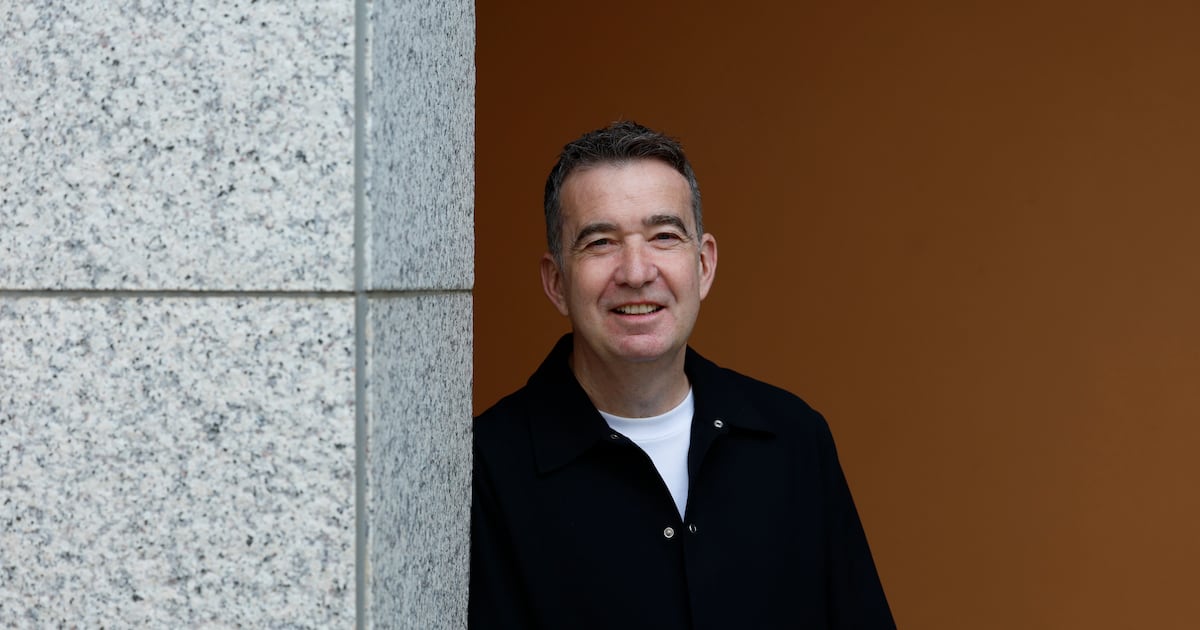
I first interviewed Mark Little in 2010, just after he left RTÉ to set up a social media-focused fact checking and verification company, Storyful. The broadcaster turned entrepreneur went on to sell Storyful to News Corp. He worked for a time at Twitter and then set up Kinzen, which he later sold to Spotify. When we first met, he was filled with optimism for technology and the era we were collectively entering, but his new book The Last Good Day on the Internet paints a darker picture of the 15 years of social change that ensued. He’s struck, he says, by “the bookend of you and me meeting after so many years”.Little is a very good communicator and an empathic, puzzle-solving thinker. The Last Good Day on the Internet is one of several recent books orbiting similarly tech-sceptical territory, from Careless People by Facebook whistleblower Sarah Wynn-Williams to End Times Capitalism by Naomi Klein and Astra Taylorto The Nerd Reich by Gil Durán. For Little it all speaks to “a craving for agency” in the face of billionaires with unimaginable power.Little’s perspective is that of a well-informed insider, and the book tracks his journey from tech-optimism to disillusionment to a new cautious hope. “When I left RTÉ, the single biggest trigger was when I was preparing for interviews on television, I would go to Twitter, and would say, ‘Hey, what questions should I ask tonight?’” He was so impressed with the input that came back that he believed there “would be a [growth in] radical transparency and accountability”.READ MOREHe still describes himself as someone “nostalgic for the future”. But he feels he got a number of things wrong. “I believed that ultimately things would get better by definition, that technology was wired for democracy, that technology was wired for creativity. We were convinced of that, and that was the fatal mistake. And it’s only when I came across Kranzberg’s first law [which states that] ‘technology is neither good nor bad, nor is it neutral’. It evolves the way you use it. “The mistake that we all made in 2008 when Obama gets elected, is we thought [technology has] got a moral compass, that social media is actually the culmination of [inventor of the world wide web] Tim Berners-Lee’s vision of this decentralised power that will make the world better, destroy oligarchs.”The biggest part of that mistake, he says, “was to think that that [positive future] was inevitable”. And he believes people are making a similar mistake now when predicting a darker future. “We talk about technology in godlike terms, which makes everyone feel powerless. That has been, I think, the secret of the success of the authoritarians, the autocrats, the oligarchs – they make us feel powerless.”He thinks we need to collectively wrest control back from the tech oligarchs who are, by their nature, control freaks, as he sees it. “[Elon Musk] has a fear of loss of control. If you read anything about him, you know he’s defined by getting the sh*t kicked out of him in a schoolyard in South Africa and also by his family’s history. So control is one thing.Mark Little: 'I think everybody in media knows that the attention economy is dying and has no future.' Photograph Nick Bradshaw / The Irish Times “Then you can see tech companies getting more and more insular. You can see them realising that people don’t like them any more and then they turn right wing ... They are so fearful of the people that they have to embrace these cosmic visions of the future ... I think these people are defined by some childhood trauma that says to them: ‘You’ve got to suffer pain. You’ve got to inflict pain. You’ve got to fight. You’ve got to be in this cosmic vision for the future.’ “So the top people, the Zuckerbergs, the Andreesens, the Musks, they’re like that. Beneath them are the smartest people in the room ... A bit like the Enron people who destroyed capitalism back in the late 20th century, this group of very talented people have never really experienced real life.”The CEO class in Silicon Valley have convinced themselves they have the solution to every problem, he says. “They think they’re polymaths. The biggest problem with entrepreneurship is that you fall in love with your own solution before you understand the problem you’re solving. You just fall in love with the idea you just invented a new widget and it’s going to save the world. So you get all these people during the pandemic, all these tech bros reading Socrates and suddenly turning into philosopher kings. They have this reverence of themselves ... There was this curdling of mission, of messianic greed.”Little is not embittered. He still loves technology. He loves the potential opened up by AI while being very aware of its cognitive, societal and financial dangers. Also, by most standards Storyful was a great success story. It sold to Rupert Murdoch’s News Corp in 2013 for $25 million. Nonetheless, he writes about it with a certain regret. He thinks now that he should have followed an open-source, non-profit, co-operative model like Wikipedia or the Internet Archive. The venture capital model has limited the scope of technology and what can be done with it, he says. “Every innovation has to be a moonshot. But for me, entrepreneurship and innovation is a woman setting up a childcare centre in Blanchardstown, or saying, ‘there’s no recycling here, so I’m going to set up a recycling firm’.”Instead, he says, we have this “cult of the veneration of the billionaire ... There has never been such concentration of power in people who have fallen in love with their own cosmic view of the future”.‘The analogue today with this younger generation is that they’re going through a digital wellbeing revolution’— Mark LittleFor Little, “social media” segued into a less useful and less human form when, for reasons of greed, the people who ran the platforms decided that what we saw would be dictated by manipulative algorithms rather than the people we chose to follow. “This was a specific decision by a group of people at a specific time that created this shitty world we live in,” he says. “It’s not evolution. It’s not some sort of natural climate change. It’s people making decisions ... I was at a leadership meeting of all these Twitter executives, and they told me they have data on every emotion, and of course they listed them all from ‘outrage’ to ‘love’. So I had to ask, ‘What about serendipity?’ Silence.”The algorithms and now the growth of generative AI has led to less serendipity, fewer interactions and an increasing sense of being overwhelmed. He thinks people, especially young people, are already rebelling by finding smaller, more controlled spaces both on and offline. “We’re starting to see something very analogous to the health and fitness movement,” he says. “If you think back to a childhood in Ireland back in the 1970s, like when I was growing up we had sugar with everything and my granny smoked like a trooper. And a generation later, look at the awareness of our mental health, our physical health. The analogue today with this younger generation is that they’re going through a digital wellbeing revolution. A resistance against the algorithm.”But that personal resistance is just the first step, he says. “The second has to be some layer of collective community struggle ... In the case of social media, the still positive part of that was Black Lives Matter. It was the Arab uprisings. That hasn’t gone away. We put too much faith in it, but it’s still there.” He is heartened by the protests against data centres in the US, he says. “That’s the biggest wave of civic activism I’ve seen possibly since the 1960s ... 4 per cent of energy in the US, the electricity, goes to data centres. It’s 23 per cent here in Ireland. What will influence these [US] elections coming up in November? Data centres.”Mark Little on Silicon Valley bosses: 'They have this reverence of themselves ... There was this curdling of mission, of messianic greed.' Photograph: Nick Bradshaw/The Irish Times And the third step, he says, is legislation and regulation, defining the parameters these companies are allowed work within. He is heartened by the recent judgment against Meta in the US for causing harm to young people. “We can redesign the platforms. We can actually go in and tell them ‘no’.”In fact, we must do this, he says. “Every single person reading this article or on the planet today will live through more change than any generation in human history. It’s not natural, this state of acceleration, speed, and then the concentration of power on top of that ... The book was quickly out of date. I said that they’re going to spend twice as much as they spent in the Apollo programme this year on AI data centres. Turns out it’s going to be something like four times. And all that’s debt ... The moment of collapse is imminent, and that is going to be so painful for us because it’ll mean possibly the destruction of the Irish economy.”[ Ireland can’t be a dumping ground for data centres other countries don’t wantOpens in new window ]Does he mean the collapse of the AI boom? He does. “If you look at the debt financing behind the AI [industry]. It’s not sustainable.” What should Ireland do? “We have a very short window of opportunity to take all that sovereign wealth money we have, and to start to invest in a kind of an open-source approach to AI, to get in on the ground in this revolution, to make sure that the focus is on the clean energy revolution ... The money we have right now from this last age of attention could be spent and invested heavily in a new form of innovation, in sustainable energy sources, not these models that suck up electricity and compute ... Is there, in the back room somewhere, an emergency cabinet working on ways to get this money to research innovation, clean energy, the kind of stuff that’s going to get us out of whatever bust happens? ... I don’t see evidence of that right now.”He’s also a little disappointed with the pace of development in traditional media since he left it all behind. “[It’s] still trapped in the attention economy, still competing against someone on TikTok who’s got 28 million followers. You’ve got news organisations in the same coliseum [as influencers] performing in the same way, and they adopt the same tactics. I think everybody in media knows that the attention economy is dying and has no future.”[ West fears AI may kill us all but China and others see ‘immense’ opportunityOpens in new window ]In keeping with his belief that we should be forming pockets of communal resistance (and collective joy), he wants to create a website for the book, an online platform where he can keep the conversation going and readers can discuss the issues he raises. “Most people think about a book as an end of a process. But I had to put it all down so I could hold myself to account. Whatever comes next, I’m not quite sure, but it’s a beginning.”Sixteen years after I first interviewed him, there’s also a sense that Little is coming full circle. He might even make some documentaries, he says. “I want to go to the States and analyse what’s going on with this data centre protest movement. And then hopefully put myself at the disposal of more community activism ... I think that’s never been more possible. And I don’t need a TV station to broadcast it.”The Last Good Day on the Internet by Mark Little is published by Hachette.
Mark Little: ‘Protests against data centres is the biggest wave of civic activism since the 1960s’
Full Article
Original Source
Read the full article at Irishtimes →KhanList aggregates and links to publicly available news content. We do not host full articles from third-party sources. Always verify important information with original sources.