
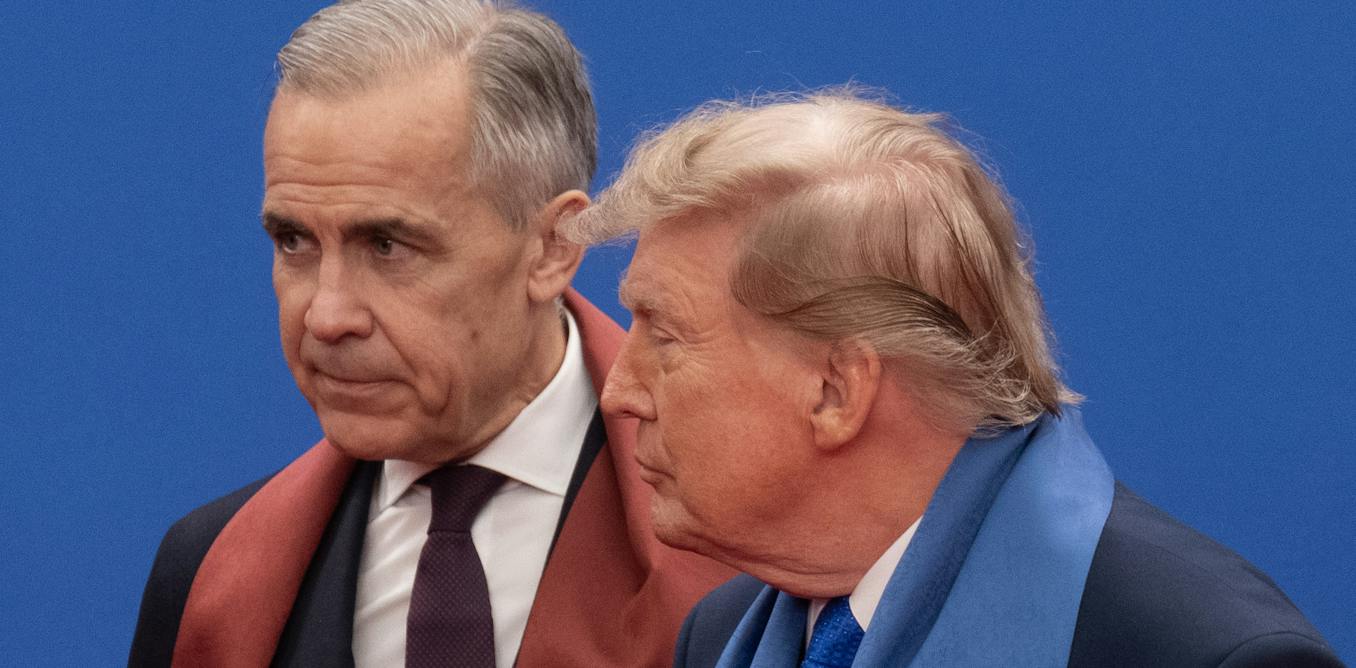
Prime Minister Mark Carney is riding a wave of domestic support and has emerged as the global poster child of a cautious but firm resistance to American bullies. He stood up to Donald Trump long before the recent Democratic landslide in the midterm elections in the United States. A central plank of Carney’s strategy consists of reducing Canada’s economic dependence on the U.S. by luring massive international investment to the country. Much of this investment into his “Projects of National Interest” will flow to infrastructure allowing Canada’s vast natural resources to access markets outside of North America. It would seem the midterm election results vindicate Carney. Yet, on closer inspection, things are more complicated. While Carney’s goal is commendable — a stable, sovereign Canada — the means he’s employing will arguably move Canada closer to the model of a society that is championed by … Donald Trump. Prime Minister Mark Carney attends a bilateral meeting with Chinese President Xi Jinping on the sidelines of the Asia-Pacific Economic Cooperation meeting in Shenzhen, China, on Nov. 17, 2026. (Maxim Shemetov/ Pool Photo via AP) Corporations benefit Consider the planned “mega tax deduction” designed to spur investment in pipelines, ports and extraction projects. The main beneficiaries would be multinational corporations and their shareholders, not Canadians. True, the investments would create jobs, but it’s worth noting that workers on both sides of the Canada-U.S. border have not received much of a share of growth in the last four decades. Other cases, such as the plan to privatize four large Canadian airports, are a classic short-term government cash grab. A WestJet aircraft takes off from Vancouver International Airport, in Richmond, B.C., in July 2026. Vancouver is one of four Canadian airports that could be privatized. THE CANADIAN PRESS/Darryl Dyck Compared to the Stellantis and Stelco debacles — when two major manufacturers failed to uphold job and production commitments made to Ottawa in exchange for federal backing or foreign-takeover approval — the federal government has a stronger position in the resource sector. That’s because the resources are located on Canadian soil. This opens up policy alternatives, which could include: Moving towards the Danish model of industrial foundations, where some profits are earmarked for social and environmental causes. Higher royalties from natural resource licences, which could be efficient in generating more for public coffers even if they marginally lowered private investment. Boosting the role of the Canada Infrastructure Bank to provide investment without loss of sovereignty, tied to Canada’s airports and ports. Eroding democratic norms In addition to the political substance, the Carney government’s efforts weaken democratic accountability. The omnibus Bill C-39 before Parliament weakens the rights of workers, non-governmental organizations and First Nations to contest the decisions made in the name of economic growth and “economic sovereignty.” Read more: What Bill C-39’s loosened environmental regulations could mean for Canadians Some First Nations probably feel the same way about Ottawa’s economic bulldozer strategy as Canadians feel about Trump’s actions. The Neskantaga First Nation’s battle to protect their homelands in northern Ontario is just one example. Gary Quisess, Chief of Neskantaga First Nation, Ont., in July 2026. THE CANADIAN PRESS/Chris Young Sustainability Carney’s strategy is doubling down on the fossil fuel sector in Canada, too. This favours profit extraction and concentrated economic interests both at home and abroad over lower-income Canadians who are most likely to suffer from the consequences of climate change in terms of extreme weather, drought, wildfire and smoke. Once again, alternatives exist. Rather than export raw materials cheaply, why not invest in the processing of lumber, oil, gas, metals and minerals at home? For decades, part of Canada’s resource curse has been that most of the processing and economic value creation (and job creation) happens abroad, and Canadians pay dearly to purchase back the final products. Promoting forms of worker or producer co-operatives and vocational training programs would allow more evenly distributed forms of economic growth without increasing Canada’s carbon footprint. What’s more, investing in renewables has vast potential and is less prone to monopolizing profits. Carney’s amnesia? In sum, Carney’s Projects of National Interest look more like Projects of National Inequality and Environmental Destruction than measures that will promote Canada’s interests in a socially and environmentally sustainable fashion. Even without some of the more repulsive and narcissistic characteristics of Trump’s presidency, the economic policy outcome will be a country that is closer than ever before to Trump’s ideal for the U.S. The fact that someone as qualified and experienced as Carney falls into this trap is both surprising and to be expected at the same time. It’s surprising because Carney is well aware that policy measures have unintended, but foreseeable, negative consequences. In 2014, as governor of the Bank of England, he conceded that “the distributional consequences of the response to the financial crisis have been significant,” exacerbating inequality. He also founded the Network for Greening the Financial System in 2017, a group of central banks analyzing and guarding against the financial risks of climate change. In short, he sounded like a champion of sustainability. Mark Carney, the outgoing Bank of England governor at the time and the COP26 finance adviser to the British prime minister, makes a speech to launch the private finance agenda for the 2020 United Nations Climate Change Conference COP26 in London in February 2020. (Tolga Akmen/Pool Photo via AP) A striking case of amnesia about this former life seems to have befallen Carney since becoming prime minister. Yet it also has simple explanations. While corporate lobbyists in Ottawa may not be as powerful as they are in the U.S. capital, they clearly have substantial influence. In addition, Carney’s background as a banker predisposes him to favour financial interests over those of working Canadians when push comes to shove. What’s the point of fighting Trump when the price you pay is to import some elements of Trumpism to Canada? The consequences of Carney’s policy agenda, in terms of exacerbating the twin crises of economic inequality and environmental degradation, could be felt in Canada long after Trump has left the Oval Office.
Mark Carney’s fight against Donald Trump won’t make Canada stronger
Full Article
Original Source
Read the full article at Theconversation →KhanList aggregates and links to publicly available news content. We do not host full articles from third-party sources. Always verify important information with original sources.