
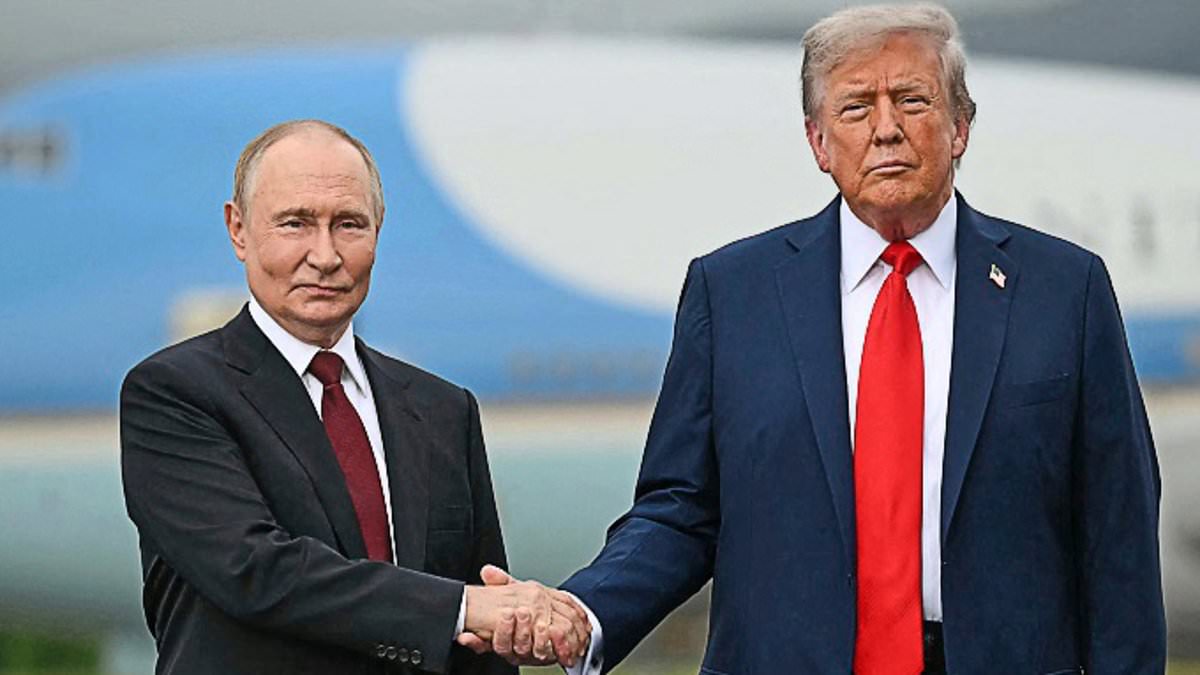
The annual Asia-Pacific Economic Cooperation summit normally passes largely unnoticed by the mainstream Western media.While it gathers representatives of 21 countries, including the US, China and Russia, most attendees are relative minnows, such as Papua New Guinea, New Zealand and Peru.But this year’s event in the southern Chinese city of Shenzhen next week is being heralded as a pow-wow on a par with the Yalta conference, the epoch-making meeting between Winston Churchill, US president Franklin D Roosevelt and the Soviet leader Joseph Stalin that took place in Crimea in February 1945.Because it emerged this week that Donald Trump will have a potentially historic encounter on the sidelines of the conference with Vladimir Putin and Xi Jinping.Just as the negotiations at Yalta laid down the guidelines for the carve-up of the globe by the world’s great powers following the defeat of the Nazis, so many reckon decisions could be taken in Shenzhen that will have devastating consequences.The bad news for America’s allies is that Trump will enter the negotiating chamber in an unprecedentedly weak position after the US’s midterm elections saw him lose Republican majorities in both the House of Representatives and the Senate. Donald Trump greets Vladimir Putin on the tarmac after they arrived in Alaska last year The US President walks with Xi Jinping in Beijing earlier this yearThe President, who once said he could end the Ukraine war in 24 hours, will be desperate for a face-saving win to bolster his beleaguered position at home – and that will send a shiver down the spine of the government in Kyiv.As things stand, Ukraine’s war effort is being shored up by regular consignments of cutting-edge weaponry from the US, Germany, Poland and, of course, the UK.But by the middle of last month, Kyiv’s supply of the sort of interceptor missiles used in its air-defence system had been all but exhausted.Part of the problem is that, since the start of the Iran war, the US has used up 80 per cent of its Thaad missiles and half its Patriots to shoot down Iranian missiles and drones in the Middle East.As winter draws in, this raises the spectre of an increasingly defenceless Ukraine being undermined by the systematic destruction of its energy infrastructure by Russia’s ballistic missiles and Shahed jet-powered drones.According to Ukraine’s foreign minister Andrii Sybiha, Putin has concluded Russia will achieve more by creating cold and darkness in Ukraine than by deploying an endless stream of cannon fodder to the frontline in the Donbas. Winston Churchill, Franklin D Roosevelt and Joseph Stalin at the Yalta conference in Crimea, which was held in February 1945The fear is that, without US help, a demoralised Ukraine could be forced to make a deal with its oppressors that would not only mean giving up the territory that Russia has already occupied in the east of the country but the entire Donbas region.Moscow is also likely to pile pressure on Trump to withdraw support for Baltic states and other countries on its western border with Europe.Despite the fact that Finland and Sweden were driven into the arms of Nato by Russia’s invasion of Ukraine, Putin has always characterised this move as a victory for Western ‘aggression’. He would like to see them disarmed and reduced to the status of a ‘buffer zone’.To this end, he and Kirill Dmitriev, the head of Russia’s sovereign-wealth fund, have long dangled the prospect of multibillion-dollar rare-earth and energy deals in front of Trump’s special envoy Steve Witkoff, a fellow billionaire property developer, who tours the world scouting for deals with the President’s son-in-law Jared Kushner.In the face of such blandishments, Trump would do well to heed the lessons of the accords reached at Yalta. Not only were they harshly criticised when Roosevelt tried to sell them to the American people, Stalin reneged on almost everything. No free elections were held in Poland, Hungary, Romania or Bulgaria. Instead Communist governments were established in all those states and opposition parties banned.Given Putin’s pathological expansionist ambitions, there is no guarantee that any deals struck in Shenzhen will hold. What is to stop him, five years down the line, taking advantage of the emasculated republics on his western flank to spread his empire back towards its Soviet borders?He has had 26 years to create a Russian elite in his own image. Sadly, a significant number of Russians, including his most likely successors, share his basic outlook.It’s a similar story in Beijing, where Xi has spent 13 years purging China’s leadership class to create a cadre of loyalists who share his vision.But while today’s China appears to bear all the hallmarks of a superpower, its rise is recent and the men at the top live in a state of acute paranoia, convinced the West will exploit any opportunity to undermine it, in alliance with its capitalist neighbours Japan and South Korea.And so Beijing will lose no chance to assert its dominance. After Mao Zedong’s People’s Republican Army triumphed in the 22-year Chinese Civil War in 1949, the anti-communist rump built a booming economy on the island of Taiwan, 80 miles off the south-east coast of China.‘Reintegrating’ the island with China would give Xi a victory even Mao failed to achieve. And while the Communists have never made a secret of how important Taiwan is to them, for Trump, it has never been any more than a pawn on the chessboard.The only factor that might give him pause is Taiwan’s role as the leading manufacturer of the sort of microchips so vital to the production of everything from smartphones to military systems.Japan and South Korea should feel equally exposed. Over the past two decades China has ramped up its shipbuilding industry so that it now attracts 60 per cent of global orders for new vessels.This boom has gone hand in hand with a vast expansion of its navy, so that the Chinese Communist Party now has the world’s largest fleet, operating 234 warships compared to the US Navy’s 219.Not surprisingly, Japan feels mortally threatened by China’s new naval build-up. If Beijing seized the islands north of Taiwan – which are also claimed by both Taipei and Tokyo – it would open the way for it to threaten the Japanese mainland itself and to break out into the Pacific.If it did, would Trump stick up for Japan? He has already pointed out that the Japanese – like us Europeans – did not back his war against Iran.While the Japanese and South Koreans have taken on board Trump’s unwillingness to play global policeman – and have begun to build new weapons systems faster than in Europe – they are increasingly preoccupied with a need to develop nuclear weapon programmes of their own.The very idea of making a bomb meets heavy resistance in the country that experienced the horrors of Hiroshima and Nagasaki, but the South Koreans have no such reservations.After all, Kim Jong Un, the deeply unstable dictator across the border in North Korea, already has his finger on the nuclear button.Deeply disturbed by the US President’s increasingly emollient approach to the man in Pyongyang – over the years Trump has described him as ‘a good friend’ and ‘a pretty smart cookie’ – the government in Seoul might well decide it’s time to acquire a nuclear deterrent of its own.So, from Eastern Europe to East Asia, America’s allies are fearful that Trump could be seduced by Chinese and Russian flattery into surrendering their territory or interests. If he is centre stage, will Trump care what is going on off stage – even if it is the sell-out of the West?Mark Almond is director of the Crisis Research Institute in Oxford.
MARK ALMOND: I fear Trump's summit with Putin and Xi next week will be like Yalta in 1945 when three leaders carved up the world
Full Article
Original Source
Read the full article at Dailymail →KhanList aggregates and links to publicly available news content. We do not host full articles from third-party sources. Always verify important information with original sources.