
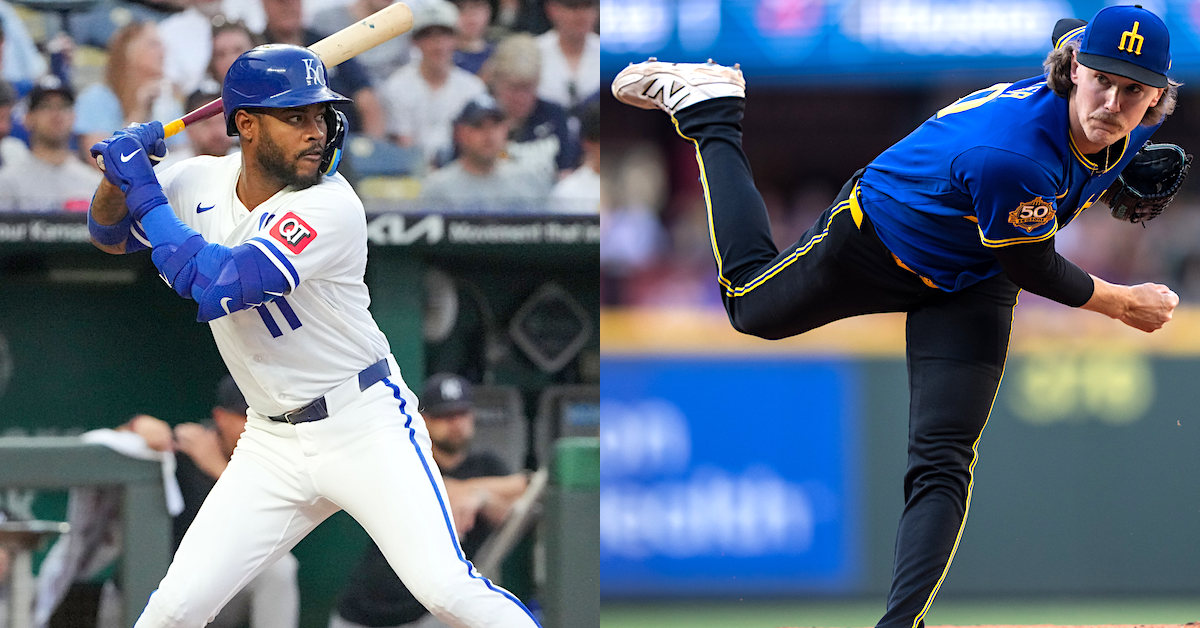
Denny Medley and Stephen Brashear-Imagn Images The offseason is off and running earlier than normal this year. Several top free agents have already signed, and more seem likely to follow. Today, the trade market got started as well. In the first big deal of the offseason, the Mariners and Royals linked up on a six-player trade. As ESPN’s Jeff Passan first reported, Maikel Garcia is headed to Seattle along with James McArthur and relief prospect L.P. Langevin, with Bryce Miller, José A. Ferrer, and Logan Evans going back to Kansas City in the deal. I’ve never understood the obsession with “winning every trade.” Playoff spots aren’t determined by who racked up the most trade points in the past year. But in this case, I’ll make an exception. I understand what both teams were thinking when making this trade. Each is improving upon a perceived weakness without breaking the bank or trading any of its top minor leaguers. But I like the Mariners’ side a lot more, because they got the best player in the deal and also the longest-controlled player (Garcia in both cases). Still, it’s worth looking at the deal from both perspectives to see why this swap happened, and how it could pan out for each team. Let’s start with the Mariners, who have been linked to a pitching-for-hitting trade for years at this point. And while their 76-86 disappointment was as much a failure of run prevention as run scoring, they came into the offseason with clear holes on the position player side and a pitching surplus. Randy Arozarena is a free agent after a career year in Seattle. J.P. Crawford also departed, and while his defense has been declining for years at this point, his steady offense was quite valuable. But the Mariners don’t just need offense from their hitters. They were the worst defensive team in baseball last year, and the problems started in the infield. All told, they were 55 runs below average by FRV or 28 below average by DRS, and whichever of those metrics you prefer, they’re both stunningly bad. None of the 15 Mariners who played the field most frequently last year ranked as above average in both systems; only two (Cole Young and Josh Naylor) got positive marks in even one of the two. Enter Garcia, one of the best defensive third basemen on the planet. He was a slick-fielding shortstop as a prospect, only to be bumped to third base because he happened to be on the same team as Bobby Witt Jr. He has the hardware and the advanced metrics you’d expect from a good shortstop playing third; he won a Gold Glove in 2025 and every statistical system and eye test you can imagine has him among the elite at the position. His glove might be his calling card, but Garcia offers far more than that. After a slow offensive start to his career, he’s matured into a solid hitter who combines elite bat-to-ball skills with enough power to be dangerous. He borders on being passive at the plate, but he makes a ton of contact when he swings and will sometimes look to lift and pull when he gets ahead in the count. We project him as a slightly above-average hitter in 2027, which makes sense to me; he’s posted a .280/.346/.425 slash line, good for a 113 wRC+, over the past two years. That comes with only 19 homers, but 59 doubles. That’s an additional risk factor in Seattle, because T-Mobile Park is a lot less friendly to gap-to-gap hitters than spacious Kauffman Stadium, which is something to keep in mind, but his contact skills should still give him a high enough floor if the doubles dry up. An average-to-plus hitter with Gold Glove defense at a key position? Sounds pricey. But Garcia won’t set the Mariners back as much money as you’d think, because he signed a five-year extension last December. He’s under team control for up to five more years; four years at a $13.1 million AAV plus a club option for 2031. You couldn’t sign a player of Garcia’s caliber to anything approaching that deal in free agency. Along with Young and Colt Emerson, that gives the Mariners three cost-controlled infielders with offensive upside. It’s a lot easier to build a good lineup when you’ve secured economical options at the toughest defensive positions. Add in Brendan Donovan, who is likely to rotate between DH and the outfield to start the year but can handle multiple infield spots in a pinch, and Seattle should have a more secure infield regardless of how it handles its two corner outfield spots. “He’d play shortstop if it weren’t for his teammate” is about to get a field test here. I’m almost certain that Garcia is the best defensive shortstop on the Mariners after this trade. Emerson is the incumbent at the position, and he’s a key part of Seattle’s future plans after signing an eight-year deal at the beginning of 2026. But he’s a tweener defensively; he initially played third so that Crawford could remain at short, and though the two swapped positions in short order before a wrist injury curtailed Emerson’s season, he didn’t look notably good or bad at either position. Scouting reports from his time as a prospect agree with that assessment; he might be an average shortstop, but it would be shocking if he were as good as Garcia, a defensive wizard, there. Still, I think that Garcia is likely to remain at third base unless things don’t go to plan at all in Seattle. Emerson signed his deal with the clear expectation of being the team’s everyday shortstop, and Garcia has already excelled at third for years. The upside feels marginal here; they’re both going to be playing the left side of the infield regardless, and moving Garcia away from where he’s had his best success feels like it might add unnecessary risk to the trade. It’s a small consideration either way for me, though; Garcia is amazing defensively regardless of position, and Emerson is no slouch. The risk with Garcia isn’t that he won’t be playable; it’s that his offense will decline by enough that he’s more of a second-division regular than a star. But even if you don’t hold defensive value in as high esteem as offensive value – a run of offense goes for more than a run of defense on the open market – Garcia is good enough at defense that he’d be a useful contributor even if his bat declines somewhat. We’re projecting him for 3.5 WAR next year, for example, and we’d still have him as an above-average regular if his offense were a lot worse than the 109 wRC+ we have him down for. If he’s a below-average hitter in the long run, the Mariners will have slightly less roster flexibility than they do today, but the low average annual value on his deal makes that risk palatable. There’s a delicate balance between having the core of your roster locked down and having too many commitments to players you’re not wild about, but I think Garcia is on the right side of that divide. There’s upside here, too; he posted 5.6 WAR in 2025 and was 20% above average at the plate. Those are star-level numbers. Garcia has hovered just off the top 50 of my trade value list in recent years; he has a high floor thanks to his defense and contact, and he’s already demonstrated that the ceiling is high too. The Mariners also added two players of lesser note in this six-player trade. McArthur pitched in the big leagues in 2023 and 2024, and captured the closer’s role in Kansas City at one point. But elbow surgery – not Tommy John, but instead a fracture – cost him the entire 2025 and 2026 seasons. He only recovered enough to throw 3 2/3 innings in the minors in 2026 before the season ended, so it’s too early to say how he’ll look upon his return to the big leagues. Before his injury, he relied on an excellent curveball and a mid-90s fastball. In two tracked innings at Triple-A this past year, both pitches were down a few ticks, but I don’t feel at all confident in projecting how that will translate with more recovery time. He’s already in his second trip (of four) through salary arbitration, and it’s very unclear how quickly he’ll be able to return to impactful major league performance, so I’m treating him mostly as a throw-in here. Langevin is less likely to pan out, but perhaps more interesting. What follows is my distillation of a report from Brendan Gawlowski. A fourth-round pick two years ago, Langevin has struggled to locate the ball in the minors, but he’s flashed an outlier-good fastball in the process. He sits in the upper 90s with huge two-plane movement, and though he throws it nearly three quarters of the time, A-ball hitters haven’t been able to get a bat on it. The rest of his game is a work in progress, though. He walked an unconscionable 21% of opposing hitters in an injury-marred 2025, and he was still up above 16% in 2026. If his fastball isn’t up to the task, he’s mostly out of luck; he throws a gyro slider in the upper 80s that misses surprisingly few bats given how much opposing hitters have to respect his fastball. Brendan notes that the Mariners are a great fit for pitchers of this profile; they have a track record of helping pitchers improve their strike-throwing, and also a history of finding better breaking balls for pitchers with good ability to generate spin. The risks here are clear, though: If you’re walking this many A-ball hitters, there’s a decent chance that your command simply won’t hack it in the big leagues. Combine the positives and negatives, and you get a 40-FV player, more or less; an interesting lottery ticket with some positive traits who is nonetheless unlikely to be a major league contributor without further development. Those are basically rounding errors compared to Garcia when it comes to evaluating this trade, but I like Seattle’s approach here. Pitching development is rarely linear, and evaluating pitchers for what they might become is thus incredibly hard. Neither McArthur nor Langevin has much standalone value today, but the Mariners have done a great job of finding an extra gear in their minor league pitchers, so bringing in more interesting options to see if something clicks can only be a good thing. I would have liked this trade for them even if they only got Garcia back; this is just pure upside from my perspective. To add Garcia to their squad for the next four-plus years, the Mariners sent out some pitching surplus. Bryce Miller, the headliner headed back to the Royals, just completed his fourth big league season, an up-and-down campaign as he attempted to bounce back from a blah, injury-filled 2025 campaign. His calling card has always been his fastball; it’s his best pitch, and at times in his big league career, it’s been the only pitch he’s comfortable throwing. He added a splitter in 2024 and leaned into it more than ever in 2026, finally pairing a stable secondary with his heater. It’s a fly ball approach, with most of the contact he allows coming on elevated fastballs or hanging secondaries. When it’s all working, Miller looks unhittable. He attacks the zone and generates plenty of chase when he fishes below it, because hitters are sitting fastball and reacting poorly to bendy stuff. But when it’s not working, the ball leaves the park, and that leaves me wondering how he’ll fit in a new stadium. Kansas City moved the fences in this season, and while it’s still not a great place to hit home runs, it’s become one of the better stadiums in baseball for fly ball-based offense. The outfield is still quite large, it’s at some elevation, and the fences are now close enough that you can’t just assume everything will stay in the park. Only Fenway Park and Coors Field were better places to hit doubles last year. Meanwhile, Miller has spent his career pitching at the best pitcher’s park in baseball, a place where extra-base hits go to die. He’s been meaningfully worse on the road throughout his career, and he’s given up far more homers without T-Mobile Park as a cushion. It’s a strange fit; I’m not saying Bryce Miller is the last pitcher I’d want to put on the mound in front of Kauffman’s new dimensions, but he’s certainly on the list. To be fair to the Royals, they really do need pitching in both the short and medium term. Ace Cole Ragans is on the shelf indefinitely after his third UCL repair, with the most optimistic timelines putting him back in the majors in the middle of next year. Ryan Bergert and Stephen Kolek, both of whom were expected to provide some bottom-of-rotation innings, each had Tommy John surgery earlier this year. Michael Wacha and Seth Lugo, the veteran mainstays who followed Ragans atop the rotation in their 2024 playoff run, are both slowing down in their mid-30s. This was a bottom-half rotation in 2026 even with a standout sophomore season from Noah Cameron, and things didn’t look likely to get better with Ragans out and the top arms aging. Miller is under team control for another three years, though there’s at least some chance that the third of those years could disappear in this winter’s collective bargaining (he’s 28, and both sides have made noise about age-linked free agency cutoffs). He’ll cost meaningfully less than Garcia, at least; he made $2.5 million in arbitration in 2026 and we project he’ll get a $3.9 million salary for 2027. But on the other hand, he has a 4.82 ERA and a 4.74 FIP over the last two years pitching in Seattle; there’s at least a chance that he doesn’t bounce back from those numbers in Kansas City. I know that projections have him with an ERA right around 4.00 (thanks to some innings in relief), but if you made me handicap it, I’d take the over on that number in his new ballpark. To the Royals’ credit, they didn’t stop with Miller. They also acquired Ferrer and Evans to bulk up their pitching staff. Ferrer is a mid-leverage reliever with outrageous stuff; he doesn’t miss a ton of bats, but his heavy sinker limits damage on contact and he floods the zone to limit free passes. That was a rough fit with Seattle’s miserable infield defense, and kind of a waste in that ballpark, but he makes far more sense in Kansas City, where Witt and Michael Massey form an excellent up-the-middle defensive duo. We’ve penciled him in as the Royals’ top setup man, and I think there’s a reasonable chance that he ends the season as the closer; he has plus stuff and is a good ballpark fit. He, too, is under team control for three more years, which should help the Royals stabilize what was a very poor bullpen in 2026. Evans debuted in 2025 and graduated as a 45-FV prospect before undergoing elbow surgery early in 2026. He missed the entire season, but as it was an internal brace procedure rather than a full UCL replacement, he could be back early next year. He looks like a fifth starter/swingman type to me, and our projections agree. He throws six pitches, none outstanding, and commands his arsenal well. His 81-inning debut comes with plenty of sample-size caveats, but he had real trouble making major league hitters swing and miss, with bottom-tier whiff and strikeout rates. That led to a slight walk problem – in that he walked more batters than league average despite great command. If you can’t put guys away, you’re bound to lose some of them to free passes, and that was the case here. Every team could use a pitcher like Evans, but he’s hardly a difference maker in the same vein as Garcia or even Miller. He’ll help fill in some of the gaps in Kansas City’s rotation if he’s able to return quickly, and there’s always a chance that an uptick in velocity or a new secondary unlocks more swing-and-miss. But given that he’s currently rehabbing from a major surgery and was only middlingly effective the last time he pitched, he’s nothing more than contingent insurance for a rickety pitching staff. Put it all together, and my take on this trade is that the Royals got a lot of pitching without actually doing enough to improve their run prevention. Miller will eat some innings, hopefully with good-enough homer suppression, and Ferrer will be a big upgrade in the bullpen. But they gave up a +10 defensive third baseman to do so, eating into a ton of the gains on that side of the ball, and they have no obvious replacement for Garcia. We’ve given the plate appearances to utilityman Nick Loftin for now, but that’s more of a “who can play third” situation than “who should play third.” I spend a lot of time telling readers not to get too caught up in projections or surplus value – but that doesn’t mean you should ignore them completely. Garcia projects for roughly double the 2027 WAR of the three players the Royals got back for him, and he’s under team control for longer too. Generally speaking, you should get more aggregate surplus value, or at least more team control, if you’re the one giving up the best individual player in a deal. The Royals didn’t do that, and they also tossed in two interesting pitchers in the bargain. My rough-cut surplus value model told me that this trade was outside its fairness bands and to reconsider; it uses our projections rather than tapping into the future state of the universe, so it’s not infallible or anything, but that’s not something you see every day given how analytically inclined and homogenous front offices have become. If I’m wrong in my assessment of this deal, it will likely come down to one of two things: Garcia wilting in the tough offensive environment in Seattle or Miller outperforming my homer-happy expectations in Kansas City. I’m definitely at least a little worried about Garcia’s offense; Seattle is a really tough place to hit, and his game isn’t particularly well-suited for it. But man, there’s a lot of room for him to be worse than the projections and still be better than what Seattle was going to do with that roster spot otherwise, and his contract is a huge plus. Likewise, could Miller be better than I’m predicting? Most definitely. But another way of looking at this is that Seattle gave up its sixth-best starter (behind Logan Gilbert, George Kirby, Bryan Woo, Kade Anderson, and Emerson Hancock) and a middle reliever and got back Kansas City’s second-best hitter. Pitchers are volatile, of course, but we have 500 innings worth of history with Miller, and he’s posted an ERA and a FIP above 4.00 despite playing in the best pitcher’s park in the majors. He might improve markedly next season. He’s capable of it; he managed a 78 ERA- and a 91 FIP- in 2024, and that’s park-adjusted, so it doesn’t give him too much credit for T-Mobile. but I don’t see any reason to expect that. His career marks are 105 (ERA-) and 104 (FIP-), respectively, and like I said, the fly ball nature of his game is going to be awkward in Kansas City. Overall, it’s a trade that I would make every time if I were the Mariners. And while I at least understand what the Royals are thinking, I don’t think they received enough pitching to make the overall deal make sense, even if they were dead set on acquiring a mid-rotation starter.
Mariners, Royals Kick Off Trade Season With Blockbuster Six-Player Swap
Full Article
Original Source
Read the full article at Blogs →KhanList aggregates and links to publicly available news content. We do not host full articles from third-party sources. Always verify important information with original sources.