
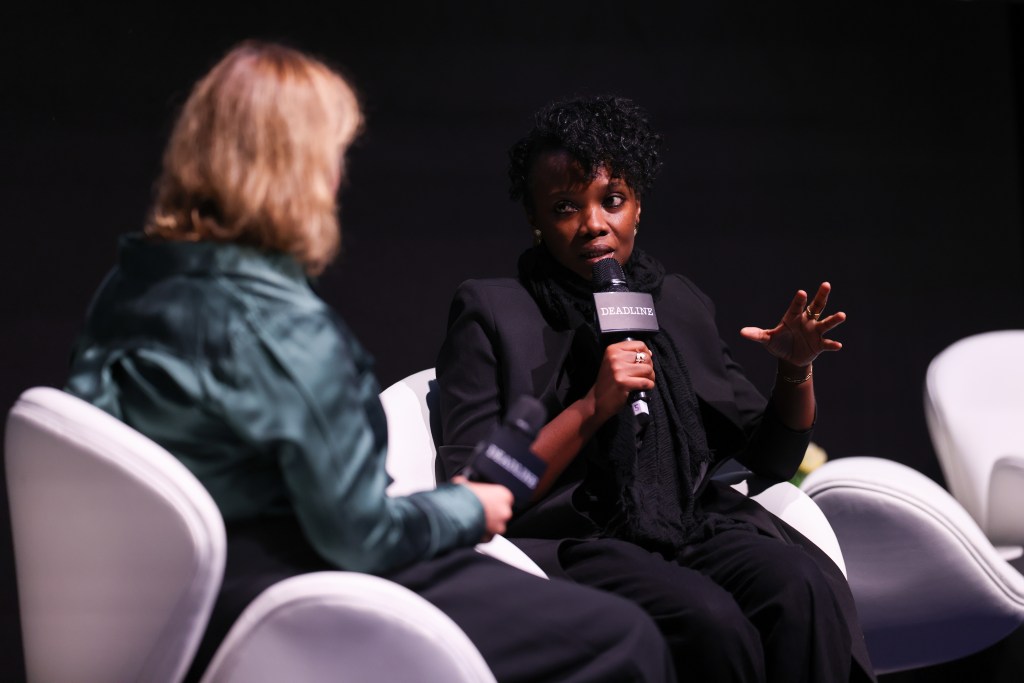
It’s been a good year for Marie-Clémentine Dusabejambo; after directing the first Rwandan feature to be accepted into the official selection by the Cannes film festival, where she was awarded the Camera d’Or, her film Ben’Imana was recently nominated as the country’s first ever Oscar submission. Set in 2012, 18 years after the genocide against the Tutsi, the film unfolds in a Rwandan village where survivors and perpetrators are grappling with the process of reconciliation. Speaking at Deadline’s Contenders London event, Dusabejambo, who was seven at the time of the genocide, revealed that she had turned to cinema after studying mathematics and physics. Several short films ensued, but the idea for Ben’Imana came after the second, in 2013. “I think it was my destiny, but it was a film that was still trying to find expression in me. I needed time to understand, to feel, to read, to hear… There’s a point in time where in every generation needs to understand what happened, where we came from, what happened, and what people decided to do in their time within their own means to be able to continue.” It was important, she said, to break through the myths and preconceptions that have sprung up around the genocide. “I wanted to be more authentic to the history,” she said, “and I also wanted to not judge the people, the generation, that came before us, and what they did. I didn’t really want to fall into the stereotype of the victim and the perpetrator. All of this was about turning our lives around, making peace, being able to create a future and put a mirror to my community.” Watch on Deadline In wrapping up, Dusabejambo praised her crew and mostly non-professional cast for bringing her story so vividly to life. “I love that the film looks like a million dollars,” she said, “but [it didn’t cost] a million dollars. The million dollars comes from the love and the art and the will of the people who worked with me to tell the story… There were many times when the fictional elements of the story were meeting the reality, because it’s 100% made by Rwandans. All of us, we are connected to this story.” Check back Monday for the panel video.
Marie-Clémentine Dusabejambo On Directing Rwanda’s Oscar Submission ‘Ben’Imana’: “We Need To Understand What Happened” – Contenders London
Full Article
Original Source
Read the full article at Deadline →KhanList aggregates and links to publicly available news content. We do not host full articles from third-party sources. Always verify important information with original sources.