
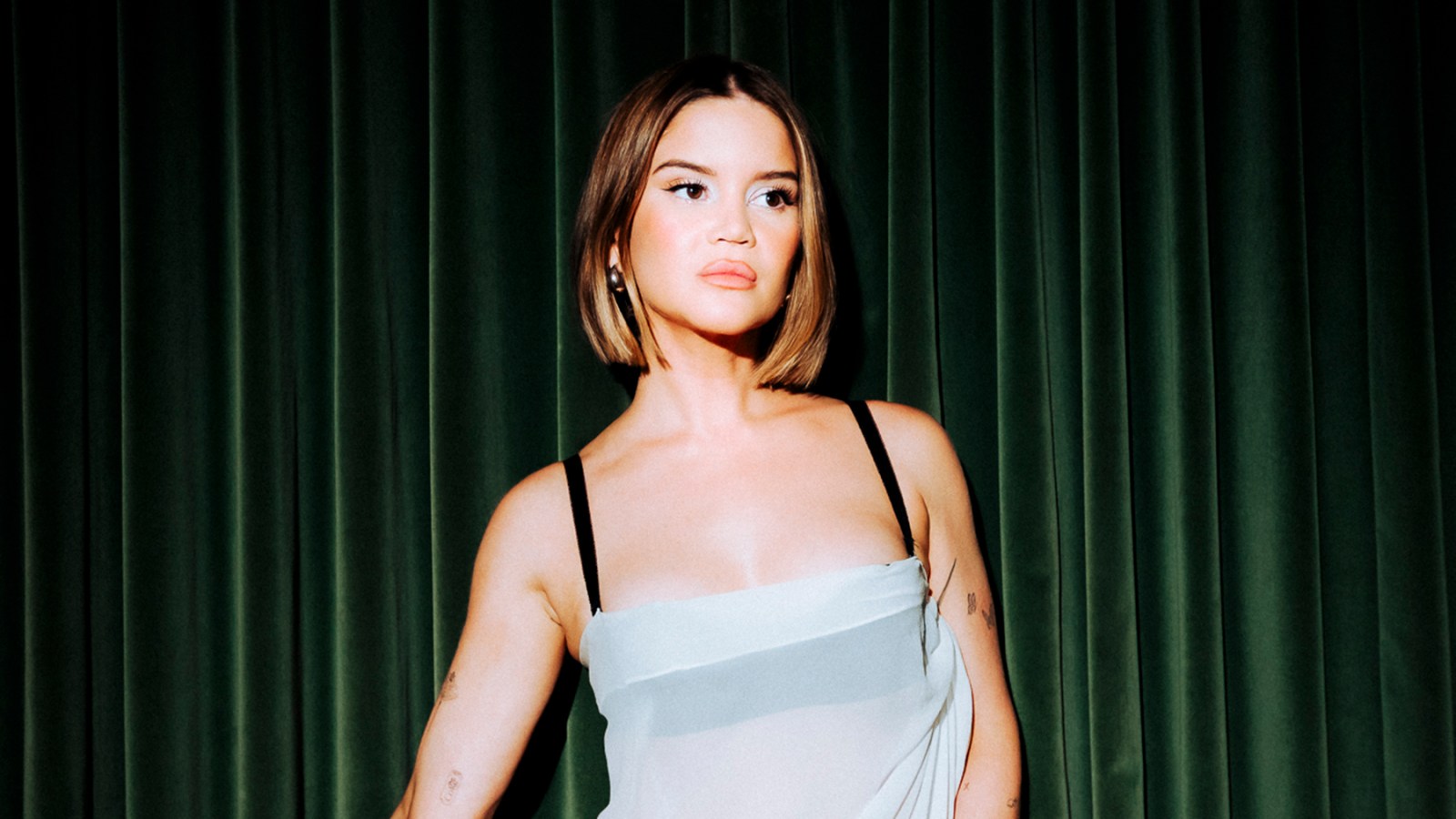
There’s something familiar about Maren Morris’s East Nashville living room. Maybe it’s the wood-paneled walls, or the gorgeous upright piano with its gilded exposed innards that evokes an old organ, or the two stained-glass windows that refract slices of tinted light. It feels, to be honest, kind of like church. “A little bit on the nose, huh,” Morris says with a laugh. A decade ago, she released her breakout single “My Church” from her debut album Hero, and she’s rolling with the metaphors. This cabin-like home she shares with her son Hayes has become her sanctuary, and, in a few weeks, she’ll be playing a Hero 10th anniversary show at the Ryman Auditorium, i.e. the “Mother Church of Country Music.” “I’ll lean into it,” Morris adds, sitting down on a tan leather couch in a pair of jeans, a black tank, and silver band around her bicep. “Sometimes you just have to. But it’s the perfect place to enshrine the memory of what we started.” It’s a quiet morning in the neighborhood, on a wooded street filled not with giant showy mansions but family houses, roaming deer, and towering trees. It is a beautiful and airy place, like real people live here: a small playscape in the yard with a slide and swings, little shoes by the door, and a Dachshund that insists on sitting as close as possible to a human leg. “He’s Velcro,” Morris says, after several failed attempts to discourage him from the couch (and my lap). Moving to this house has been a returning for Morris, and she isn’t afraid of going back. Her life right now is big on both reflection and new beginnings. Morris bought the home from Jess Busbee, the wife of her late producer and friend Michael Busbee, a.k.a. busbee, who died in 2019 after battling an aggressive brain cancer. That piano by the door was his, and they wrote her song “80s Mercedes” on it. Now a photo of Morris, in a white fur jacket hugging busbee, sits on the mantel next to a collection of awards and a Wheaties box with her face on it. It’s not always easy to be confronted with his memory, but she welcomes it. She’s good with sitting in discomfort. Editor’s picks When Jess Busbee moved to Nashville after her husband died, this was their “healing house.” Now it’s Morris’s. “It’s this ten-year evolution of full circle moments,” Morris says, who divorced her ex, artist Ryan Hurd, in 2024. “It was the perfect place for me and Hayes to start over.” When Morris moved to Nashville from Arlington, Texas, in 2013, she lived here on the East Side, across the river from Music Row where most of the mainstream country music action happened. Rents were cheaper, and it’s where artists and creative people gravitated: “East Nashville” was almost more emblematic of a cultural divide than a physical one. Over the years, as those once-struggling artists like Morris found their way to the main stages, that’s shifted. “There’s less writing in the publishing houses, and everyone has a home studio over here,” Morris says. Laura Veltz, who co-wrote “The Bones” and “I Could Use a Love Song” with Morris, lives just down the road, and so do buddies like John Osborne and Lucie Silvas. Morris didn’t plan for her return to coincide so poetically with the 10 year anniversary of Hero. But it’s fitting, and she’s been celebrating both coming back to where she started and heralding the album that launched her career with special shows (a night with the symphony at Colorado’s Red Rocks, the Ryman gig) and an anniversary edition, Hero: A Second Wind, which contains several new tracks and some unheard demos. When it was released in 2016, Hero shocked the country music establishment in more ways than one. Its lead single, “My Church,” gained initial traction not on country radio, but on streaming, building fans on Spotify before a major label even signed on. It spurred several hits including “I Could Use a Love Song,” which went to Number One despite being both a ballad and recorded by a woman — two things the airwaves are notoriously unfriendly to. And it blended genres, with influences from Patty Griffin to Beyoncé (on songs like “80s Mercedes” you can hear both a soulful, poppy rhythm and the sticky Texas drawl of Hayes Carll when she says “time” like it’s two syllables). It also showcased a vocalist with a singular tone that could hit almost any note, and who wanted to explore all the bounds of that range. Related Content “I learned that you didn’t really have to choose,” says Morris, who gives a lot of credit to the time she spent writing on both Music Row and with more independent voices in East Nashville. “You can be both commercial sounding and have something catchy, which is just in me, but then also really push yourself in a sonic way. You can create melodies that aren’t expected, or when you think you’re about to go back to the chorus, do a left turn. There are so many hodgepodge things I learned how to blend through those two worlds.” Brittney Spencer, Morris’s friend and frequent member of the Highwomen, remembers cueing up Hero on her walk to work in North Nashville. Three songs in, she says, she had to hit pause: She was shocked by what she was hearing. “I couldn’t believe an album like this was coming out of Nashville,” Spencer says. “Maren’s voice paired with the production and lyrics felt so in-your-face good.” Spencer’s reaction wasn’t unique: For artists in Nashville, especially women and anyone who wasn’t a cookie-cutter straight white dude wanting to make either traditional or bro-y country music, it was paradigm-shifting. “I remember thinking ‘what is this,’ and I mean that in the best way possible,” says Morris’s friend Cassadee Pope. The two have known each other since a writing session in 2014, and have weathered quite a few media storms together. “It was really refreshing to hear a major label artist in Nashville produce something that felt so unique and singular. I think it raised the bar for everyone to work harder to find their own voice as opposed to catering to the country radio standard.” Though “My Church” never hit Number One, it did manage to climb to No. 9 on Billboard’s country airplay chart. It also won a Grammy, and earned her an appearance on Saturday Night Live. Some purists, who seemed content to classify what was essentially rock music from men as country but not Morris’s interpretation of the genre, were perturbed. Since she mentioned “Johnny Cash” in “My Church,” shouldn’t she be following some sort of country music code? Could she be more polite, actually? Maybe cuss less? But Morris never declared herself a traditionalist, nor did she have any interest in proving her Texas bona fides. Hero stood alone, exactly as she wanted it to. Friend and tourmate Lindsay Ell describes the record as having “its own point of view,” she says. “And it definitely had a sound of its own. It didn’t try too hard, but was just perfectly itself.” Maren Morris onstage at the “Mother Church of Country Music,” the Ryman Auditorium in Nashville. Photo: Nicole Mago* Nicole Mago* In the years that followed, Morris’s career has been unlike almost any other to come out of Nashville. She’s rarely stayed with the safe choice. The singer was at Newport Folk Festival with the Highwomen, not a flashy Music Row party, when none other than Dolly Parton informed her that her song “Girl” had hit Number One (our interview took place before Parton’s death, which left Morris, like pretty much everyone on earth, heartbroken). She coined a diss for the ages, “Insurrection Barbie,” and urged the genre to give respect to its Black female voices onstage at the CMA Awards. She paired up with Zedd to create a massive pop hit, “The Middle,” in 2018, and came out as bisexual in 2024. Last year, she released the excellent Dreamsicle without any real genre walls. She traded larger arenas for more intimate venues after not playing nice meant a more curated fanbase. Morris’s political evolution isn’t as stark as it might seem: in the video for the lead single and title track from Girl, she wore a shirt emblazoned with the word “feminist.” And yes, there was that “Insurrection Barbie” moment, when she and Pope publicly shot back at Brittany Aldean, the influencer wife of country star Jason Aldean, after she shared some transphobic views online. But the overlooked part of the drama was how Morris used that moment — parlaying some ridiculous Fox News coverage into producing a “Lunatic Country Music Person” T-shirt to raise $150,000 for charities benefitting transgender youth. These days, she’s loosened her grip on the need to be heard. “Having to be in every conversation, win every battle, clap back at every asshole,” Morris says. “I did burn out and I had to rest.” She is happy, however, to comment on the “stupid fucking data centers. I think we are all against [those],” she says. (When I remind her that even Trump-friendly artist Gavin Adcock has been vocally against data centers, she replies, “I guess pigs can fly”). “I think we all agree on more than we think,” she continues, “but so much is wedged through propaganda and culture wars. You focus on all these cultural differences instead of actual financial ones, like how they’re stealing our fucking money for a war that no one wanted or voted for.” Morris did have a funny moment the other day while talking to a member of her touring crew about the “Insurrection Barbie moment”: He didn’t realize that it was his boss who started the whole thing. Morris looks back on it with a laugh. “I’ll own it, because I just think it’s not offensive — it’s funny,” she says. “I think that’s what chaps anyone’s ass who thinks it’s offensive, because, deep down, they’re like, ‘Damn, that’s good.'” She smiles before her face turns a hair serious. “Anyway, it’s child’s play compared to ‘Quiet, piggy.'” Still, things changed for Morris in Nashville after those headlines. But it was more like the final drop in a glass of water already filled to the rim. As a woman in country music, “the shelf life was always going to be the shelf life,” she says. “This is my life’s work. I really want to put it somewhere that it will be cared for. And if that has to look smaller, so be it. I’ll have more care for it.” Her friend and fellow Highwoman Brandi Carlile told Rolling Stone that she’s “been watching Maren’s moves, and I’m feeling really proud of her.” Comments about “leaving” country music got taken out of context, but Morris doesn’t feel the need to beat what she calls a “dead horse” anymore (especially since she was literally singing country music, with her country band, this summer). Morris has no regrets. “I never have a moment of, ‘Gosh, I would be in a much different place, a better place career-wise, if I had just played the game and kept my mouth shut and kissed the proverbial ring,'” she says. “I feel a little bit more at peace and vindicated, because I’ve not changed my tune.” She has a more edited fanbase now, a group that’s dedicated, engaged, and here for the long haul. In an economy full of canceled tours and undersold arena dates, Morris thinks it’s important that artists put aside their egos and evolve with the times, even if it means downgrading the size of their venues. “There’s a lot of pride probably with artists that don’t want to,” she says. “It’s almost like if you’ve graduated to arenas or stadiums and then you go to a lower cap, there’s a pridefulness of, ‘Well, that’s a failure.’ But it’s not. It sometimes has nothing to do with you, it’s just the way the world has changed. To still give your fans the experience of seeing you and giving them the escape, I think you can bite the bullet and play the smaller venue.” Morris’s shows this summer have felt affirming and cathartic. The audiences are full of all kinds of people singing along, embracing songs on Dreamsicle even without much airplay or traditional support. She’s had time to pursue other creative interests as well, like writing for film, acting, and even releasing two children’s books. It’s all building toward the sort of intentional longevity she hopes to have, like her heroes Sheryl Crow or Bonnie Raitt. “I still just sometimes walk out and wonder, ‘How are all these people here?’” she says. “And it’s not to diminish my work or my presence. I’ve just been taught by the book and from a young age, that there’s only one way to do something. Now that I’m doing it my way, I think it still shocks me that people still show up.” The idea of folks who stick by you has been a theme in Morris’s life since the early days. It’s on Hero’s “Company You Keep,” Girl’s “All My Favorite People,” Dreamsicle’s “People Still Show Up.” Morris looks for that in others, but expects it from herself, too. “It’s really comforting to have a friend you know will be there beside you when shit hits the fan,” Pope says. “We both prioritize family and chosen family so I think that grounds us, and reminds us what truly matters. We also actually care about the people we advocate for, so that makes whatever backlash we receive feel worthless. And when the internet explodes over us in a more playful way, we laugh about it and go on with our lives!” This summer, after she gets off the road, Morris will be stationary for the first time in ages. There’s nothing on the books but some writing sessions, and she’s excited to do a little work around the house, explore the neighborhood, and get Hayes ready to start kindergarten. She’s even going to a yoga retreat, hosted by her friend and former bandmate Rachel Beauregard. Some new music is in the works, but it’s as open and free as she is right now (she describes what she’s creating as “weird” and “off the wall” kinds of songs). And she’s been embracing belting and big vocal moments, listening to D’Angelo and Vulfpeck. She thinks about touring with a jazz quartet. “Happiness is just getting a demo back from a song I wrote, and having a jolt of hope that it could be nothing or a life-changing few minutes,” she says, rising from the couch to get ready to load into the car waiting outside. “You never know. That’s the scary hope of it all.” Maren Morris played her debut album ‘Hero’ in full during a headlining performance at the Ryman Auditorium in Nashville. Photo: Nicole Mago* Nicole Mago* IT’S A HALF AN HOUR BEFORE SHOWTIME, and Morris is backstage in a black catsuit. We’re at the Ryman for the Hero anniversary show, and the green room is not filled with champagne or trays of caviar, but children running toy trains along the floor. She wants to introduce me to Hayes, who will also be in the audience for the show tonight. He’s starting kindergarten next week, and is proudly wearing his custom tour lanyard and a mini pair of glasses. He is, objectively, adorable. Another little boy, about Hayes’ size, walks up to Morris. “Hey, Maren,” he asks. “Do you have any solo albums?” “I do,” she responds sweetly. “Hero!” He nods and returns to the table of toys with Hayes. “I think he may be a journalist when he grows up,” she says, before disappearing to get changed for the show. “He’s just always curious.” The Ryman pews are filled with friends, family, and fans who, based on how well they know every word to every song, have either been with Morris from the beginning or catch up really fast. Michelle Branch is here, who will play “Goodbye to You” with Morris on her childhood guitar, and so is Pope, who will hop onstage to close out the evening with a long-teased pop-punk version of “The Bones.” Perhaps most importantly to Morris is Jess Busbee and her children, to whom she will dedicate the show. Trending Stories Morris, in a while gauzy dress and bare feet, walks out to a standing ovation. Playing through the entire Hero album, in chronological order, she doesn’t say too much, other than some thank you’s and a few little stories here and there (as she has been doing for years now, she replaces the call-out to Diddy on “Rich” with Dolly). But before the last song, she announces that she has a few words for two important people: her younger self, and her son. Her advice to both are the same. “I would like to say that you are going to grow so much in very uncomfortable ways,” Morris says, looking out toward the sold-out crowd. “You’re not always going to do it gracefully, but you know your heart and you matter. You don’t have to be productive to matter. You don’t have to have output to matter. Whatever you end up doing, your worth is not what you do. I’m proud of you. You’re gonna go so far.”
Maren Morris Is Happy With Where She’s Landed: ‘I Feel Vindicated’
Full Article
Original Source
Read the full article at Rollingstone →KhanList aggregates and links to publicly available news content. We do not host full articles from third-party sources. Always verify important information with original sources.