
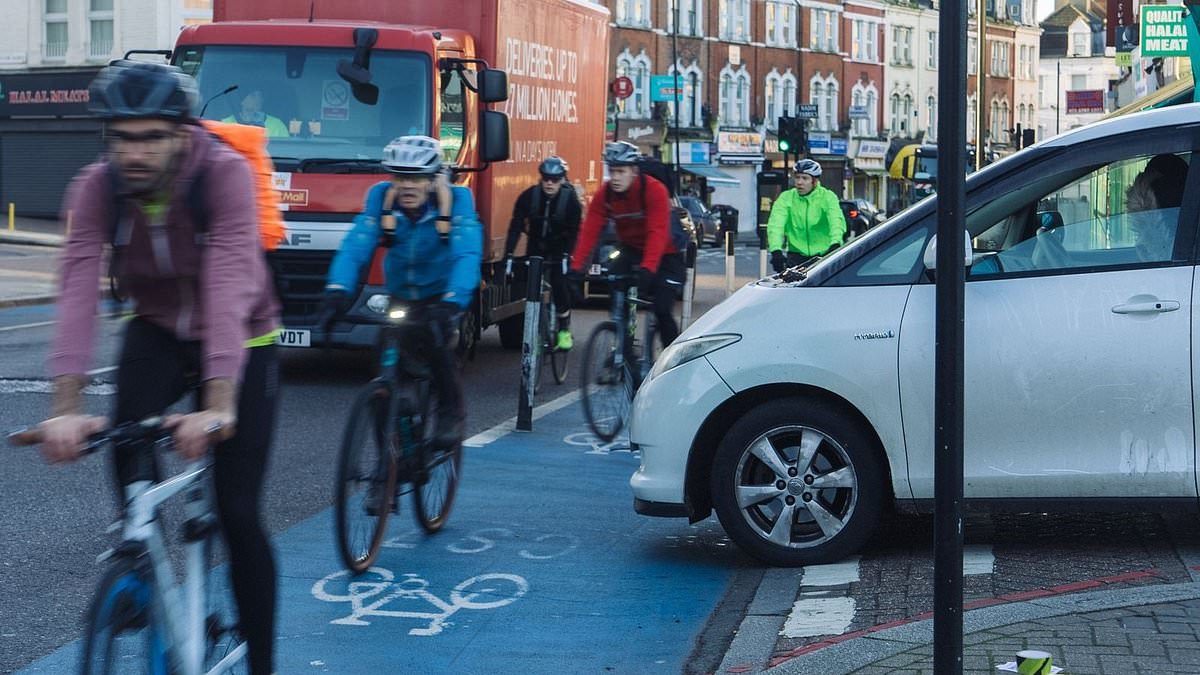
London's top 20 most dangerous junctions for cyclists have been identified by campaigners who want more protection on the capital's roads.The map from the London Cycling Campaign uses collision data from emergency services split by fatal, serious and slight incidents over the past five years.A junction on Cycle Superhighway 7 at Upper Tooting Road in Wandsworth, south London, was worst for the fourth year running following 27 cycling collisions.In second place was an area of Haringey in north London where Broad Lane and West Green Road meet High Road, with 18 collisions over the period.Hackney in east London was third, at the junction of Great Eastern Street, Curtain Road, Gatesborough Street, Leonard Street, New Inn Yard and Phipp Street.King Street and Weltje Road in Hammersmith was fourth; followed by Carpenters Road, High Street, Jupp Road West and Wise Road in Newham in fifth.Completing the top ten were three junctions in the Southwark area, a second in Hammersmith and Fulham and another in the City of London.Campaigners are now calling for more 'all-round protected' junctions, which give cyclists and pedestrians a dedicated green-light phase while cars are held on red. The junction of Ansell Road, Derinton Road, Lessingham Avenue, Price Close and Upper Tooting Road in Wandsworth had eight serious cyclist collisions and 19 slight collisionsTom Fyans, chief executive of the London Cycling Campaign, said: 'Less than a handful of London boroughs so far have delivered 'all round protected' junction designs, despite a growing list of cities and towns outside London managing to.'Why haven't Transport for London yet managed a single one, why are so few boroughs delivering them and why does filtering side road junctions with significant collision patterns seem so difficult also? London's top ten most dangerous junctions Ansell Road, Derinton Road, Lessingham Avenue, Price Close and Upper Tooting Road (Wandsworth): Eight serious cyclist collisions and 19 slight collisionsBroad Lane, High Road and West Green Road (Haringey): Eight serious cyclist collisions and ten slight collisionsCurtain Road, Gatesborough Street, Great Eastern Street, Leonard Street, New Inn Yard and Phipp Street (Hackney): Nine serious cyclist collisions and nine slight collisionsKing Street and Weltje Road (Hammersmith and Fulham): Seven serious cyclist collisions and 16 slight collisionsCarpenters Road, High Street, Jupp Road West and Wise Road (Newham): One fatal collision, two serious collisions and nine slight collisionsBorough High Street, Duke Street Hill, King William Street, London Bridge and Railway Approach (Southwark): Six serious cyclist collisions and 18 slight collisionsDunton Road, Kinglake Street, Madron Street, Mina Road and Old Kent Road (Southwark): One fatal collision, two serious collisions and seven slight collisionsWestway and Wood Lane (Hammersmith and Fulham): One fatal collision, three serious collisions and two slight collisionsApothecary Street, Bridewell Place and New Bridge Street (City of London): Seven serious collisions and three slight collisionsOld Kent Road and St James's Road (Southwark): One fatal collision, two serious collisions and three slight collisions 'Concerns over drivers facing a few seconds more on journey times all too often seems to trump dealing with fatal and serious collisions for those cycling, walking and wheeling.'The group also cited concerns about a pair of Old Kent Road junctions where cyclists have died in the past years; and a Stratford High Street junction where a man in his 20s was killed by a lorry while cycling along Cycleway C2 last year.Jeremy Leach, chair of the campaign group London Living Streets, said: 'This once again highlights the danger junctions pose to pedestrians, who make up half of all fatalities on London's roads.'The presence of two junctions on the Old Kent Road also underscores how much work remains to make TfL's 'red route' network safe.'It has been over ten years since the Old Kent Road was designated as an Opportunity Area, yet we've seen little or no meaningful change to protect people walking and cycling.'Changes to junctions, filtered side roads, fully-signalised crossings, reduced speeds and lower levels of traffic are all needed urgently if London is to achieve its Vision Zero goals.'Campaigners did however welcome improvements at the 'notorious' Wood Lane/A40 junction in White City, west London, where PhD researcher Chuijiang 'Christina' Kong was killed aged 23 by a lorry while cycling in October 2021.Responding to the findings, TfL cited its £150million investment in improving roads for cyclists and pedestrians as well as its work on 48 'Safer Junctions'.Helen Cansick, TfL's head of Healthy Streets investment planning, said: 'Our deepest sympathies are with everyone impacted by loss of life and injuries on London's roads.'We are determined to eliminate death and serious injury on the road network and are working hard to deliver improvements at some of the capital's most dangerous and intimidating junctions.'Our Safe and Healthy Streets funding dedicates more than £150million to improve London's roads for people cycling, walking and accessing public transport, with more than half of this being delivered through London's boroughs. Campaigners want more 'all-round protected junctions', which give cyclists and pedestrians a dedicated green-light phase while cars are held on red. An example in Waltham Forest is above'We have so far completed work at 48 Safer Junctions across London, including the recent upgrades to the junctions on both sides of Lambeth Bridge and we are currently consulting on proposals to make Monument Junction safer for everyone who uses it.'We remain committed to helping boroughs improve road safety on their local road networks and made available £94.8million to the London Boroughs in 2026/27 to support delivery of safer and healthier streets across our capital.'We welcome this research and will continue to work closely with campaigners, councils and local communities across London to improve road safety and end the devastation caused by collisions.'The latest TfL casualty data shows 23,792 people were injured on London's roads in 2025, as a result of 20,874 collisions.Car occupants accounted for 7,293 or 31 per cent of all injuries, followed by people cycling at 5,675 or 24 per cent and walking at 4,698 or 20 per cent.The total number of cyclists injured was up 16 per cent on the 2024 figure of 4,878; while the number of walkers injured rose 6 per cent on the 2024 total of 4,449.
Map reveals London's 20 most dangerous junctions for cyclists as 23,000 people injured on the capital's roads last year
Full Article
Original Source
Read the full article at Dailymail →KhanList aggregates and links to publicly available news content. We do not host full articles from third-party sources. Always verify important information with original sources.