
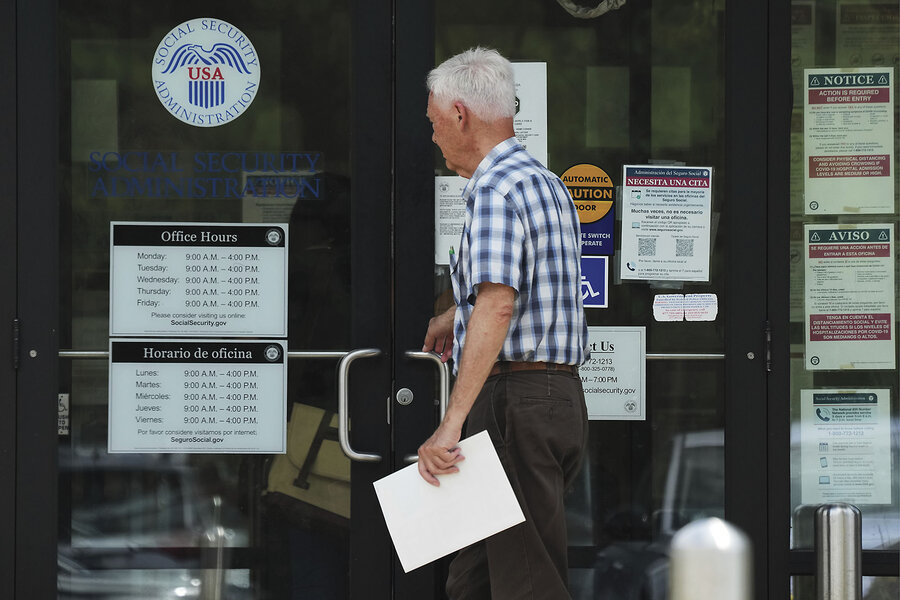
Until this year, Rep. John Larson hadn’t faced a Democratic opponent for his deep-blue Connecticut seat since winning it in 1998. In August, though, the septuagenarian member of Congress lost a primary to former Hartford Mayor Luke Bronin, who made his relative youth – he’s among the youngest Generation Xers – a central campaign theme.In his victory speech, Mr. Bronin urged Democrats to bring more young people into the fold, echoing the rhetoric of other candidates pushing for generational change. The party is still reeling from President Joe Biden’s refusal to bow out of the 2024 election campaign sooner amid concerns about his age.Many young Americans “have lost faith that our system is capable of making changes that matter to them, and we built a campaign where young people were very much a part of it,” Mr. Bronin said. But on a fiscal issue that generates intergenerational sparks – the rising costs of benefits for older adults driving the national debt – there’s little daylight between younger and older Democrats. This continuity reflects the disproportionate power wielded by baby boomer politicians, as well as baby boomer voters, donors, and volunteers over both major parties, particularly when it comes to policies on retiree entitlements. Rusty Jones/APLuke Bronin, former Hartford mayor and Democratic candidate for Connecticut’s 1st Congressional District, speaks during an election night watch party in Hartford, Connecticut, Aug. 11, 2026. Mr. Bronin promises to strengthen Social Security and Medicare, which Mr. Larson has long championed by introducing successive bills that would raise payroll taxes and expand benefits. The two programs account for 40% of the $7.4 trillion federal budget and are paid from trust funds that are forecast to become insolvent by 2032 and 2033, respectively. Interest on the $40 trillion debt, meanwhile, now exceeds the annual defense budget.As a voting bloc, older adults have long been a potent force that makes entitlement reform a political third rail. But during an election year in which many younger people say they are struggling to start families and build wealth, some are asking why they are underwriting the retirement of affluent baby boomers. In 2023, over one-third of Social Security benefits went to older adults with gross incomes of $100,000 or more, according to an IRS analysis cited in a Washington Post editorial.Any long-term fix for Social Security hinges on raising taxes and adjusting retiree benefits, says Thomas Kahn, who served as the staff director of the House Budget Committee from 1997 to 2016. (“You can’t say cuts. You say adjustments,” he said.) Lawmakers must strike a balance between the interests of current retirees against future ones. “Middle-aged people and younger people understandably do not want to see their payroll taxes go up,” he says. Legislative power rests in the hands of a Congress whose average members are closer in age to retirees than to voters in their 20s and 30s. Most shy away from a thorny and combustible issue. Last year, Congress held only two hearings related to Social Security, and only 7 out of 56 candidates for Senate in the midterms have taken a stance on how to safeguard the program, according to a Brookings Institution analysis.In June, Sen. Elizabeth Warren, a Democrat from Massachusetts, and Sen. Bernie Moreno, a Republican from Ohio, proposed ending the cap on payroll taxes, currently $184,500, to plug the gap for Social Security. Taxing higher earners is popular among Democrats but anathema to Republicans; Mr. Moreno’s proposal was roundly criticized by many conservatives. Fiscal hawks on the right have long advocated cuts to entitlement programs. President Donald Trump has repeatedly promised to protect Social Security, however, binding the hands of Republican lawmakers.Differing prioritiesTensions over entitlement spending map onto much broader frustrations among young Americans with their older political elites’ priorities, says David Schultz, a political scientist at Hamline University in Minnesota and co-author of “Generational Politics in the United States.” “For my students, capitalism isn’t working,” he says of his undergraduate classes, who complain about the cost of tuition, healthcare, and housing. Michael Conroy/AP/FileNicholas Hartnett, owner of Pure Power Solar, holds a panel as his company installs a solar array on the roof of a home in Frankfort, Kentucky, July 17, 2023. Meanwhile, political action on climate change, which younger voters are far more likely to see as a priority, has been kicked down the road. “My students will say, ‘You older generations ignored [it] because you’re not going to be alive to deal with it and we will be,” says Professor Schultz.Students feel “that the system is run by a bunch of older, rich, white people who don’t want to give up power,” he says. (Generation Z, which includes cohorts of college students, is far more racially diverse than older generations: around half are nonwhite.)Young adults also worry about the effect of AI on their jobs and whether they can afford a mortgage on a starter home. Home ownership rates have mostly recovered since the 2008 financial crisis but first-time buyers’ median age is now over 50. The highest rates of ownership are among Americans ages 70 to 74. The second-highest group is aged 75 or older.“The best real estate is being hoarded by older people,” says Samuel Moyn, a law professor at Yale and author of “Gerontocracy in America: How the Old Are Hoarding Power and Wealth – and What To Do About It.” This is partly because an outsize generation of baby boomers came of age during an era of wealth and opportunity. “It’s too easy to scapegoat the boomers who were in the right place at the right time,” he says. Some of the generational turnover among Democrats has been led by harder left-leaning candidates. But their challenge tothe party’s senior leadership goes hand in hand with support for the older adults whose votes they need. In Michigan, Senate nominee Abdul El-Sayed has called for a freeze on state property taxes for older adults to allow them “to age in place and with dignity.”Baby boomers make up the majority of the roughly 66 million Americans who are age 65 or older. But a decline in birth rates means that fewer workers are paying into the system to fund the retirement of older adults, who also are living longer. Twenty years ago, the ratio of working-age adults to Social Security recipients was 3.3. Today, it’s about 2.9 and projected to fall further. Restrictions on immigration also shrink the number of taxable workers.Given this fiscal crunch, should older adults who are affluent forgo some benefits? Yes, says Russ Greene, who heads the Prime Mover Institute, a right-leaning think tank in Austin. He argues that retiree programs are redistributing wealth from workers and young families to tax-privileged baby boomers who own valuable assets and can afford their own retirement. Compared with other rich democracies, older adults in the U.S. receive a level of benefits that he calls, provocatively, “Total Boomer Luxury Communism.” And their wealth and political influence shields their entitlements.Many retirees can’t afford a luxury lifestyle, he says. But they’re primed to resist any cuts to the programs they depend on and prefer to raise taxes on workers. Their “disproportionate political power” likely means that “younger people are going to have to end up paying for the ... moral shortcomings and reckless spending of their elders,” he says. “That’s profoundly unjust.”Other conservative commentators have framed payroll tax hikes to pay for retirees as taking money from “fertile” workers who may end up having fewer children as a result. The ballooning bill for senior entitlements in theory leaves less money available for pro-family spending. The federal government spent $5,595 per child on programs targeting those under age 18 in 2019, compared with $29,189 per person on senior entitlement programs, according to an Aspen Institute study.Questions of fairnessLeft-leaning defenders of Social Security argue that decades of unfunded tax cuts enacted by Republicans have blown up the national debt and made it harder to fix entitlement programs. To penalize retirees for the government’s fiscal irresponsibility would betray the social contract after adults spent their working lives paying into the system, says Max Richtman, president and CEO of the National Committee to Preserve Social Security and Medicare. Instead, lawmakers should raise taxes on the wealthy to strengthen both programs. He rejects the criticism that benefits for retirees come at the expense of younger generations. “It’s a false choice,” he says, since lawmakers could choose to raise revenues for youth programs. “It’s important to see the whole picture. There is a value to Social Security beyond the benefits for seniors,” he says, noting that payments also go to dependents and survivors.Many retirees have modest incomes and rely mostly on Social Security checks. There’s “a very small slice” who don’t need the money, says Mr. Richtman, a former Senate staffer. But any major cost-cutting would “go deep into the middle class. Once people understand that’s where you’re going, I don’t think people will support that.”The Committee for a Responsible Federal Budget has proposed capping full retirement benefits at $100,000 for couples, or $50,000 for individuals. It says the bottom 80% of Social Security recipients would not be affected and that the measure would save at least $100 billion over 10 years. Phelan M. Ebenhack/APSupporters hold “No Tax on Social Security” signs during a visit by President Donald Trump, May 1, 2026, in The Villages, Florida. Surveys show that Social Security is overwhelmingly popular. Mr. Richtman worries that support could wane if future benefits are means-tested as a cost-cutting measure. “There’s not a lot of support for welfare programs. There’s tremendous support for Social Security,” he says.Other polling underscores that entitlement spending raises questions over intergenerational fairness. A December 2025 poll commissioned by the Cato Institute, a free-market think tank, found that 89% of those over age 65 prefer to raise taxes on workers to preserve their Social Security checks. Younger Americans, however, were more open to means-testing benefits: 47% of respondents aged 18-29 supported cuts to benefits to make the program sustainable.Finding the fixThe last time Congress reformed Social Security was in 1983. Lawmakers agreed to raise the age of retirement to 67 and slow the rate of benefit growth. The legislation, signed by President Ronald Reagan, also raised payroll taxes.Making tough choices may prove harder next time the trust funds run dry. In 1983, 11% of the population was age 65 and older. By 2030, more than 20% are projected by the U.S. Census Bureau to be age 65 or older. The number of older adults is growing faster than that of working-age adults, while the number of those under age 18 has declined in recent years as a result of the post-2008 baby bust. (This demographic outlook is a global trend: the Census Bureau recently calculated that the number of over-65s worldwide had outnumbered the number of children aged 0-5 for the first time in recorded history.)In elections, turnout increases with age: roughly three-quarters of older adults vote, compared with 60% of adults ages 25 to 44 and less than half of those aged 18 to 24. Lawmakers who want to reform entitlements must confront this electoral math and the lobbying power of retirees. When the Department of Government Efficiency forced the Social Security Administration to cut back its phone services last year, AARP members quickly mobilized to urge Congress to restore services, albeit with limited success. Deepen your worldviewwith Monitor Highlights.Politics with respectGet political stories with respectful analysis.There‘s a world of new ideas in everyBooks newsletter.There‘s more to life, enrich yours withCulture & Learning weekly.Follow humanity‘s discoveries withScience & Nature stories in your inbox.Gain a spiritual perspectivefrom the stories in your inbox.Want to understand the deeper impact of critical events? Learn the Monitor‘s insight.Already a subscriber? Log in to hide ads. Some conservatives warn that the rising share of older voters amounts to a “gerontocratic capture” that could box out any serious entitlement reform. “The political will to invest in young families, children, and rising workers gets crowded out by the sheer weight of obligations to the incumbents. If we don’t rebalance now, we won’t rebalance at all,” wrote Jeff Giesea in The Free Press.Mr. Kahn, who now directs the Center for Congressional and Presidential Studies at American University, says a more likely scenario is a rerun of 1983, when imminent insolvency forced Democrats and Republicans to hash out a compromise for Social Security. If Congress doesn’t act in time, the program makes automatic cuts. “One way or another, this thing is going to get fixed. There’s no way anyone will want to serve in Congress and face the political heat if senior citizens see their checks drop by 20 or 30%,” he says. ALREADY A SUBSCRIBER? LoginReal news can be honest, hopeful, credible, constructive.The Christian Science Monitor was founded in 1908 to lift the standard of journalism and uplift humanity. We aim to “speak the truth in love.” Our goal is not to tell you what to think, but to give you the essential knowledge and understanding to come to your own intelligent conclusions. Join us in this mission by subscribing.
Many voters want generational change. Boomer priorities still rule.
Full Article
Original Source
Read the full article at Csmonitor →KhanList aggregates and links to publicly available news content. We do not host full articles from third-party sources. Always verify important information with original sources.