
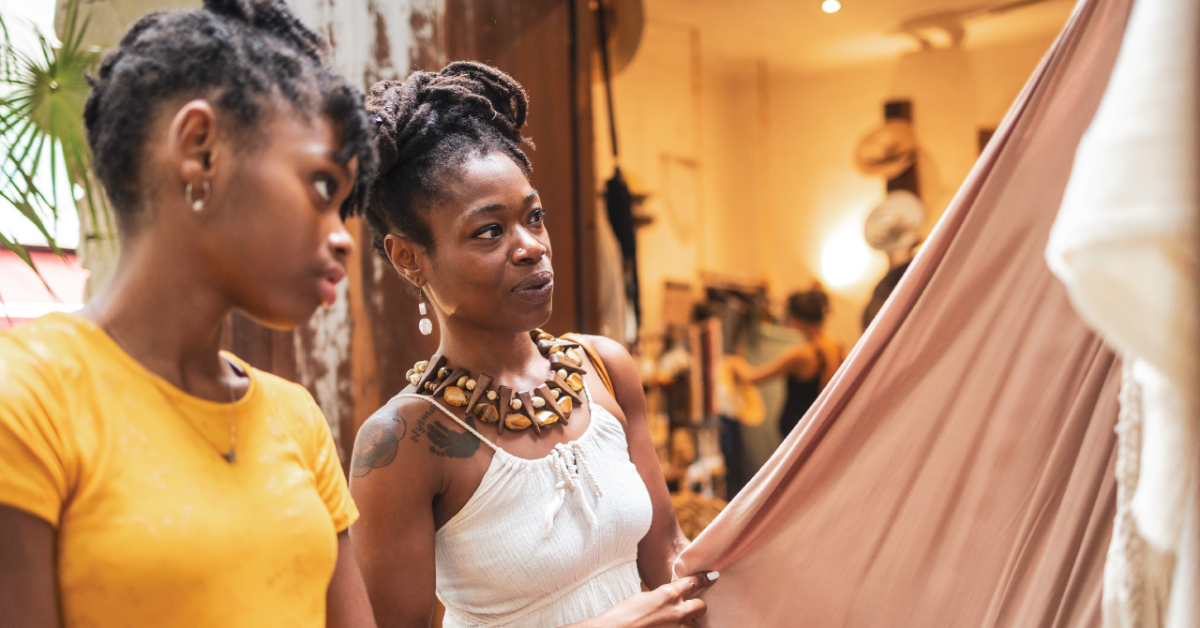
A mother and her teenage daughter explore a market in Mexico. (MStudioImages via Getty Images) Black Americans say they learn what it means to be a Black man or Black woman mainly from the people closest to them. Mothers play the largest role, followed by other personal connections, according to a Pew Research Center survey from June 2025. About this research This Pew Research Center analysis focuses on how much people and media have influenced Black Americans’ views of their identities as Black men or Black women. Why did we do this? Pew Research Center does research to inform the public, the media and decision-makers. This analysis builds on previous work about the importance of identity and family to Black Americans. It also builds on the Center’s work studying Americans’ gender identity. Learn more about Pew Research Center, our research on Black Americans and our race and ethnicity research. How did we do this? We surveyed 4,271 U.S. Black adults from June 16 to 29, 2025, including 1,057 respondents from Pew Research Center’s American Trends Panel and 3,214 from SSRS’s Opinion Panel. The survey is representative of the views of the full U.S. Black adult population, which includes U.S. adults who self-identify as Black, either alone or in combination with other races or a Hispanic identity. In this survey, we asked Black adults an open-ended question about the most important thing they learned from the people who influenced them about being a Black man or Black woman. We chose quotations to highlight in this analysis for illustrative purposes; they don’t necessarily represent the majority opinion in any particular group or in the United States. Quotations have been edited for spelling, punctuation and style. Here are our survey questions, the detailed responses and the survey methodology. Acknowledgments Pew Research Center is a subsidiary of The Pew Charitable Trusts, its primary funder. This analysis was made possible with support from the Trusts and from the People & Voices Initiative. The Center is grateful to a panel of experts who gave advice on the survey and/or publication: Camille Burge-Hicks, chair and associate professor of political science at Villanova University; Shantel Buggs, associate professor of sociology and African American studies at Florida State University; Sean Joe, Benjamin E. Youngdahl professor of social development at Washington University in St. Louis. Khadijah Edwards, former research associate, and Kiana Cox, former senior researcher, developed the survey questionnaire and the project, alongside Sahana Mukherjee, associate director of race and ethnicity research, and Carolyne Im, former research analyst. We also appreciate guidance from Mark Hugo Lopez, director of race and ethnicity research; Eileen Yam, director of science and society research; and Juliana Menasce Horowitz, senior associate director, social and demographic trends research. Mothers have a large influence on most Black people’s views of what it means to be a Black man or woman % of U.S. Black adults who say __ has/have influenced their views about what it means to be a Black man or woman a great deal or fair amount * Responses are among those who are married, living with a partner or in a committed relationship.Note: Black men were asked about being a Black man; Black women were asked about being a Black woman. Black respondents are single-race Black and non-Hispanic, Black and at least one other race and non-Hispanic, or Black and Hispanic. Shares of respondents who didn’t answer or offered other answers are not shown. Source: Survey of U.S. adults conducted June 16-29, 2025. PEW RESEARCH CENTER Mothers have a large influence on most Black people’s views of what it means to be a Black man or woman % of U.S. Black adults who say __ has/have influenced their views about what it means to be a Black man or woman a great deal or fair amount Black menBlack womenTheir mother6568Their father5249Their spouse or partner*5057Their friends4954Other family members4751Religion or religious leaders3742Their teachers3536 * Responses are among those who are married, living with a partner or in a committed relationship.Note: Black men were asked about being a Black man; Black women were asked about being a Black woman. Black respondents are single-race Black and non-Hispanic, Black and at least one other race and non-Hispanic, or Black and Hispanic. Shares of respondents who didn’t answer or offered other answers are not shown. Source: Survey of U.S. adults conducted June 16-29, 2025. PEW RESEARCH CENTER Roughly two-thirds of Black men (65%) say their mother has influenced their views about what it means to be a Black man a great deal or a fair amount. And 68% of Black women say the same about their views of being a Black woman. About half or more of Black men and Black women say their father, spouse or partner, friends, and other family members have shaped their views. Smaller shares say community members like religious leaders or teachers have influenced them. In total, 79% of Black men and 83% of Black women say at least one of these connections has influenced them a great deal or a fair amount. Do different media types shape views about being a Black man or a Black woman? Black adults tend to be less likely to say different kinds of media have influenced their views about being a Black man or woman than to say this about the people in their lives. 36% of Black men and 39% of Black women say entertainment media influenced their views on their identity % of U.S. Black adults who say __ has/have influenced their views about what it means to be a Black man or woman a great deal or fair amount Note: Black men were asked about being a Black man; Black women were asked about being a Black woman. Black respondents are those who are single-race Black and non-Hispanic, Black and at least one other race and non-Hispanic, or Black and Hispanic. Shares of respondents who didn’t answer or offered other answers are not shown. Source: Survey of U.S. adults conducted June 16-29, 2025. PEW RESEARCH CENTER 36% of Black men and 39% of Black women say entertainment media influenced their views on their identity % of U.S. Black adults who say __ has/have influenced their views about what it means to be a Black man or woman a great deal or fair amount Black menBlack womenEntertainment media (such as television, movies, music, etc.)3639Social media (such as Facebook, Instagram, TikTok, YouTube, etc.)2431Podcasts1618 Note: Black men were asked about being a Black man; Black women were asked about being a Black woman. Black respondents are those who are single-race Black and non-Hispanic, Black and at least one other race and non-Hispanic, or Black and Hispanic. Shares of respondents who didn’t answer or offered other answers are not shown. Source: Survey of U.S. adults conducted June 16-29, 2025. PEW RESEARCH CENTER 36% of Black men and 39% of Black women say entertainment media (like TV, movies or music) have influenced their views of what it means to be a Black man or woman a great deal or a fair amount. Smaller shares say the same about social media: 24% of Black men and 31% of Black women say platforms such as Facebook, Instagram, TikTok and YouTube have influenced how they view being a Black man or woman. Fewer still say this of podcasts: 16% of Black men and 18% of Black women cite podcasts as a large influence on their views. Overall, 43% of Black men and 46% of Black women say at least one of these kinds of media have influenced them a great deal or a fair amount. Younger Black adults are more likely than their older counterparts to say these forms of media have influenced their views, especially social media. This reflects younger adults’ greater use of social media in general. 29% of Black men under 50 say social media platforms have had a great deal or fair amount of influence for them on what it means to be a Black man. That compares with 17% of those ages 50 and older. The gap is even larger among Black women: 41% of those under 50 say social media platforms have had a large influence for them on what it means to be a Black woman, compared with 16% of those 50 and older. What have Black adults learned about being a Black man or woman from their relationships? In an open-ended question, we asked Black adults to describe the most important thing they learned about being a Black man or woman from the people who influenced them. Respondents mentioned a wide range of topics. Some wrote about values, character, self-confidence, resilience, or pride in Black identity or culture. Others mentioned experiences of discrimination, stereotypes or unequal treatment. Here’s what some Black men say are the most important things they learned about being a Black man from those who influenced their views: “Never to run away from responsibilities. … Leave it better than you found it. Always put God first and obey him.” – Black man, mid-40s “The most important thing is being responsible for those under your care. Work hard and work well. Finish what you start. Manage your affairs with intelligence and integrity.” – Black man, early 70s “Pride in ourselves, our culture, our music. Respect ourselves and each other.” – Black man, late 50s “To always have class and represent my culture well. Consistently break the stereotypes of what Black or African American men are seen as. Also to work 10 times harder at everything I do to overcome the unspoken gap of racism in society.” – Black man, mid-40s “That we must work hard and do our best to continually prove that we are competent, smart, loving and good people, and to know that no one is better than we are, as we are no better than anyone else.” – Black man, early 60s Here are responses from Black women about the most important thing they learned about being a Black woman from those who influenced their views: “I’ve learned that I am enough. … I can be soft and fierce, tired and powerful, and joyful and hurt.” – Black woman, early 60s “What it means to be a Black woman in America is somewhat complicated. I am a combination of my life experiences, my aspirations and Black women in my life who have influenced me today. The most important thing about being a Black woman that I’ve learned is to not forget where my family comes from and what I continue to carry on.” – Black woman, early 20s “That we always need to be put together. Aware of how we hold ourselves and how we look. Because prejudice for a Black woman comes in all forms. We are judged by what we wear, our skin color, our hair, our personalities, etc. We are seen as a group and not individuals.” – Black woman, mid-30s “You can do all things. There is never ‘I can’t’ in my vocabulary.” – Black woman, late 60s “To always take pride in myself [and] love myself unconditionally with flaws and all because that’s what makes me beautiful and unique. Take pride in the skin that I was born in.” – Black woman, early 40s Note: Here are our survey questions, the detailed responses and the survey methodology. Detailed tables The tables below provide additional information about the people or media that have influenced Black adults’ views of their identities. About two-thirds of Black men say their mother has influenced views of their identity % of U.S. Black men who say __ has/have influenced their views about what it means to be a Black man a great deal or fair amount Their motherTheir fatherTheir spouse or partner*Their friendsOther family membersReligion or religious leadersTheir teachersTotalAll Black men65525049473735Age18-496352464744343250+67535552514240Educational attainmentHS or less65515548474037Some college66534749473734Bachelor’s+64545052483434IncomeLower income64505247433837Middle income64544951503631Upper income7156**56523637PartisanshipRep/Lean Rep5751**42443228Dem/Lean Dem68535453484038 ReligionChristian69585355504541Unaffiliated59434240422322Community typeUrban63525348463739Suburban65514953483631Rural**************Among Black men who say being Black is …Extremely/Very important75606060564544Less important41332225251913 * Responses for spouse or partner are among those who are married, living with a partner or in a committed relationship.** Results are not shown due to small sample sizes.Note: Results for other religious affiliations are not shown due to small sample size. Black respondents are single-race Black and non-Hispanic, Black and at least one other race and non-Hispanic, or Black and Hispanic. “Some college” includes those with an associate degree and those who attended college but did not obtain a degree. Family income tiers are based on adjusted 2024 earnings. Shares of respondents who didn’t answer are not shown. Source: Survey of U.S. adults conducted June 16-29, 2025. PEW RESEARCH CENTER Many Black women say various family members – especially mothers – have influenced their identity % of U.S. Black men who say __ has/have influenced their views about what it means to be a Black man a great deal or fair amount Their motherTheir fatherTheir spouse or partner*Their friendsOther family membersReligion or religious leadersTheir teachersTotalAll Black women68495754514236Age18-496648555349383550+70526255554837Educational attainmentHS or less67496152494539Some college70525755554236Bachelor’s+66475353493732IncomeLower income70516154524538Middle income65465253493833Upper income74565959543436PartisanshipRep/Lean Rep57445345433833Dem/Lean Dem71516057544337ReligionChristian71515956534736Unaffiliated60465247482732Community typeUrban70515858574337Suburban68505553484034Rural64476048484639Among Black women who say being Black is …Extremely/Very important76546561584741Less important41322827252519 * Responses for spouse or partner are among those who are married, living with a partner or in a committed relationship.Note: Results for other religious affiliations are not shown due to small sample size. Black respondents are single-race Black and non-Hispanic, Black and at least one other race and non-Hispanic, or Black and Hispanic. “Some college” includes those with an associate degree and those who attended college but did not obtain a degree. Family income tiers are based on adjusted 2024 earnings. Shares of respondents who didn’t answer are not shown. Source: Survey of U.S. adults conducted June 16-29, 2025. PEW RESEARCH CENTER 36% of Black men say entertainment media have influenced their identity % of U.S. Black men who say __ has/have influenced their views about what it means to be a Black man a great deal or fair amount Entertainment media such as television, movies, music, etc.Social media such as Facebook, Instagram, TikTok, YouTube, etc.PodcastsTotalAll Black men362416Age18-4939291950+321712Educational attainmentHS or less402721Some college332314Bachelor’s+342213IncomeLower income392719Middle income342115Upper income322012PartisanshipRep/Lean Rep342625Dem/Lean Dem382414ReligionChristian382617Unaffiliated322013Community typeUrban372618Suburban332113Rural***Among Black men who say being Black is …Extremely/Very important432720Less important2015 8 * Results are not shown due to small sample size.Note: Results for other religious affiliations are not shown due to small sample size. Black respondents are single-race Black and non-Hispanic, Black and at least one other race and non-Hispanic, or Black and Hispanic. “Some college” includes those with an associate degree and those who attended college but did not obtain a degree. Family income tiers are based on adjusted 2024 earnings. Shares of respondents who didn’t answer are not shown. Source: Survey of U.S. adults conducted June 16-29, 2025. PEW RESEARCH CENTER 39% of Black women say entertainment media have influenced their identity % of U.S. Black women who say __ has/have influenced their views about what it means to be a Black woman a great deal or fair amount Entertainment media such as television, movies, music, etc.Social media such as Facebook, Instagram, TikTok, YouTube, etc.PodcastsTotalAll Black women393118Age18-4944412350+3116 9Educational attainmentHS or less493922Some college353217Bachelor’s+312012IncomeLower income463922Middle income312413Upper income2518 8PartisanshipRep/Lean Rep433724Dem/Lean Dem393117ReligionChristian382716Unaffiliated414222Community typeUrban423219Suburban353016Rural423519Among Black women who say being Black is …Extremely/Very important423419Less important272412 Note: Results for other religious affiliations are not shown due to small sample size. Black respondents are single-race Black and non-Hispanic, Black and at least one other race and non-Hispanic, or Black and Hispanic. “Some college” includes those with an associate degree and those who attended college but did not obtain a degree. Family income tiers are based on adjusted 2024 earnings. Shares of respondents who didn’t answer are not shown. Source: Survey of U.S. adults conducted June 16-29, 2025. PEW RESEARCH CENTER Alexandra Cahn is a research assistant at Pew Research Center. Carolyne Im is a former research analyst focusing on race and ethnicity at Pew Research Center. Joseph Copeland is a research analyst at Pew Research Center. Sahana Mukherjee is an associate director of race and ethnicity research at Pew Research Center.
Many Black Adults Say Close Relationships Influence Their Views About Being a Black Man or Woman
Full Article
Original Source
Read the full article at Pewresearch →KhanList aggregates and links to publicly available news content. We do not host full articles from third-party sources. Always verify important information with original sources.