
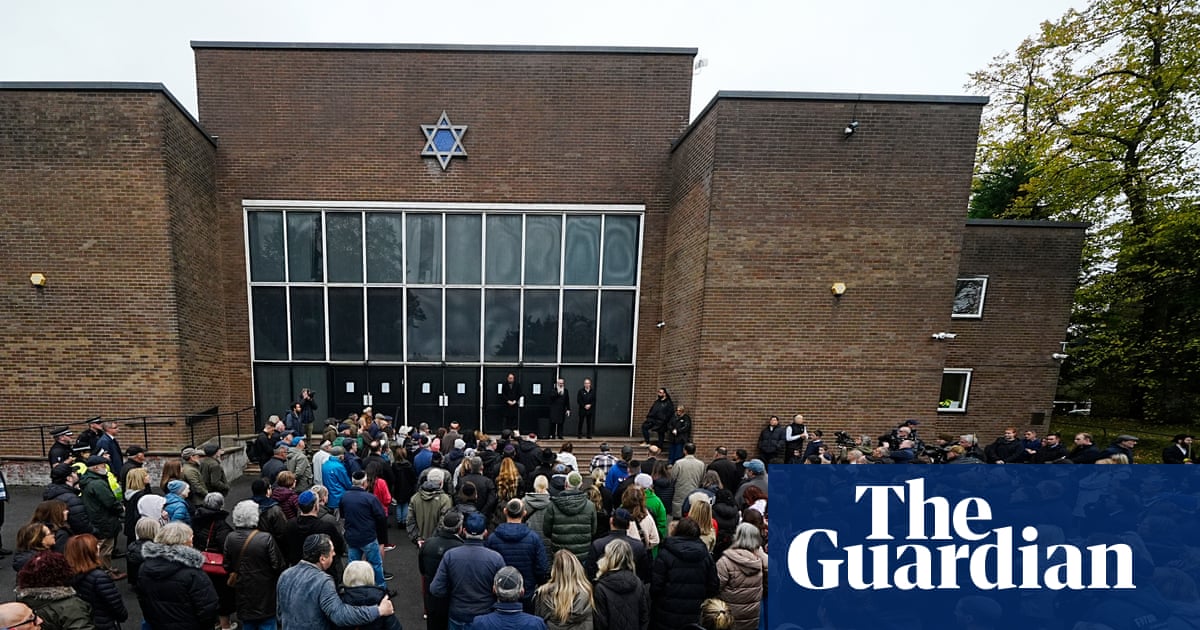
Ministers are seeking to block intelligence material from being heard at an inquest into the death of two men killed in the 2025 Manchester synagogue attack.Lawyers for Shabana Mahmood, the home secretary, told a coroner on Thursday that disclosing the MI5 files would pose a serious risk to national security.Melvin Cravitz, 66, died as a result of multiple knife wounds inflicted by the attacker, Jihad al-Shamie. Adrian Daulby, 53, was killed by a single police gunshot wound as he held the building’s doors shut against the terrorist.A senior coroner is due to examine the deaths of the two men at the Heaton Park Hebrew synagogue on 2 October last year during Yom Kippur, the holiest day in the Jewish calendar.The full inquest will focus on al-Shamie’s background, as well as what the state knew about him before the attack. It will also examine security at the synagogue, the role of the state in assessing the risks to the Jewish community in Greater Manchester, and the response to the attack.Mahmood told the Commons on 13 October that al-Shamie was “never referred to the Prevent programme, nor was he known to counter-terrorism policing or the security services”.At a pre-inquest review on Thursday, barristers for the families of Cravitz and Daulby said they were concerned that the emergence of MI5 material “may contradict” that statement.Anna Morris KC, representing Daulby’s family, said there had been a “demonstrable lack of candour” by the security services in other proceedings, including the inquiry into the Manchester Arena attack.She said Daulby’s family were “concerned that this application [by the Home Office] and the information behind it may contradict statements made public by security services and counter-terrorism police that the suspect was not known to counter-terrorism police”.The deaths of Daulby and Cravitz are being examined by Alexia Durran, the chief coroner of England and Wales, at Manchester coroner’s court.Edward Pleeth, counsel to the inquest, told the hearing the government was seeking to withhold “potentially relevant security sensitive material held by MI5” and “potentially relevant security sensitive material held by counter-terrorism police”.Pleeth said this unspecified material was judged by the government to “cause serious harm to national security” if it was disclosed publicly.He said the inquest legal team was satisfied that the information was so sensitive it could not be aired even in a redacted form.There was “no adequate alternative to complete non-disclosure”, Pleeth said, describing the concerns about its disclosure as “well-evidenced”.Durran is now considering whether to ask the government to convert the inquest into a statutory public inquiry to allow the MI5 material to be heard in private.Unlike public inquiries, coroner’s inquests cannot legally consider evidence given in secret hearings.Neil Sheldon KC, representing the Home Office, described the MI5 material as a “discrete body of information” that had been “identified as relevant and has the potential to impact the inquest”.The application to block the information from being heard publicly was not an “extreme approach” but was “cogent, compelling and supported by detailed analysis”, he told the court.Victoria Ailes, representing Cravitz’s family, said his family had “questions in this entire area” and were concerned that this new material came after “statements by the secretary of state to the House of Commons [that al-Shamie] was not known to counter-terrorism police or the security services”.Al-Shamie, a Syrian-born UK citizen, launched the attack while wearing what seemed to be a suicide vest. Before police arrived, the 35-year-old called 999 and pledged allegiance to Islamic State.Last month, a man who conducted hostile reconnaissance at a military base alongside al-Shamie was jailed for life with a minimum term of 16 years, after admitting preparing acts of terror.Mohammad Asim Bashir, 31, and al-Shamie travelled by car to the UK Defence Academy in Shrivenham, Swindon, in August last year, two months before the synagogue attack.Bashir was identified when counter-terrorism officers searched al-Shamie’s mobile devices after the Heaton Park attack.However, Greater Manchester police said last month that officers had seized his phones months earlier in 2025 after unrelated arrests, but that they were not examined until after the attack.Another man, Hekmat Omar Ali Hakim, was charged on 21 August with failing to disclose information in relation to the synagogue attack. Hakim, 49, pleaded not guilty at Westminster magistrates court. He is due to attend a hearing at the Old Bailey on 25 September.
Manchester synagogue attack: ministers seek to block MI5 files from inquest
Full Article
Original Source
Read the full article at Theguardian →KhanList aggregates and links to publicly available news content. We do not host full articles from third-party sources. Always verify important information with original sources.