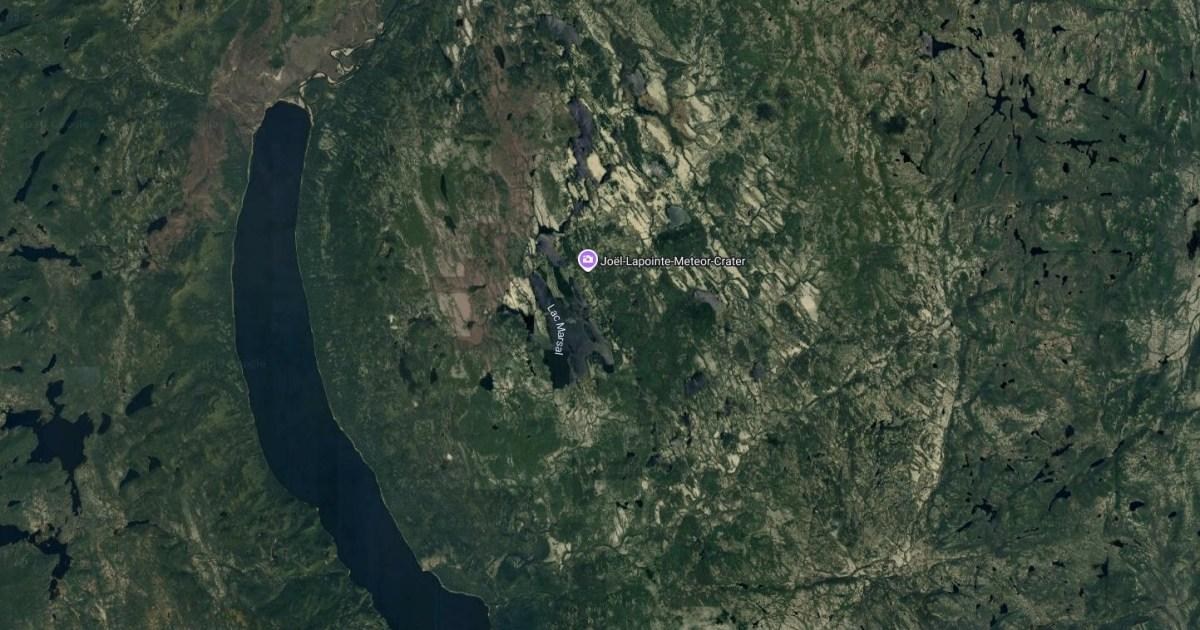
Worst places to set up a tent (Picture: Getty/Metro) Nothing makes for a perfect camping trip quite like a lake, fresh air and a gigantic hole caused by an equally gigantic killer rock. Amateur astronomer Joël Lapointe was planning his next trip to Côte-Nord, Canada, when he spotted a strange pit on Google Maps. But researchers realised that this circle smudge on his computer screen was a previously unidentified, 390-million-year-old meteor crater. The cosmic pockmark in Quebec’s remote Côte-Nord region looked ‘a little faded and round, like a kind of pit’, Lapointe told Radio Canada. ‘It’s not every day that an ordinary citizen finds a 390-million-year-old crater,’ he said. ‘I encourage everyone to not ignore intuition or an observation, even if it isn’t part of your field of expertise.’ To view this video please enable JavaScript, and consider upgrading to a web browser that supports HTML5 video The crater is now listed as the ‘Joël-Lapointe-Meteor-Crater’ on Google Maps, described as a five-star tourist attraction. Gordon Osinski, a planetary geology professor at Western University, helped confirm the crater and will present his team’s findings next month at the annual meeting of the research group, the Meteoritical Society. He told Metro that after hearing of Lapointe’s discovery, he, of course, went straight to Google Maps. Maybe Lapointe wasn’t just seeing things. ‘We then looked at other satellite data not available to the public in Google Earth to investigate further,’ the founder of the crater database Impact Earth said. ‘The topographic data in particular was very helpful as this clearly showed a very circular depression. After seeing this, I was definitely over 50:50 in terms of being convinced.’ The now-labelled meteor site on Google Maps (Picture: Google Maps) Stretching at about 15 miles, the Joël-Lapointe-Meteor-Crater is one of the largest craters discovered in recent years. After all, the asteroid would have caused an eruption of energy that punched out a 25km-wide basin and raised a ring of mountains around Lake Marshal. But despite its size, not every crater looks like someone took an ice cream scoop of Earth – instead, researchers need to dig deep to find clues. This includes tracking down impact melt rock, formed when the heat of the explosive collision squeezes and melts part of the land. ‘Most of these features are microscopic, so you can only confirm in the lab with samples.’ Osinki said. That’s why Osinski and his team set off to the remote region in what Osinski said was one of the toughest expeditions he’s done in October. Shatter cones seen around the impact site (Picture: Gattacceca, J. et al.) A float plane only got them about 50 metres from the ditch, forcing them to walk the rest of the way with their gear. Once there, however, they discovered that some of the cliffs around what Lapointe spotted were impact melt rock. They even found the much easier-to-spot shatter cone, the wavy grooves etched by the collision. ‘The bottom line is that we had to physically visit the place to confirm it,’ Osinski said. After verifying the crater, researchers met with representatives of the Innus of Ekuanitshit, the indigenous people who live in the area, to name it. They settled on ‘Uhaachatik’, which roughly translates in Innu-aimun as ‘renowned for woodland moose’, Osinski said. Where are all the craters? The Earth is constantly being pummeled by space rocks, with 10,000kg of leftovers from the solar system’s formation raining down on us every day. Yet we have only found 200 or so craters – far less than the tens of thousands that should be there – and half are underwater. What extraterrestrial dents we have found so far can range from as wide as the 120-mile-wide scar in Mexico’s Yucatán Peninsula, likely caused by the meteor that killed the dinosaurs, to only a few dozen feet. A map of all the known impact craters (Picture: Impact Earth) Of the known crash sites, 20 are in Canada, with its ancient, stable bedrock largely unchanged over millions of years. ‘Impact cratering is a fundamental geological process not just on Earth but all planetary bodies in the solar system with solid surfaces,’ Osinski said. ‘By dating this crater, like we have, we also get a better idea of the rate of impact events on Earth and what this means for the future.’ Get in touch with our news team by emailing us at webnews@metro.co.uk. For more stories like this, check our news page. Arrow MORE: Meteorite that crashed into home in New York ‘shows signs of how life came to Earth’ Arrow MORE: Donald Trump threatens to send a bill to Canada because wildfire smoke has blown into the US Arrow MORE: Terrifying footage shows the inside of a train being engulfed by a wildfire News Updates Stay on top of the headlines with daily email updates.
Man stumbles on meteor crater planning camping trip on Google Maps
Full Article
Original Source
Read the full article at Metro →KhanList aggregates and links to publicly available news content. We do not host full articles from third-party sources. Always verify important information with original sources.